01Facts
The appellant claimed that 1.89 acres in Survey No. 110/1B and 0.95 acres in Survey No. 92/1A, Ullaibettu Village, Mangaluru Taluk, fell to her share under a family partition deed dated 21.08.1965.
¶ 2The father of Respondents 1 to 10 (Babu Belchada, since deceased) filed Form 7 claiming tenancy in occupancy of the lands.
¶ 3On 03.09.1981, the Land Tribunal recognized occupancy rights in his favour after inquiry.
¶ 3Pursuant to that order, revenue records were mutated in his name on 18.06.1983, and the appellant was admittedly aware of the mutation.
¶ 5The appellant contended that she was not a party to the Land Tribunal proceedings.
¶ 4In 2010, she filed an appeal against the mutation with an application for condonation of delay; the Assistant Commissioner rejected it on 09.03.2015.
¶ 5She filed W.P. No. 6426/2020 (LR) on 28.02.2020, about five years later, without a credible explanation for the delay.
¶ 6The learned Single Judge declined to entertain the writ petition on the ground of inordinate delay and laches (order dated 23.09.2026).
¶ 1–202Issues
i.1. Whether the writ petition challenging the Land Tribunal's order dated 03.09.1981, filed nearly 39 years later, was liable to be dismissed on grounds of inordinate delay and laches.
¶ 3, 10–11ii.2. Whether the appellant's plea that she was not a party to the original Land Tribunal proceedings and had no notice could excuse the delay.
¶ 4, 8–903Law Applied
The Court relied on the principles laid down by the Supreme Court in Chennai Metropolitan Water Supply and Sewerage Board v. T.T. Murali Babu (2014) 4 SCC 108, which holds that unexplained delay and laches defeat equitable relief, that "indolent litigants" who sleep over their rights deserve no indulgence, and that "procrastination is the greatest thief of time".
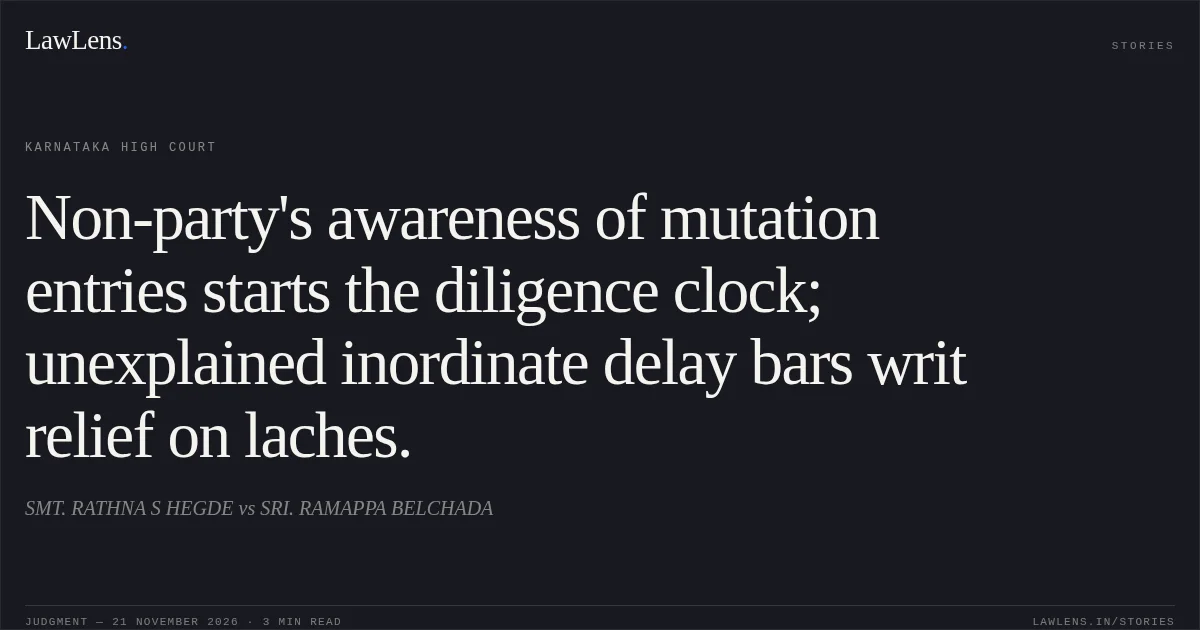
¶ 7Under the same authority, a "not a party / no notice" plea loses its protection where a party sleeps over its rights or pursues remedies sluggishly with unexplained gaps.
¶ 9The Court treated the date of knowledge (here, the 1983 mutation, and at the latest 2010) as the starting point for measuring diligence.
¶ 8The judgment does not identify the specific statutory provision under which the Land Tribunal acted or the writ jurisdiction was invoked.
Section 4 of the Karnataka High Court Act is cited only as the basis for the appeal.
p. 2Provisions in the judgment · 1 · Linked ones open on LawLens
KARNATAKA HIGH COURT ACT, 1961 Section 4
04Reasoning
The Court held that the appellant's "not a party" contention was unpersuasive because she admittedly knew of the 1983 mutation.
¶ 5Her diligence therefore ran from at least 2010, when she first challenged the mutation.
¶ 8Applying T.T. Murali Babu, the Court found that the delay was not explained in any credible way: roughly 27 years passed between the mutation and the 2010 appeal, the appeal was rejected in 2015, and a further five years elapsed before the writ petition was filed.
¶ 5, 6, 10The Court reasoned that this prolonged inactivity caused injustice by unsettling an order and mutation that had attained finality and affected the rights of others.
¶ 7, 10The Court therefore held that the lack of notice did not shield the appellant from the consequences of her sluggishness, and that the Single Judge's refusal to entertain the petition on laches grounds was justified.
¶ 9, 1105Holding
The Court answered both issues against the appellant. Her knowledge of the mutation from 1983, and her unexplained delay of nearly 27 years before challenging it, together with a further five-year gap after the 2015 rejection, constituted inordinate delay and laches. Her "not a party / no notice" plea therefore could not save the writ petition.
¶ 9–11The Court held that the learned Single Judge was justified in declining to entertain W.P. No. 6426/2020 (LR).
¶ 11The Writ Appeal is dismissed, and the pending interlocutory application is disposed of as a consequence.
¶ 12–13Original Court PDF
SMT. RATHNA S HEGDEvsSRI. RAMAPPA BELCHADA
Click to open original judgment
Original judgment, available to read, download and summarize on LawLens.in