01Facts
The petitioner filed her return for Assessment Year (AY) 2013-14 on 26.03.2014, declaring income of Rs.25,73,320.
¶ 2(i)No scrutiny assessment under Section 143(3) was framed.
¶ 2(i)A notice dated 30.03.2021 under pre-amendment Section 148 was issued by ITO, Ward 7(1), Ludhiana. Its reasons rested on a single item: bogus LTCG of Rs.26,40,000 from penny-stock trading, with a general reference to "other income which comes to the notice during the course of assessment proceedings".
¶ 2(ii)–(iii)The petitioner challenged the notice in CWP No. 2880 of 2022. The petition was tagged with CWP No. 14886 of 2021 and kept in abeyance following interim orders.
¶ 2(iv)After Union of India v. Ashish Agarwal (2023) 1 SCC 617, the Revenue conceded, and the Court directed by order dated 30.04.2026, that the notice be treated as a show cause notice under Section 148A(b) and that proceedings continue from that stage, with all pleas kept open.
¶ 2(v)By letter dated 08.05.2026, the AO enclosed two Insight Portal items: Rs.26,40,000 (Dayanand Singh) and Rs.58,10,325 (Mahanivesh (India) Ltd.), the latter not part of the original reasons.
¶ 2(vi)The petitioner did not reply.
¶ 2(vi)By order dated 25.06.2026 under Section 148A(d), the AO aggregated the items to Rs.84,50,325, treated shares as an "asset" under the Explanation to Section 149(1), and invoked the ten-year period. A notice under Section 148 of the same date followed.
¶ 2(vii)The writ petition was filed on 03.07.2026.
02Issues
i.1. Whether the second item of Rs.58,10,325, first put to the petitioner on 08.05.2026 and absent from the notice dated 30.03.2021, could be added to the Section 148A(b) show cause notice and tested against that notice's date rather than 08.05.2026.
¶ 3 · ¶ 6(i)–(iii) · ¶ 7(i)ii.2. Whether the aggregate of Rs.84,50,325 can sustain the extended limitation under Section 149(1)(b) where the original item (Rs.26,40,000) is below the Rs.50 lakh threshold.
¶ 6(v) · ¶ 7(i), 7(iv)iii.3. Whether the general reference to "other income" in the reasons, or the Explanation to Section 147, can enlarge jurisdiction at the Section 148A stage.
¶ 4(iv) · ¶ 6(iv) · ¶ 7(ii)iv.4. Whether the petitioner's failure to reply to the 08.05.2026 letter, or the availability of an alternative remedy, bars writ jurisdiction.
¶ 4(vii) · ¶ 6(vi) · ¶ 7(iii)v.5. Whether a limitation plea not specifically pleaded may be decided where it is a pure question of law going to jurisdiction.
¶ 7(iv)03Law Applied
The Court applied Section 148A(b) and (d), which require a show cause notice and disclosure of the material relied upon, and held that a notice treated as a Section 148A(b) notice under Ashish Agarwal stays confined to the grounds on which it was issued; the material may be supplied but cannot enlarge the escapement alleged.
¶ 6(i)–(ii)Under Section 149, as substituted by the Finance Act, 2021, the ten-year period under Section 149(1)(b) requires escaped income of Rs.50 lakh or more. The first proviso imports the unamended six-year limit (extended to 30.06.2021 by the Taxation and Other Laws (Relaxation and Amendment of Certain Provisions) Act, 2020), and both the old and new conditions must be satisfied.
¶ 4(vi) · ¶ 6(iii), 6(v)The third proviso excludes time only for a proceeding actually pending and stayed.
¶ 6(iii) · ¶ 7(i)The Explanation to Section 147 operates only in a reassessment after a valid Section 148 notice.
¶ 6(iv) · ¶ 7(ii)As held in Union of India v. Rajeev Bansal (2024) 469 ITR 46 (SC), limitation for a deemed notice is tested against the deemed notice date.
¶ 4(vi)Writ jurisdiction is available where limitation goes to the root of jurisdiction and the facts appear on the record, per Whirlpool Corporation v. Registrar of Trade Marks (1998) 8 SCC 1.
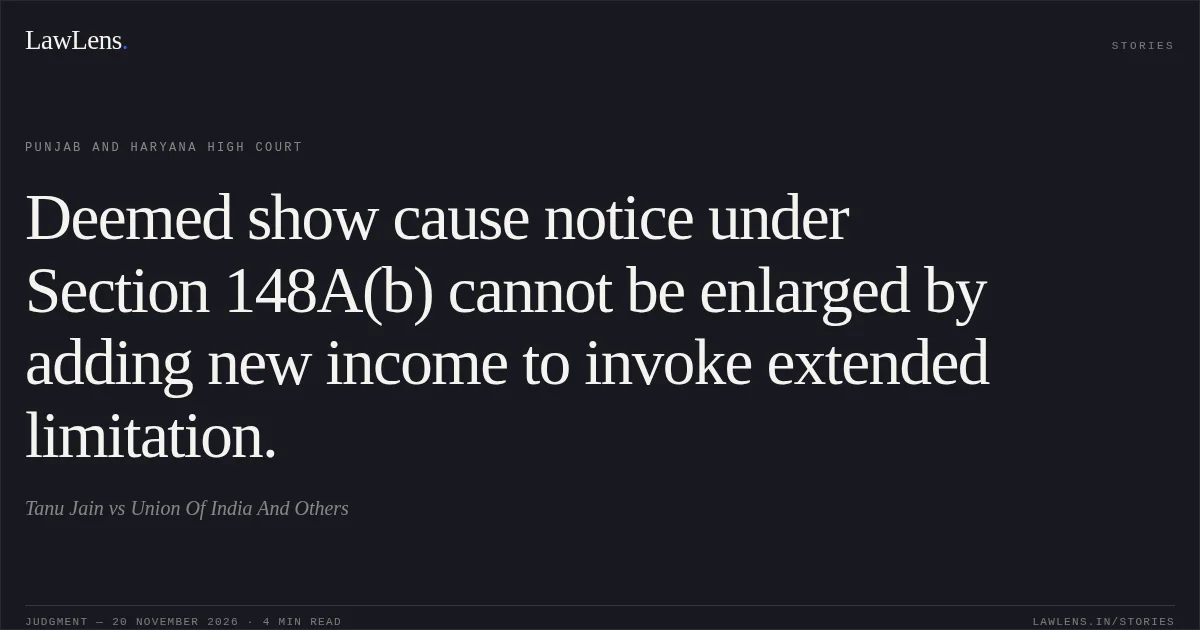
¶ 6(vi)The Court relied on its own decision in CWP No. 20141 of 2026 (Tanu Jain v. Union of India), decided on materially identical facts.
¶ 6Provisions in the judgment · 7
Income Tax Act, 1961 Section 142Section 143Section 147Section 148Section 148ASection 149Section 246A
04Reasoning
The Court treated Tanu Jain as controlling because the facts, the AO, the AY, the sequence of proceedings and the two Insight Portal sources were identical.
¶ 6, 8The second item was excluded not because of its amount but because it was not part of the notice dated 30.03.2021 and was first put to the petitioner on 08.05.2026. Its limitation therefore runs from that date. Under either the ten-year period (expired 31.03.2024) or the six-year period (expired 30.06.2021), it is time-barred.
¶ 7(i)The third proviso does not help the Revenue, since the only proceeding stayed between 15.02.2022 and 30.04.2026 was founded on Rs.26,40,000.
¶ 7(i)The "other income" reference in the reasons records no belief about any identified item and only anticipates the Explanation to Section 147, which cannot operate before a valid Section 148 notice.
¶ 7(ii)The petitioner's silence did not confer jurisdiction the statute withholds, and her pleas were preserved by the order of 30.04.2026.
¶ 7(iii)The limitation plea was not specifically pleaded, but it is a pure question of law going to jurisdiction, arising from the Department's own pleadings. The Department's case rests entirely on the aggregate, so the Court held that the plea could be decided.
¶ 7(iv)Without the second item, only Rs.26,40,000 remains, which is below the Rs.50 lakh threshold. Since the Section 148A(d) order and the Section 148 notice are single jurisdictional acts founded on the aggregate, nothing could be severed and saved. A remand limited to Rs.26,40,000 would be an empty formality, and relief was moulded accordingly.
¶ 7(iv)05Holding
The Court held that the second item of Rs.58,10,325, first disclosed on 08.05.2026, cannot be added to the notice dated 30.03.2021, and that it is barred by limitation whether tested under the ten-year or the extended six-year period.
¶ 6(iii), 7(i)The original item of Rs.26,40,000 is below the Rs.50 lakh threshold, and the "other income" reference and Section 147 Explanation cannot cure this at the Section 148A stage.
¶ 6(iv)–(v), 7(ii)The limitation plea was decided despite not being specifically pleaded, and the petitioner's failure to reply and the alternative remedy did not bar relief.
¶ 7(iii)–(iv)The writ petition is allowed. The letter dated 08.05.2026 (P-14), the order dated 25.06.2026 under Section 148A(d) (P-15), and the notice dated 25.06.2026 under Section 148 (P-16) are quashed, along with all consequential proceedings for AY 2013-14. No order as to costs.
¶ 8–9Original Court PDF
Vandana JainvsUnion Of India And Others
Click to open original judgment
Original judgment, available to read, download and summarize on LawLens.in