01Facts
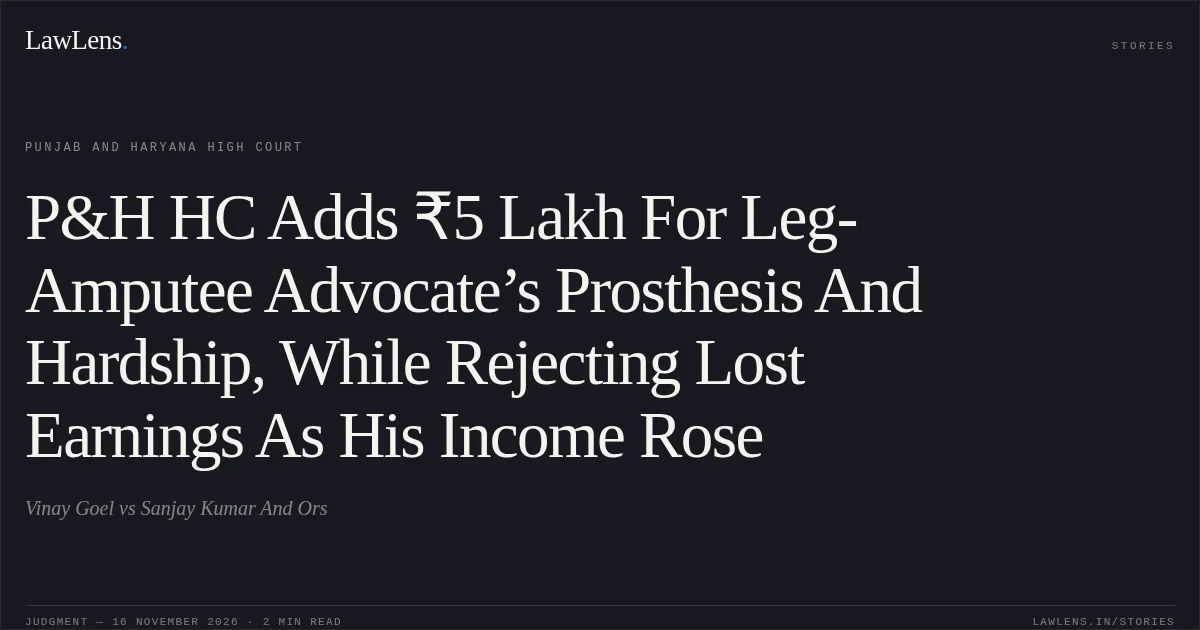
The appellant, a practising advocate, was injured when a car struck him on 28 May 1994.
¶ 2–6Following multiple injuries, prolonged treatment and persistent infection, his right leg was amputated above the knee in 2006.
¶ 2–6The Tribunal initially awarded ₹3,57,674; after additional evidence and remand, it reassessed compensation at ₹11,70,336, including treatment, prosthesis and attendant expenses, and ₹1,00,000 for pain and suffering.
¶ 2–6, 9The appellant appealed for enhancement, while the findings on negligence and liability were not challenged.
¶ 11–1302Issues
i.1. Whether the Tribunal’s award should be enhanced for future prosthesis replacement, transportation and incidental expenses, and loss of amenities and permanent hardship.
¶ 14, 18–23ii.2. Whether the appellant was entitled to further compensation for loss of income during treatment or future loss of earning capacity, having regard to the amputation and the evidence of his professional earnings and career.
¶ 15–1703Law Applied
Section 168 of the Motor Vehicles Act, 1988 requires an award of just, fair and reasonable compensation.
¶ 10Under R.D. Hattangadi v. M/s Pest Control (India) Pvt. Ltd., (1995) 1 SCC 551, compensation includes pecuniary losses, such as medical expenses and lost earnings, and non-pecuniary losses, such as pain, suffering and loss of amenities.
¶ 10Raj Kumar v. Ajay Kumar, (2011) 1 SCC 343, establishes that the percentage of physical disability does not necessarily equal loss of earning capacity; functional impact must be assessed in light of the claimant’s work and ability to earn.
¶ 10Non-pecuniary compensation must be assessed in light of the injury’s nature and consequences, while avoiding duplication.
¶ 21–22Provisions in the judgment · 2 · Linked ones open on LawLens
Motor Vehicles Act, 1988 Section 166Section 168
04Reasoning
The medical evidence established that the amputation resulted from the accident-related injuries and that the appellant would require a prosthesis, supporting a reasonable award for future replacement despite the absence of reliable proof of its precise future cost.
¶ 11–14His repeated treatment and mobility needs also justified additional transportation and incidental expenses, and the permanent amputation warranted compensation for loss of amenities and hardship distinct from pain and suffering.
¶ 18–23However, the appellant’s continued legal practice, increased income and appointment as a Debt Recovery Tribunal Presiding Officer did not establish measurable future loss of earning capacity; the 80% limb disability alone did not justify applying a multiplier.
¶ 15–17Nor was greater actual income loss during treatment proved.
¶ 15–1705Holding
The appeal was partly allowed.
¶ 23–27The Court enhanced total compensation from ₹11,70,336 to ₹16,70,336, adding ₹50,000 for transportation and incidental expenses, ₹1,50,000 for loss of amenities, permanent inconvenience and hardship, and ₹3,00,000 for future prosthesis replacement.
¶ 23–27The additional ₹2,00,000 was awarded interest at 7.5% per annum from institution of the claim petition; the ₹3,00,000 for future replacement was awarded interest at 6% per annum from the judgment date.
¶ 23–27The insurer was directed to deposit the enhanced amount, with applicable interest, within eight weeks, subject to adjustment of amounts already paid or deposited.
¶ 23–27Original Court PDF
Vinay GoelvsSanjay Kumar And Ors
Click to open original judgment
Original judgment, available to read, download and summarize on LawLens.in