01Facts
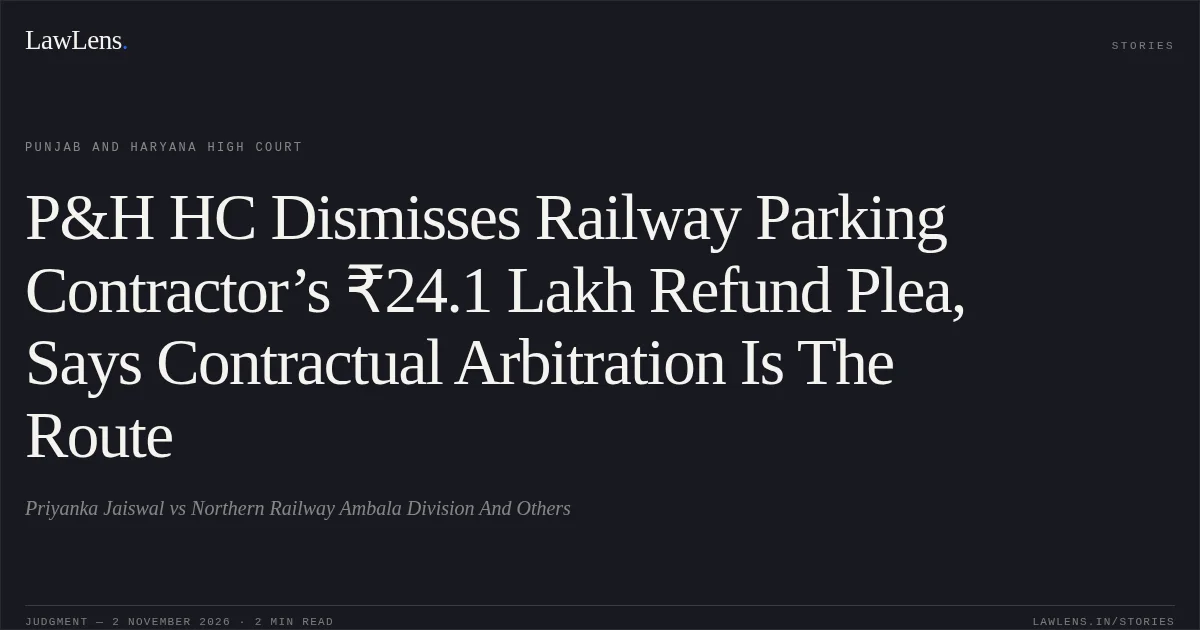
The petitioner was awarded a five-year contract for parking and access-control rights at Ambala Cantonment Railway Station.
¶ 1After incurring financial losses, she gave notice on 14 August 2025 seeking to surrender the contract under Clause 17.1, stating that surrender would take effect after six months of operation and requesting return of her security deposit of Rs. 24,10,000.
¶ 1–2The Railway did not accept the notice and, on 9 October 2025, terminated the contract for non-payment of the third-quarter advance licence fee and forfeited the security deposit.
¶ 2The petitioner challenged the forfeiture and sought a declaration that the contract had been validly surrendered.
¶ 2The agreement incorporated a dispute-resolution clause providing for arbitration under the Indian Railways Standard General Conditions of Contract.
¶ 4–502Issues
i.1. Whether the Court should exercise its jurisdiction under Article 226 over a contractual dispute where the parties had agreed to an arbitration mechanism.
¶ 4–9ii.2. Whether the petitioner’s surrender of the contract was valid and the forfeiture of the security deposit lawful. The Court did not decide this issue on its merits.
¶ 1, 3, 6–803Law Applied
Article 226 confers discretionary writ jurisdiction, which may ordinarily be declined where an effective alternative remedy—particularly an agreed arbitration process—is available for resolving a contractual dispute.
¶ 7In State of U.P. v. Bridge & Roof Co. (India) Ltd., (1996) 6 SCC 22, the Supreme Court held that parties should ordinarily pursue the contractual dispute-resolution mechanism they agreed upon.
¶ 7In Kerala State Electricity Board v. Kurien E. Kalathil, (2000) 6 SCC 293, it held that disputes concerning interpretation of contractual terms and the parties’ contractual rights and liabilities are ordinarily for a civil court or arbitration, and do not become public-law disputes merely because a party is a State instrumentality.
¶ 7The Court also referred to Assistant Commissioner of State Tax v. Commercial Steel Ltd., (2022) 16 SCC 447, on the availability of an alternative remedy.
¶ 7Under Clause 22 of the contract, the parties adopted the dispute-resolution provisions of the Indian Railways Standard General Conditions of Contract, including Clauses 63 and 64 on dispute resolution and arbitration.
¶ 4–504Reasoning
The Court treated the dispute over the interpretation of Clause 17.1, termination of the contract and forfeiture of the deposit as arising from the parties’ contractual relationship.
¶ 6Because the petitioner had accepted the agreement, including its arbitration clause, and had not established an exceptional circumstance or breach of a fundamental right warranting writ intervention, the Court held that the contractual mechanism should be pursued instead of the writ proceeding.
¶ 8It therefore left the merits of the surrender and forfeiture dispute for the agreed dispute-resolution process.
¶ 9–1005Holding
The Court dismissed the writ petition on the ground that an alternative contractual remedy of arbitration was available, without expressing any opinion on the merits.
¶ 10It left the petitioner at liberty to invoke Clause 22 of the contract, read with the applicable provisions of the Indian Railways Standard General Conditions of Contract, April 2022, in accordance with law.
¶ 11Original Court PDF
Priyanka JaiswalvsNorthern Railway Ambala Division And Others
Click to open original judgment
Original judgment, available to read, download and summarize on LawLens.in