01Facts
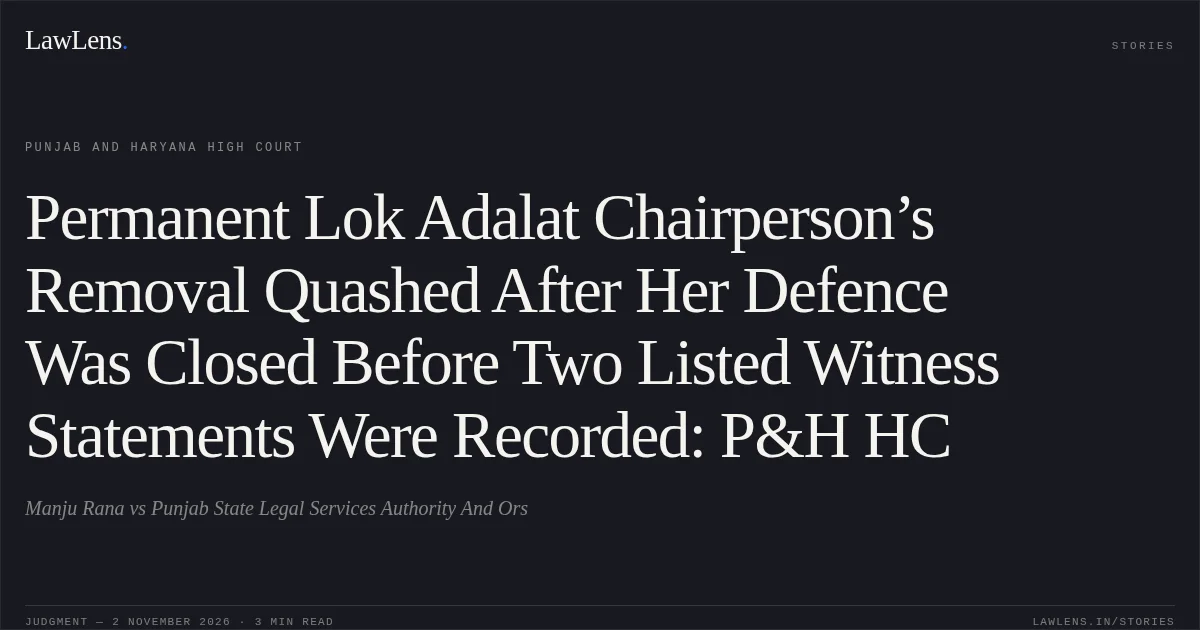
The petitioner was appointed Chairperson of the Permanent Lok Adalat (Public Utility Services), Kapurthala, for five years from 10 May 2017.
¶ 2Following complaints alleging abuse of position, including issuing oral directions for demolition and acting beyond jurisdiction, the Executive Chairman of the Punjab State Legal Services Authority initiated an inquiry under the Permanent Lok Adalat (Other Terms and Conditions of Appointment of Chairman and Other Persons) Rules, 2003.
¶ 2–4The petitioner denied the allegations and sought further time and material to prepare her defence.
¶ 5–8Although the record showed that statements of two listed witnesses had not been recorded, her request was rejected, her defence was closed, and the allegations were found proved as “unrebutted.”
¶ 5–8She was removed on 12 June 2018.
¶ 5–8She challenged the closure of her defence and the removal order under Article 226 of the Constitution.
¶ 1, 1002Issues
i.Whether the removal order under Rule 5(e) of the 2003 Rules could be sustained when the petitioner’s defence was closed despite her request for unrecorded witness statements and further time to respond to the allegations.
¶ 11ii.Whether the court should determine the truth of the individual allegations or confine its review to whether the prescribed inquiry procedure was fair.
¶ 1803Law Applied
Rule 5(e) of the 2003 Rules permits removal where a Chairperson has abused their position so as to render continued service prejudicial to the public interest, but its proviso requires an inquiry in accordance with Rule 6.
¶ 12Under Rule 6, when allegations are denied, the inquiry must examine their truth and afford the Chairperson an opportunity to meet the evidence and present a defence; removal may follow only if the competent authority is satisfied that the charges are proved on the inquiry report.
¶ 12–14The principle in Meenglas Tea Estate v. Their Workmen, AIR 1963 SC 1719, requires a person facing a charge to know the evidence supporting it and to have a fair opportunity to challenge and rebut that evidence.
¶ 21State of U.P. v. C.S. Sharma, AIR 1968 SC 158, supports the principle that denial of an opportunity to produce witnesses and lead defence evidence can vitiate disciplinary proceedings.
¶ 2204Reasoning
The petitioner denied the charges and sought material and time to defend herself; she had not admitted the allegations or declined to participate.
¶ 6, 23The respondents had recorded that statements of two listed witnesses had not been taken, yet rejected her request, closed her defence, and proceeded to treat the evidence as unrebutted.
¶ 5, 7–8, 19Applying Rule 6 and the principles of natural justice, the Court held that the petitioner had been denied an effective opportunity to meet the case against her, causing real prejudice.
¶ 20–24The defect concerned the inquiry process itself and was not cured by the subsequent finding that the evidence was unrebutted.
¶ 20–24The Court therefore did not reappraise the allegations or decide whether they were true.
¶ 18, 2605Holding
The petition was allowed.
¶ 26–27The order dated 11 June 2018 closing the petitioner’s defence and the consequential removal order dated 12 June 2018 were quashed for failure to provide an effective opportunity of defence under Rule 6 of the 2003 Rules.
¶ 26–27As the petitioner’s five-year tenure had expired, the Court declined to order reinstatement, but directed that her claim for consequential monetary or service benefits, if any, be considered by the competent authority in accordance with law.
¶ 28Original Court PDF
Manju RanavsPunjab State Legal Services Authority And Ors
Click to open original judgment
Original judgment, available to read, download and summarize on LawLens.in