01Facts
The petitioner was appointed as a Junior Scale Stenographer in the District Consumer Disputes Redressal Forum, Fatehgarh Sahib, in 1997.
¶ 2In 2003, he was transferred “in public interest” to the State Consumer Disputes Redressal Commission, Punjab; the transfer order did not specify deputation, a fixed tenure, retention of lien, or a condition of repatriation.
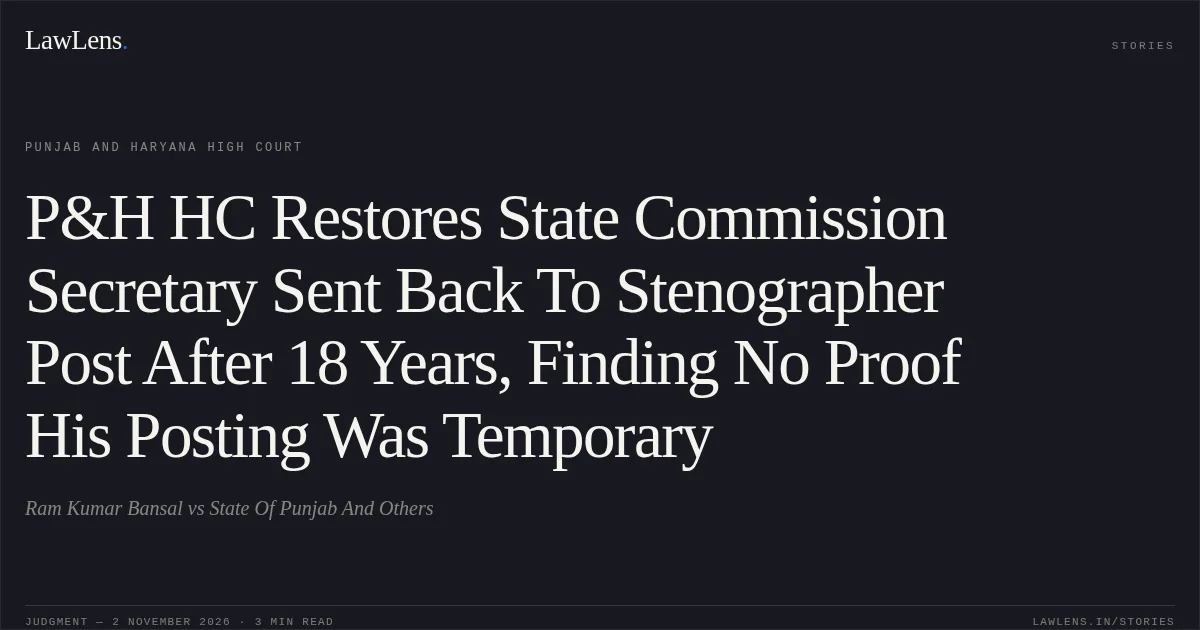
¶ 15, 17He was subsequently promoted in the State Commission as Senior Scale Stenographer, Judgment Writer and Secretary, the latter appointment being notified in the Punjab Government Gazette.
¶ 2, 20In 2021, he was repatriated to the District Commission on the ground that he remained its employee and had served in the State Commission against ex-cadre posts.
¶ 4–6His challenge to that order was followed by a further order rejecting his request for relief; the petitioner then sought judicial review of both orders under Articles 226 and 227 of the Constitution.
¶ 1, 4–602Issues
i.1. Whether the 2003 transfer placed the petitioner in the State Commission on a temporary or ex-cadre basis, making his repatriation to the District Commission lawful.
¶ 15–22, 27ii.2. Whether the respondents established a statutory or service-rule basis for repatriating the petitioner after nearly 18 years of service and successive promotions in the State Commission.
¶ 19–26, 30iii.3. Whether the subsequent order adequately considered the petitioner’s claim for consequential relief following his exoneration in disciplinary proceedings.
¶ 28–3203Law Applied
Under State of Punjab v. Inder Singh, (1997) 8 SCC 372, deputation is ordinarily a temporary transfer outside an employee’s cadre, with the employee returning to the parent establishment when the deputation ends.
¶ 16Palure Bhaskar Rao v. P. Ramaseshaiah, (2017) 5 SCC 783, distinguishes a transfer simpliciter from recruitment by transfer; determining the nature of an employee’s movement requires consideration of the governing rules and the actual transfer order.
¶ 21A draft regulation does not constitute an enforceable service rule unless it has acquired legal force.
¶ 23Although genuine repatriation of a deputationist is not, by itself, punishment under Rule 5 of the Punjab Civil Services (Punishment and Appeal) Rules, 1970, the authority must first establish that the employee was serving on deputation or under a temporary arrangement.
¶ 2704Reasoning
The Court found that the 2003 order transferred the petitioner to the State Commission without describing the arrangement as deputation, fixing its duration, or reserving a right of repatriation.
¶ 17–22The respondents identified no applicable rule or contemporaneous order establishing that his posting was temporary or ex-cadre, despite his nearly 18 years of service and successive promotions in the Commission.
¶ 17–22The respondents’ reliance on alleged defects in his qualifications or promotions did not establish that the original transfer was temporary; nor could an unnotified draft regulation supply the necessary legal basis.
¶ 22–25The Court also held that the later order did not substantively address the claim for consequential relief following exoneration and repeated the unsubstantiated premise underlying the repatriation order.
¶ 28–3305Holding
The Court allowed the petition and quashed the repatriation order dated 23 March 2021 and the subsequent order dated 18 October 2023.
¶ 34It directed the respondents to restore the petitioner to the position he occupied in the State Commission immediately before repatriation, with continuity and consequential service benefits to be determined as if the impugned order had not been passed.
¶ 35–37No recovery was to be made of salary or other monetary benefits already paid for service actually rendered; the directions were to be implemented within four weeks of receipt of a certified copy of the judgment.
¶ 35–37Original Court PDF
Ram Kumar BansalvsState Of Punjab And Others
Click to open original judgment
Original judgment, available to read, download and summarize on LawLens.in