01Facts
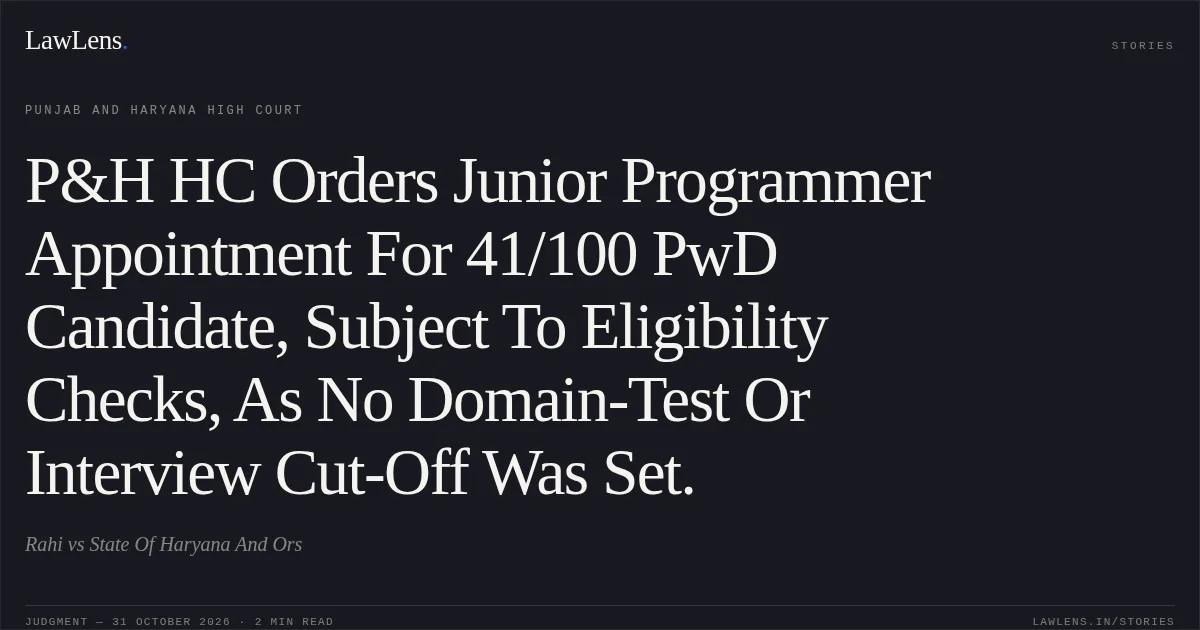
The petitioner, a person with benchmark disability, applied for the post of Junior Programmer against a PwD-reserved vacancy.
¶ 1The advertised selection scheme allocated 100 marks across the written examination, academic qualifications, Domain Knowledge Test and interview, but prescribed no minimum qualifying marks for the latter two components.
¶ 6–8After participating in the selection process, the petitioner was declared “Not Found Suitable.”
¶ 6–8The result disclosed under the Right to Information Act showed that he had scored 41 marks overall, compared with 36 marks for another candidate in the relevant category.
¶ 17He sought, among other relief, reconsideration of his candidature under the notified criteria.
¶ 1, 6–8, 1702Issues
i.1. Whether the respondents could declare the petitioner “Not Found Suitable” by applying an undisclosed minimum benchmark for the Domain Knowledge Test or interview, when no such benchmark was prescribed in the advertisement.
¶ 7–15ii.2. Whether the petitioner’s candidature was required to be assessed, and the result recast, according to the notified composite selection scheme and aggregate merit.
¶ 6, 17–1803Law Applied
Articles 14 and 16 of the Constitution require fairness and equal opportunity in public employment.
¶ 16Under the principle against changing the “rules of the game” after the process has begun, a recruiting authority may devise selection procedures and benchmarks, but any benchmark for a stage of recruitment must be stipulated before that stage is conducted.
¶ 16The Court relied on the Constitution Bench decision in Tej Prakash Pathak v. Rajasthan High Court, (2025) 2 SCC 1, which affirmed that principle and the limits it places on recruitment discretion.
¶ 16It also applied the rule that, once a quantified selection scheme is notified, the authority must adhere to it and cannot introduce an undisclosed disqualifying condition after candidates have participated.
¶ 9–1504Reasoning
The advertisement allocated marks to four components and did not specify a separate qualifying threshold for either the Domain Knowledge Test or the interview.
¶ 7–17The petitioner was assessed under that scheme and was not rejected for ineligibility or deficient qualifications; rather, he was declared unsuitable despite securing the higher aggregate score shown in the result.
¶ 7–17The respondents therefore could not rely on an undisclosed benchmark to exclude him.
¶ 7–17The Court held that the selection committee’s discretion to assess suitability had to remain within the notified criteria and that the petitioner’s merit had to be determined by considering the marks awarded across all prescribed components.
¶ 7–1705Holding
The writ petition was allowed.
¶ 18–21The respondents were directed to recast the result in accordance with the advertised criteria and, subject to verification of the petitioner’s eligibility, documents and other applicable requirements, issue him an appointment letter for the Junior Programmer post.
¶ 18–21He was granted consequential benefits, including notional seniority and service benefits from the date his batchmates joined, but no salary for the period before his actual joining.
¶ 18–21The exercise was to be completed within eight weeks of receipt of a certified copy of the judgment.
¶ 18–21Original Court PDF
RahivsState Of Haryana And Ors
Click to open original judgment
Original judgment, available to read, download and summarize on LawLens.in