01Facts
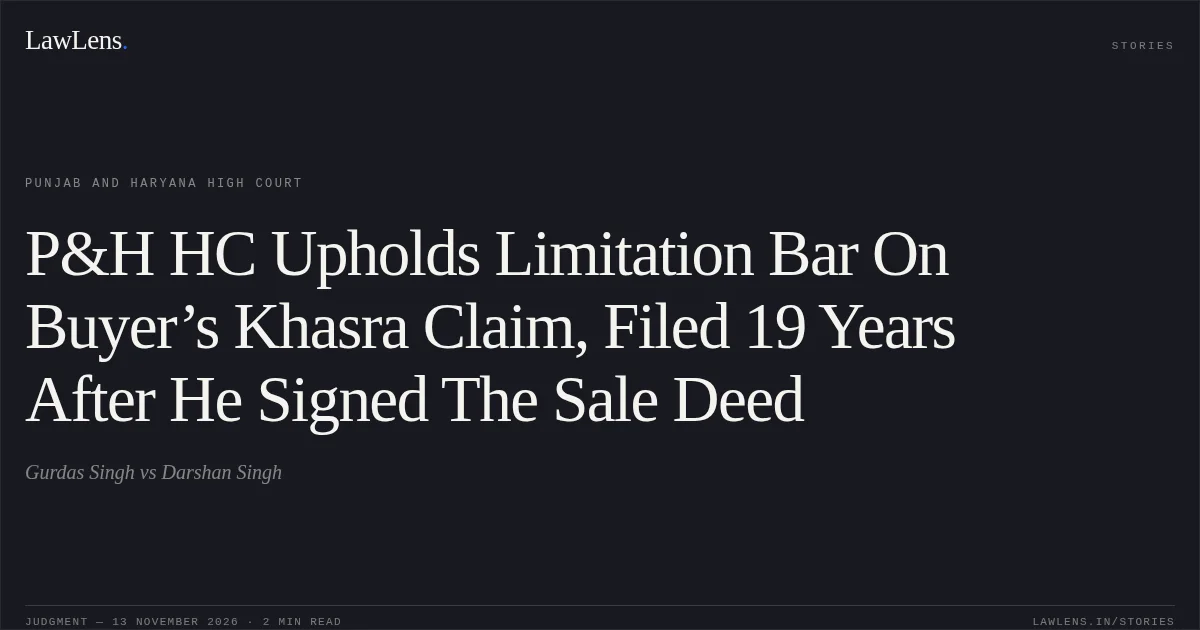
The plaintiff sought rectification of a sale deed dated 4 January 2000, alleging that the wrong khasra number had been entered due to a typographical error, and sought consequential declaratory relief concerning ownership and possession.
¶ 1–5He claimed to have discovered the discrepancy in 2018 when seeking mutation.
¶ 1–5The defendant disputed the deed and consideration.
¶ 1–5The Trial Court dismissed the suit, and the First Appellate Court affirmed.
¶ 1–5The plaintiff filed a Regular Second Appeal; the High Court condoned the 129-day delay in filing it and then considered the appeal on the merits.
¶ 1–5 · CM-14664-C202602Issues
i.Whether the suit for rectification and consequential declaration, instituted in 2019 in respect of the sale deed executed on 4 January 2000, was barred by limitation.
¶ 8ii.Whether the concurrent findings dismissing the suit disclosed perversity or legal infirmity warranting interference in the Regular Second Appeal.
¶ 6–8.303Law Applied
The Court stated that a suit seeking rectification of an instrument is subject to a three-year limitation period.
¶ 8.2It applied the principles that a party to an instrument is ordinarily fixed with knowledge of its recitals, and that a later approach to revenue authorities does not, by itself, create a fresh cause of action or revive a stale claim.
¶ 8.1–8.2Provisions in the judgment · 2 · Linked ones open on LawLens
Code of Civil Procedure, 1908 Section 151
Limitation Act, 1963 Section 5
04Reasoning
The plaintiff was a signatory to, and the sole beneficiary of, the 2000 sale deed.
¶ 8–8.3The alleged discrepancy in the khasra number appeared on the face of the instrument, so the Court rejected his assertion that he first learned of it in 2018.
¶ 8–8.3Because the suit was filed only in 2019, the later revenue proceedings did not provide a fresh cause of action or extend the limitation period.
¶ 8–8.3The Court therefore found no perversity or legal infirmity in the concurrent findings of the courts below.
¶ 8–8.305Holding
The High Court held that the suit was barred by limitation and found no substantial ground to interfere with the concurrent judgments.
¶ 8.3–9It dismissed the Regular Second Appeal and disposed of any pending miscellaneous applications.
¶ 8.3–9Original Court PDF
Gurdas SinghvsDarshan Singh
Click to open original judgment
Original judgment, available to read, download and summarize on LawLens.in