01Facts
The appellant challenged his conviction under Sections 366-A and 376 IPC, arising from allegations that the informant’s minor daughter was taken away on 12 September 2010 and sexually assaulted.
pp. 2–3She was recovered on 17 September and medically examined the following day.
pp. 2–3The Sessions Court sentenced the appellant to four years’ rigorous imprisonment under Section 366-A and five years’ rigorous imprisonment under Section 376, to run concurrently.
pp. 2–3On appeal, the High Court scrutinised the evidence of the victim, the informant-father, the medical witnesses and the investigating officer.
pp. 6–802Issues
i.1. Whether the prosecution evidence, particularly the testimony of the victim and her father, proved beyond reasonable doubt that the appellant committed rape under Section 376 IPC.
pp. 11–12, 17–18ii.2. Whether the evidence established the statutory ingredients of procuration of a minor girl under Section 366-A IPC, including the requisite intent concerning illicit intercourse with “another person”.
pp. 24–26, 34–3603Law Applied
Under Section 366-A IPC, the prosecution must prove that the accused induced a minor girl to go from a place or do an act with the intent, or knowledge of likelihood, that she would be forced or seduced to illicit intercourse with another person; the “another person” element is essential (Sat Parkash v. State of Haryana, (2015) 16 SCC 475).
pp. 24–26A conviction may rest on a sole witness, including a prosecutrix, if the evidence is wholly reliable; where it is neither wholly reliable nor wholly unreliable, the court must exercise caution and seek corroboration in material particulars (Vadivelu Thevar v. State of Madras, AIR 1957 SC 614; Sunil Kumar v. State (Govt. of NCT of Delhi), (2003) 11 SCC 367).
pp. 19–21A prosecutrix’s testimony need not invariably be corroborated, but material contradictions may make reliance unsafe; medical evidence is corroborative and its absence does not, by itself, disprove rape (State of Punjab v. Gurmit Singh, (1996) 2 SCC 384; Nirmal Premkumar v. State, 2024 SCC OnLine SC 260).
pp. 12–18The prosecution must prove guilt beyond reasonable doubt; suspicion, however grave, cannot replace proof (Santosh @ Bhure v. State (NCT of Delhi), 2023 INSC 443).
pp. 27–30Provisions in the judgment · 3 · Linked ones open on LawLens
Indian Penal Code, 1860 Section 376Section 379
Code of Criminal Procedure, 1973 Section 164
04Reasoning
The Court found the father’s claim to have witnessed the taking away doubtful because it was an improvement, was inconsistent with the investigating officer’s evidence, and was accompanied by unexplained inaction and a two-day delay in lodging the report.
pp. 8–11, 21–22The victim’s evidence varied as to the persons who committed rape and the date and circumstances of the occurrence; her Section 164 CrPC statement was considered only to assess consistency, not as substantive evidence.
pp. 14–16The medical evidence did not establish recent intercourse or independently connect the appellant to the alleged act, while the victim’s recovery alone did not prove his participation.
pp. 16–18, 22–23The Court therefore held that the prosecution evidence, taken cumulatively, did not prove the Section 376 charge beyond reasonable doubt.
pp. 24–26, 31–32Section 366-A also failed because there was no clear, trustworthy evidence that the appellant induced the victim for illicit intercourse with another person.
pp. 24–26, 31–3205Holding
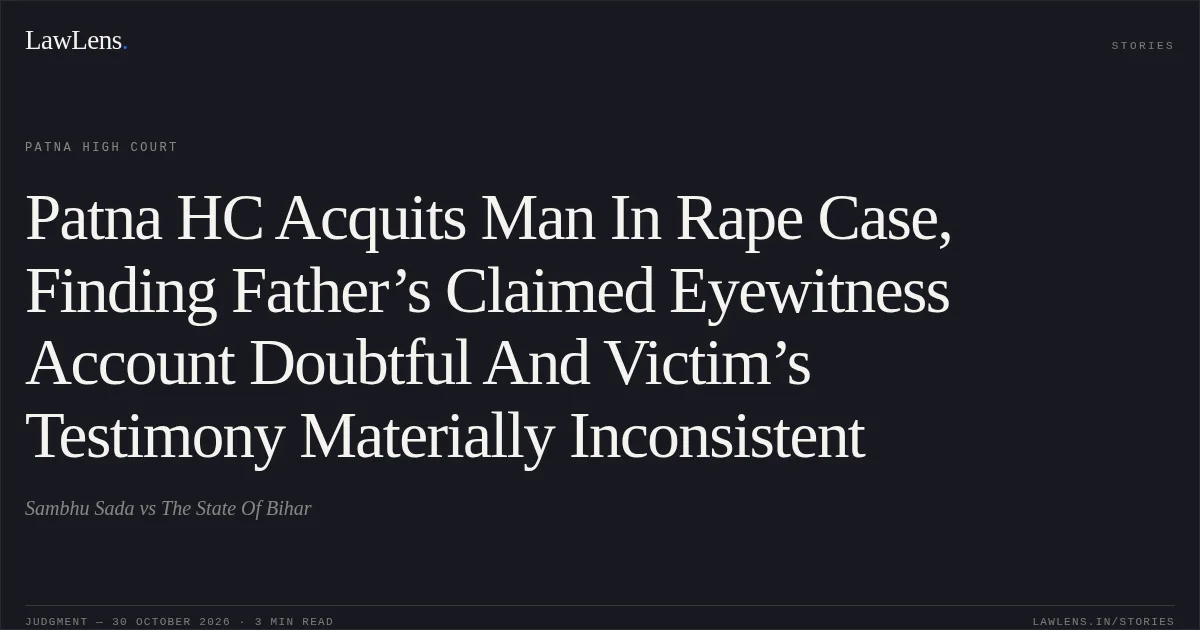
The High Court allowed the appeal, set aside the conviction and sentence under Sections 366-A and 376 IPC, and acquitted Sambhu Sada because the prosecution had not proved guilt beyond reasonable doubt.
pp. 31–33The bailors and sureties were discharged, any fine paid was ordered to be returned, and the trial court records were directed to be transmitted forthwith.
p. 33Original Court PDF
Sambhu SadavsThe State Of Bihar
Click to open original judgment
Original judgment, available to read, download and summarize on LawLens.in