01Facts
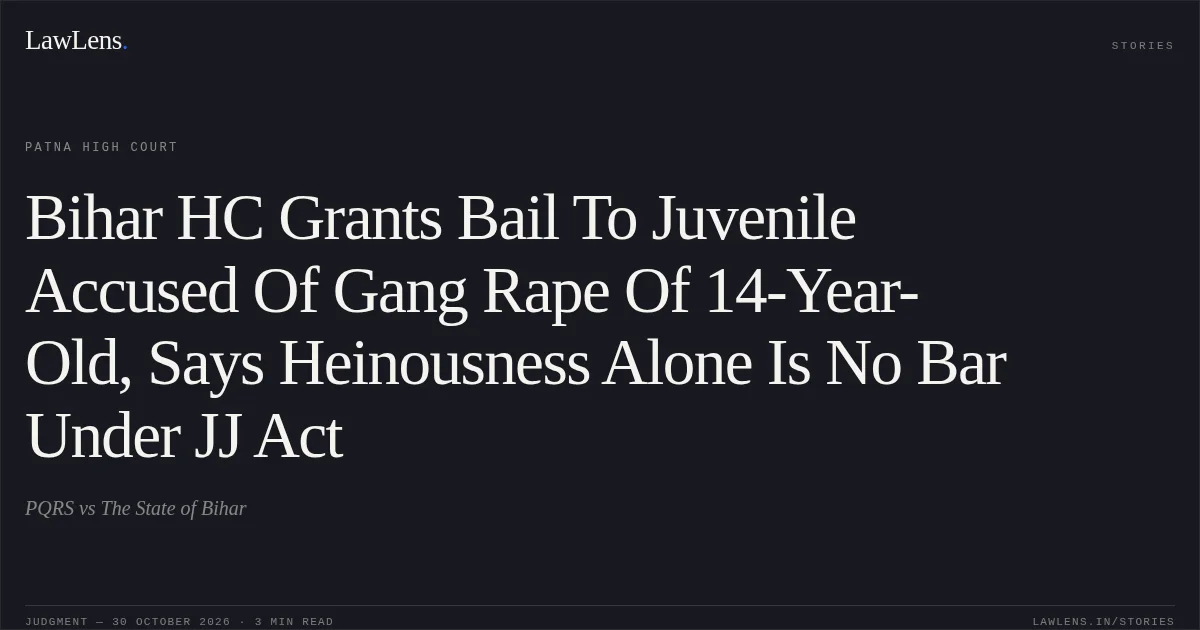
The appellant, a child in conflict with law, was accused of participating with co-accused in the gang rape of a 14-year-old girl.
p. 2 · ¶ 28The victim’s statement under Section 183 of the BNSS supported the allegation against him.
p. 2 · ¶ 28The Special Court rejected his bail application under Section 12 of the Juvenile Justice (Care and Protection of Children) Act, 2015 (JJ Act), citing the heinous nature of the alleged offence.
p. 1The appellant challenged that order, submitting that the offence’s gravity was not a permissible ground for refusing bail under Section 12.
pp. 3–4The Social Investigation Report recorded that he had no criminal antecedents, was a Class 10 student, and had no reported association with known criminals.
p. 20 · ¶ 3302Issues
i.1. Whether the heinous nature of the alleged offence, by itself, is a permissible ground to deny bail to a child in conflict with law under Section 12 of the JJ Act
pp. 18–20 · ¶ 26(1)–26(5), 29–30ii.2. Whether the material on record established any of the grounds in the proviso to Section 12(1) that would justify refusing the appellant bail
pp. 20–21 · ¶ 31–3403Law Applied
Section 12(1) of the JJ Act makes release on bail the rule for a child alleged to be in conflict with law, notwithstanding other laws; bail may be refused only where there are reasonable grounds to believe that release is likely to bring the child into association with a known criminal, expose the child to moral, physical or psychological danger, or defeat the ends of justice.
pp. 5–7 · ¶ 9–11The court relied on Juvenile in Conflict with Law v. State of Rajasthan, 2024 SCC OnLine SC 5297, and In Re: Exploitation of Children in Orphanages in the State of T.N. v. Union of India, (2020) 14 SCC 327, for the requirement that refusal be supported by findings on the statutory grounds.
pp. 5–7 · ¶ 9–11It also relied on Section 3 of the JJ Act, including the principles of the child’s best interests, family responsibility and institutionalisation as a last resort, in interpreting “ends of justice” in the context of the Act’s rehabilitative purpose.
pp. 12–16 · ¶ 18–24The court held that the gravity of the alleged offence is not, by itself, a ground to deny bail under Section 12.
pp. 18–19 · ¶ 26(2), 26(5)Provisions in the judgment · 6 · Linked ones open on LawLens
Juvenile Justice (Care and Protection of Children) Act, 2015. Section 12Section 18Section 2Section 15Section 3
Bharatiya Nagarik Suraksha Sanhita, 2023 Section 183
04Reasoning
Although the allegations were serious and supported by the victim’s statement, the court held that their gravity could not substitute for a finding under one of Section 12(1)’s three statutory exceptions.
pp. 19–20 · ¶ 28–30The Social Investigation Report disclosed no criminal antecedents or association with known criminals and did not indicate that release would expose the appellant to danger; the record likewise did not establish that release would defeat the ends of justice.
p. 20 · ¶ 32–33The Special Court had refused bail solely because of the offence’s heinous nature, without relying on a permissible statutory ground.
p. 21 · ¶ 34The court therefore found the refusal legally unsustainable.
p. 21 · ¶ 3405Holding
The appeal was allowed and the Special Court’s order set aside.
pp. 21–22 · ¶ 35The appellant was directed to be released on bail on a bond of ₹10,000, subject to his father’s affidavit undertaking to supervise him, keep him away from criminal persons, support his development and studies, ensure his attendance when required, and prevent further offending or threats to witnesses.
pp. 21–22 · ¶ 35The father was also directed to reside in the appellant’s village in Bihar.
pp. 21–22 · ¶ 35Original Court PDF
PQRSvsThe State of Bihar
Click to open original judgment
Original judgment, available to read, download and summarize on LawLens.in