01Facts
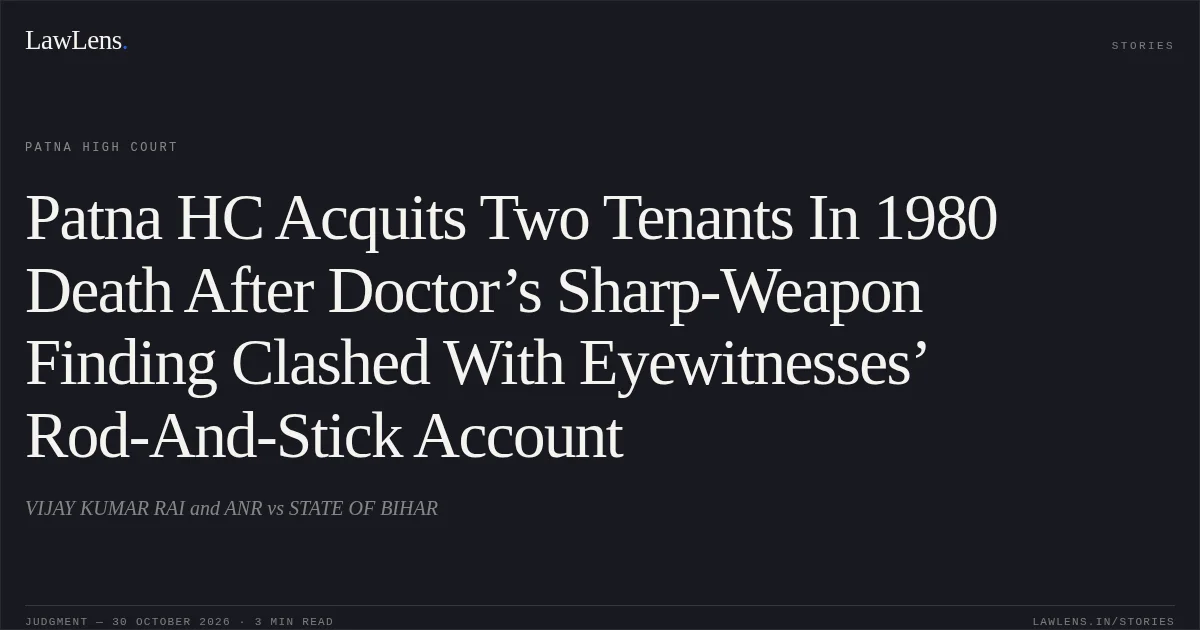
The appeal challenged the appellants’ convictions for the fatal assault of Purushottam Prasad: Vijay Kumar Rai was convicted under Section 302 IPC and Prabhu Narayan Rai under Section 302 read with Section 34 IPC.
¶ 1Each was sentenced to life imprisonment and fined ₹5,000.
¶ 8The prosecution alleged that, during a dispute at the tenants’ residence, the appellants struck Purushottam with a mosquito-net stick and an iron rod; he later died in hospital.
¶ 2–6The prosecution relied principally on four related eyewitnesses.
The emergency doctor, PW 9, found two incised wounds and attributed them to a sharp-cutting weapon, excluding an iron rod as their cause.
¶ 36–39The post-mortem doctor and Investigating Officer were not examined, and the post-mortem and inquest reports were not duly proved.
¶ 62–70The trial court convicted the appellants while acquitting the co-accused.
¶ 77–7802Issues
i.1. Whether the prosecution proved beyond reasonable doubt that the appellants inflicted the injuries that caused Purushottam’s death, given the discrepancies in the eyewitness accounts and the conflict with the medical evidence.
¶ 51–60, 71–76ii.2. Whether non-examination of the Investigating Officer and post-mortem doctor, and the resulting lack of proof of relevant reports, materially prejudiced the defence and weakened the prosecution case.
¶ 62–70iii.3. Whether the evidence against the appellants was sufficiently distinct and reliable to sustain their convictions despite the acquittal of the co-accused.
¶ 77–7803Law Applied
Sections 302 and 34 IPC govern, respectively, the offence of murder and liability for a criminal act done in furtherance of common intention.
¶ 1, 8The prosecution must prove guilt beyond reasonable doubt; where the evidence reasonably admits of two views, the view favourable to the accused should ordinarily be adopted.
¶ 79Non-examination of an Investigating Officer is not invariably fatal; its effect depends on whether it caused prejudice to the accused, including by preventing effective proof of contradictions or testing of the investigation, as stated in Behari Prasad v. State of Bihar, (1996) 2 SCC 317.
¶ 62–67Medical evidence is generally corroborative, but a material conflict between it and the eyewitness account may undermine the prosecution case in the circumstances of the particular case.
¶ 71, 74–76Provisions in the judgment · 6 · Linked ones open on LawLens
Indian Penal Code, 1860 Section 302Section 34Section 341Section 323Section 325
Code of Criminal Procedure, 1973 Section 313
04Reasoning
The eyewitnesses attributed blunt weapons—a rod and a mosquito-net stick—to the appellants, but PW 9 described the deceased’s injuries as incised wounds caused by a sharp-cutting weapon and expressly excluded an iron rod.
¶ 55–59No eyewitness attributed use of a sharp weapon to either appellant, and the prosecution did not connect any such weapon to them or explain the wrist injury.
¶ 58–61, 74–76The witnesses also differed about the deceased’s and assailants’ positions during the assault; the Court considered these discrepancies significant alongside the medical conflict.
¶ 53–54, 72–73The Investigating Officer’s absence prevented effective examination of alleged contradictions and of the scene and seized articles; the post-mortem evidence was also unavailable to establish the precise cause of death.
¶ 65–70In that context, the Court found the prosecution evidence insufficiently reliable to prove the appellants’ responsibility beyond reasonable doubt.
¶ 76, 83–8505Holding
The Court held that the prosecution had not proved beyond reasonable doubt that the appellants inflicted the fatal injuries in the manner alleged.
¶ 85–88It allowed the appeal, set aside the convictions and sentences, and acquitted both appellants on benefit of doubt.
¶ 85–88As they were on bail, they were discharged from their bail-bond liabilities.
¶ 85–88Original Court PDF
VIJAY KUMAR RAI and ANRvsSTATE OF BIHAR
Click to open original judgment
Original judgment, available to read, download and summarize on LawLens.in