01Facts
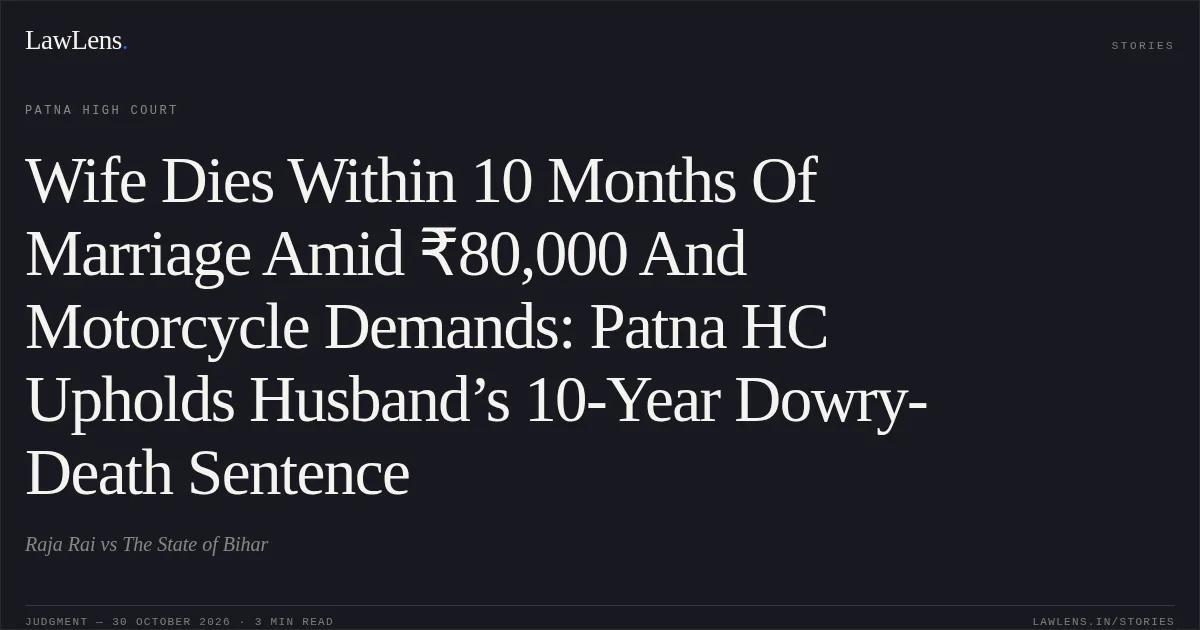
The appellant’s wife died at her matrimonial home on 10 April 2021, less than a year after their marriage.
pp. 2–4Her father alleged that the appellant and his family had demanded ₹80,000 and a motorcycle and subjected her to assault when the demands were not met.
pp. 2–4The post-mortem recorded multiple injuries, including fractured ribs and a lacerated lung, and attributed death to haemorrhage and shock caused by a hard and blunt substance.
pp. 22–23The trial court convicted the appellant under Sections 304B and 498A IPC and Section 4 of the Dowry Prohibition Act; it imposed ten years’ rigorous imprisonment under Section 304B IPC, with further sentences for the other offences, to run concurrently.
p. 2The appellant appealed, contending, among other things, that the prosecution had not established cruelty soon before death and that the injuries resulted from falling bricks.
pp. 6–802Issues
i.Whether the evidence established that the deceased was subjected to dowry-related cruelty or harassment soon before her unnatural death, so as to attract Section 304B IPC and the presumption under Section 113B of the Evidence Act
pp. 25–29ii.Whether the appellant’s explanation that the deceased’s injuries were caused accidentally by falling bricks raised a probable defence sufficient to rebut that presumption
pp. 25–29iii.Whether the trial court’s convictions and sentences warranted appellate interference
pp. 28–3003Law Applied
Section 304B IPC applies where a woman dies from burns, bodily injury, or otherwise than under normal circumstances within seven years of marriage, and it is shown that soon before her death she was subjected to cruelty or harassment by her husband or his relatives in connection with a dowry demand.
pp. 28–29Once those foundational facts are established, Section 113B of the Indian Evidence Act, 1872 requires the court to presume that the accused caused the dowry death; the accused may rebut that presumption by establishing a probable defence.
pp. 28–29The judgment also records the appellant’s convictions under Section 498A IPC and Section 4 of the Dowry Prohibition Act, but its substantive analysis principally addresses Section 304B IPC and the Section 113B presumption.
pp. 2, 28–29Provisions in the judgment · 5 · Linked ones open on LawLens
Indian Penal Code, 1860 Section 34Section 302
Dowry Prohibition Act, 1961 Section 3Section 4
Code of Criminal Procedure, 1973 Section 313
04Reasoning
The Court found that the deceased’s death was unnatural, resulted from bodily injuries, and occurred within seven years of marriage.
pp. 25–26It accepted the evidence of the informant, the deceased’s brother and uncle, and PW-9 as establishing persistent demands for money and a motorcycle, accompanied by assault, continuing until the incident.
pp. 25–26The Court rejected the accidental-injury explanation: although bricks were reportedly near the body, the Investigating Officer did not report a fallen wall, and the appellant neither substantiated that account nor raised it in his Section 313 statement.
pp. 26–28It therefore held that the evidence established dowry-related cruelty soon before death, bringing the Section 113B presumption into operation; the appellant had not rebutted it.
pp. 28–2905Holding
The High Court held that the prosecution established the ingredients of dowry death and that the appellant failed to rebut the statutory presumption.
pp. 28–29It dismissed the appeal and affirmed the impugned conviction and sentence.
p. 30The operative paragraph expressly refers to the convictions under Sections 304B and 498A IPC and sentences for those offences; although the judgment’s opening records a conviction and sentence under Section 4 of the Dowry Prohibition Act, the final paragraph does not separately restate that conviction or sentence.
p. 2, 30Original Court PDF
Raja RaivsThe State of Bihar
Click to open original judgment
Original judgment, available to read, download and summarize on LawLens.in