01Facts
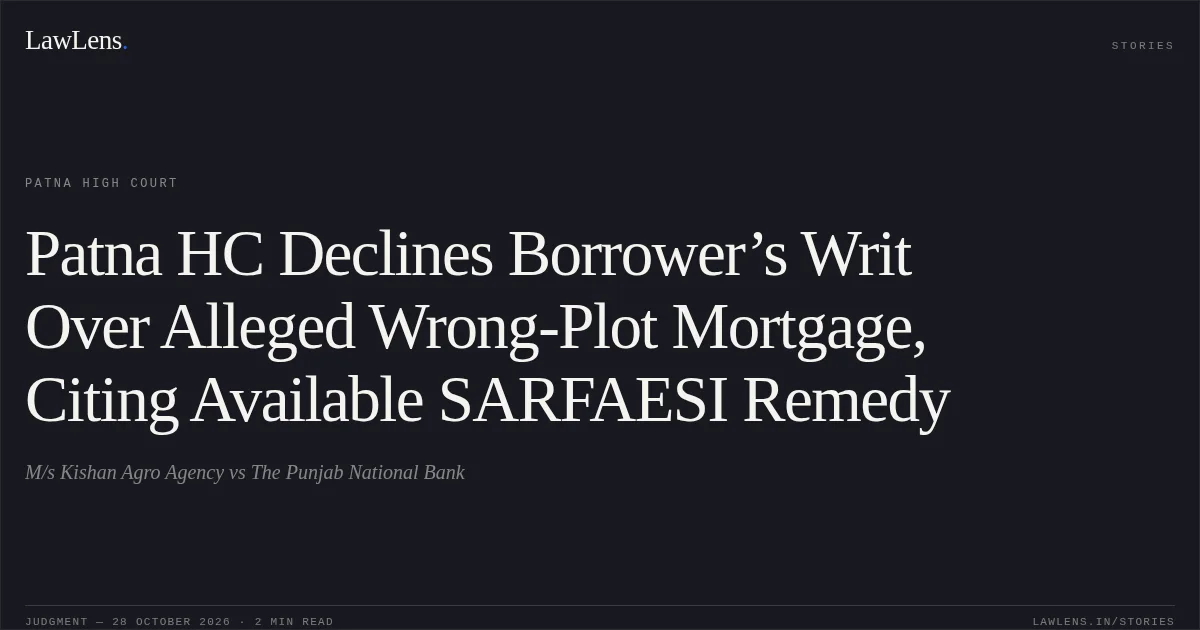
The petitioner challenged the bank’s SARFAESI action, alleging that when a cash-credit facility of ₹15 lakh was secured by an equitable mortgage, the bank’s authorised lawyer mistakenly verified a different parcel of land—Khata No. 262, Plot No. 1355—instead of the land described in the petitioner’s intended mortgage documents, Khata No. 118, Plot No. 109.
pp. 2–4The petitioner sought, among other reliefs, a direction to treat the latter property as the mortgaged property and to refrain from further recovery action; he also expressed willingness to settle the loan.
pp. 2–4The High Court considered the availability of an alternative remedy and disposed of the writ petition without determining the underlying property or mortgage dispute.
pp. 4–602Issues
i.1. Whether the writ petition was maintainable under Article 226 where an alternative remedy was available under the SARFAESI framework.
pp. 4–6ii.2. Whether the petitioner’s request to settle the loan required permission or a specific direction from the Court.
p. 603Law Applied
Under Article 226, the High Court will ordinarily decline to entertain a petition where an effective statutory remedy is available, with particular rigour in matters concerning recovery of public dues and bank debts.
pp. 4–5In United Bank of India v. Satyawati Tondon, (2010) 8 SCC 110, the Supreme Court held that parties should ordinarily exhaust remedies under the relevant recovery legislation before invoking writ jurisdiction.
pp. 4–5Celir LLP v. Bafna Motors (Mumbai) (P) Ltd., (2024) 2 SCC 1, reiterated that High Courts should not entertain Article 226 petitions where an effective remedy is available under the SARFAESI Act.
p. 5The Court also relied on PHR Invent Educational Society v. UCO Bank, 2024 INSC 297, as reiterating the same principle.
pp. 5–604Reasoning
The petitioner’s claims concerned the identification of the property allegedly mortgaged and the bank’s recovery action. Applying the alternative-remedy principle in the cited Supreme Court decisions, the Court held that the petitioner should pursue the remedy available before the appropriate forum rather than seek relief under Article 226.
pp. 4–6It left the merits of the property and mortgage dispute undecided and stated that the appropriate authority could consider limitation.
p. 6As to settlement, the Court observed that the petitioner could approach the bank directly and did not require the Court’s permission to do so.
p. 605Holding
The Court held that the writ petition was not maintainable in view of the available alternative and effective remedy and disposed of it, leaving the petitioner at liberty to approach the appropriate forum, with limitation to be considered by the concerned authority.
p. 6It also clarified that the petitioner could approach the bank to settle the loan without seeking judicial permission.
p. 6Original Court PDF
M/s Kishan Agro AgencyvsThe Punjab National Bank
Click to open original judgment
Original judgment, available to read, download and summarize on LawLens.in