01Facts
The petitioner, an elected member of the Temple Advisory Committee (TAC) of Kakkad Sree Dharmasastha Temple, Perunad, was excluded from the TAC.
¶ 1He alleged that the exclusion rested solely on unsubstantiated criminal imputations, though he had been validly elected with a substantial number of votes.
¶ 1He sought a direction to the Travancore Devaswom Board (TDB) to disregard those imputations and include him in the TAC.
¶ 1The Standing Counsel for the TDB submitted that the allegations involve offences under several sections of the Indian Penal Code, including Sections 329(4), 115(2), 351(2), 384, 447, 294(b), 506 and 34, and that three FIRs (Exts. P7, P8 and P9) are pending investigation.
¶ 2 · pp. 3–4The Standing Counsel relied on Ext. P2, the "Certificate of Involvement/Non-Involvement in Offences," which every elected member must mandatorily obtain, and argued that Ext. P2 shows the petitioner's involvement and bars inclusion under the approved bye-laws.
¶ 2 · p. 4The petitioner conceded that the FIRs are pending but contended that the charges are concocted, fraudulent and baseless.
¶ 3 · pp. 4–502Issues
i.1. Whether a duly elected member of a TAC may be excluded from the committee where criminal FIRs are pending against him and the mandatory certificate of involvement in offences reflects such involvement.
¶ 2 · p. 4 · ¶ 5 · p. 5ii.2. Whether the Court, in writ jurisdiction, may examine the merits of the pending criminal charges to determine whether the petitioner is eligible for inclusion.
¶ 4 · p. 503Law Applied
The bye-laws governing the constitution of TACs, as approved by the High Court, require every candidate to produce a "Certificate of Involvement/Non-Involvement in Offences."
¶ 4 · p. 5The bye-laws are treated as binding while they remain in force.
¶ 5 · p. 5It is not within the Court's province in such proceedings to examine the charges or to declare a person guilty or not guilty.
¶ 4 · p. 5Provisions in the judgment · 8 · Linked ones open on LawLens
Indian Penal Code, 1860 Section 329Section 115Section 351Section 384Section 447Section 294Section 506Section 34
04Reasoning
The Court accepted that the bye-laws mandate the certificate, and that the petitioner's pending FIRs were conceded.
¶ 3 · p. 4 · ¶ 4 · p. 5Because the bye-laws require a certificate of involvement or non-involvement, the petitioner's exclusion followed from the prescribed eligibility condition, not from any adjudication of guilt.
¶ 4 · p. 5The Court declined to evaluate the petitioner's claim that the charges were fabricated, holding that doing so would require it to assess the merits of criminal proceedings, which is outside its province in this writ.
¶ 4 · p. 5The petitioner's electoral success did not displace the bye-law requirement, since the bye-laws, so long as they stand, preclude the relief sought.
¶ 5 · p. 5The Court left the petitioner's remedy to exoneration in the criminal proceedings, not to adjudication of the allegations in writ.
05Holding
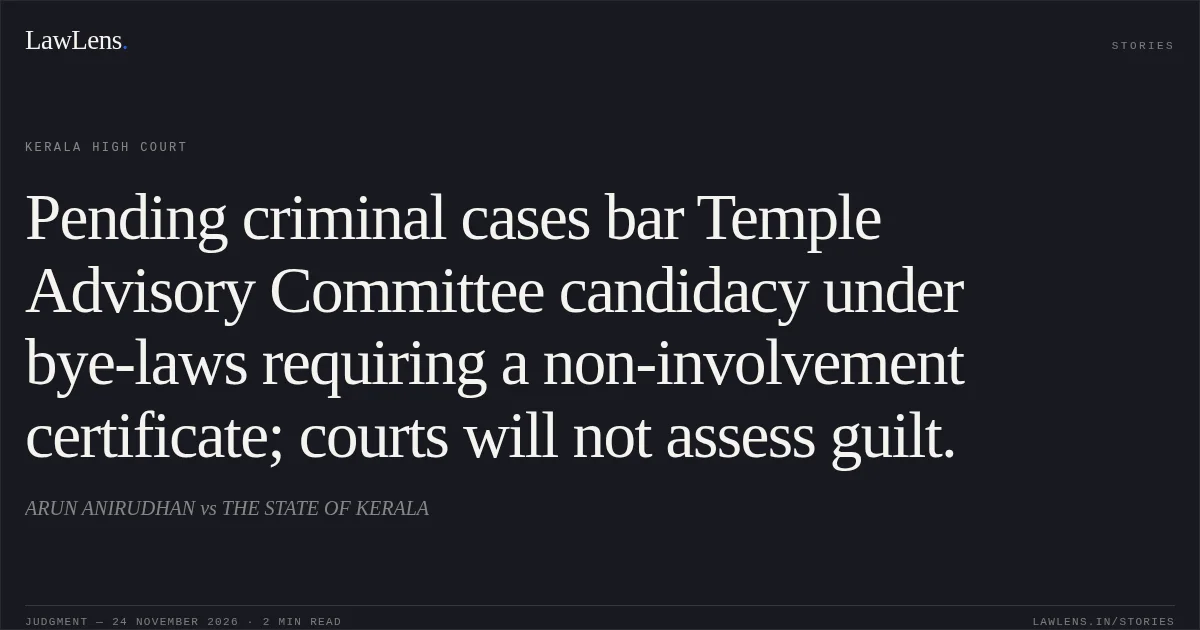
Under the approved bye-laws, a candidate with pending criminal FIRs reflected in the mandatory certificate of involvement cannot be included in the TAC, and the Court will not examine the merits of the charges to determine guilt or innocence.
¶ 4 · p. 5 · ¶ 5 · p. 5The writ petition was dismissed. The petitioner was granted liberty to invoke other remedies available in law, including for re-inclusion after he is duly exonerated.
¶ 5 · pp. 5–6Original Court PDF
ARUN ANIRUDHANvsTHE STATE OF KERALA
Click to open original judgment
Original judgment, available to read, download and summarize on LawLens.in