01Facts
The petitioners are successors-in-interest of the plaintiff in Title Suit No. 62/1971, which was decreed on 19.3.2010.
¶ 1 · p. 2 · ¶ 4 · pp. 3–4The decree declared that the defendant club or its members had no title to the suit property, no right to use it as a playground, and no easement. It granted a permanent injunction restraining the club and its members from building a pucca boundary wall, fencing, or making any construction on the land, and a mandatory injunction directing removal of any goal post or sign board.
¶ 4 · p. 4The defendants' Title Appeal No. 105/2010 was dismissed on 12.7.2022.
¶ 5 · p. 4A second appeal was disposed of on 27.2.2026, affirming the lower courts' decisions.
¶ 1 · p. 2 · ¶ 5 · p. 4The petitioners sought police assistance to use the land.
Respondent Nos. 6–11 contended that the decree granted only limited rights, that the defendants had pleaded adverse possession, that no eviction direction was made, and that a club room on the land should not be disturbed.
¶ 2 · pp. 2–302Issues
i.1. Whether a writ court under Article 226 may direct police protection to enforce rights declared in a civil court decree.
¶ 7 · pp. 5–6 · ¶ 8 · p. 6ii.2. Whether the decree dated 19.3.2010 determines the parties' rights unambiguously so as to warrant police protection in its enforcement.
¶ 9 · pp. 6–7iii.3. Whether the absence of an express eviction direction, or the defendants' adverse possession plea, precludes enforcement of the decree against the club and its members.
¶ 6 · p. 503Law Applied
Article 226 of the Constitution of India, under which writ jurisdiction to grant police protection is restricted.
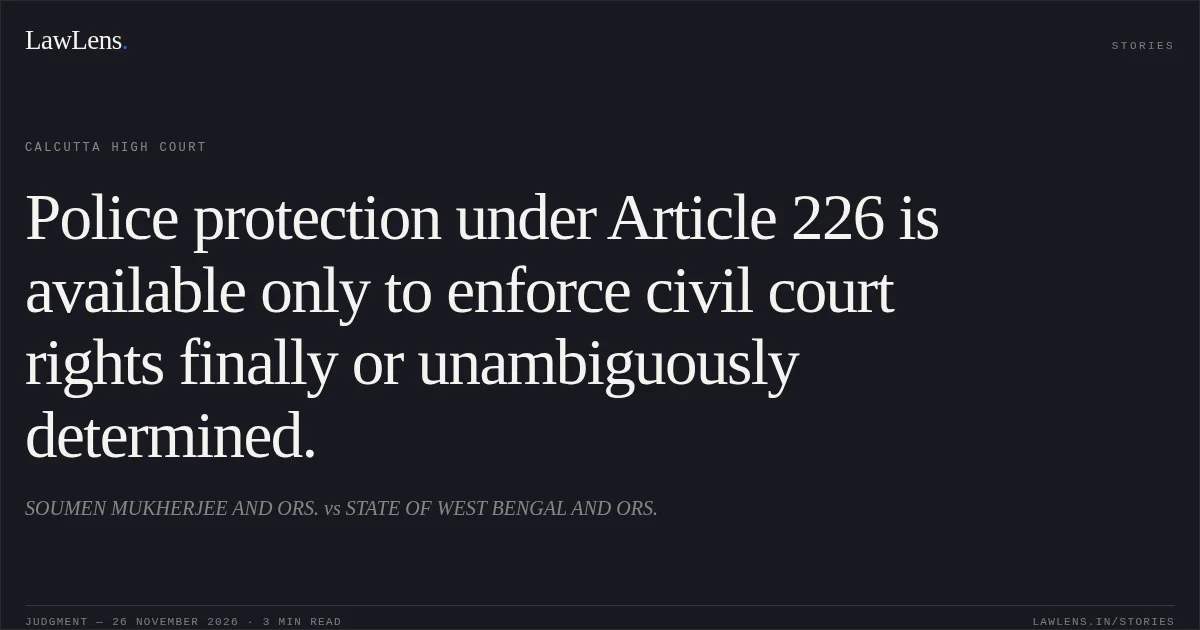
¶ 7 · p. 5P.R. Murlidharan & Ors. v. Swami Dharmananda Theertha Padar & Ors., (2006) 4 SCC 501, para. 19, which holds that a writ for "police protection" is available only where rights have been determined finally by a civil court, or at least at an interlocutory stage in an unambiguous manner, and then only in furtherance of the decree or order.
¶ 7 · pp. 5–6 · ¶ 8 · p. 6A decree which has been upheld on appeal and second appeal stands as the operative determination of rights.
¶ 5 · p. 5 · ¶ 9 · p. 704Reasoning
The decree of 19.3.2010 was not disturbed by the First Appellate Court or in second appeal, so it stands as a final determination of rights.
¶ 5 · pp. 4–5The operative terms of the decree, a declaration of no title and a permanent injunction against any structure or wall, are unambiguous.
¶ 9 · pp. 6–7This satisfies the threshold in P.R. Murlidharan for police assistance in aid of a decree.
¶ 8 · p. 6The respondents' argument that no eviction direction was passed and that adverse possession was pleaded was rejected. Because the suit was decided in the plaintiff's favour and the defendants were restrained from making any structure, the omission of an express eviction direction was held to be immaterial.
¶ 6 · p. 5The court treated the existing club room as an issue of compliance with the injunction, not as a ground to deny enforcement.
¶ 2 · p. 3 · ¶ 6 · p. 505Holding
The decree dated 19.3.2010 unambiguously determines the parties' rights, and police protection in its aid is permissible under P.R. Murlidharan.
¶ 9 · pp. 6–7The Officer-in-Charge, Chandernagore Police Station (Respondent No. 5), was directed to protect the petitioners' rights as successors-in-interest of the plaintiff. He was also directed not to permit the private respondents, as members of the defendant club, or the club itself to use the suit land in any manner inconsistent with the decree. The writ petition was disposed of accordingly.
¶ 10 · p. 7 · ¶ 11 · p. 7Original Court PDF
SOUMEN MUKHERJEE AND ORS.vsSTATE OF WEST BENGAL AND ORS.
Click to open original judgment
Original judgment, available to read, download and summarize on LawLens.in