01Facts
The testator, Sh. Trilochan Singh Manchanda, held a 25% share in M/s New Era Offset Printers, a partnership with his three sons under a Partnership Deed dated 13.02.1980.
¶ 2The firm's business premises were on a DDA plot at C-63/3, Okhla Industrial Area, Phase-II, New Delhi.
¶ 2By a registered Will dated 24.03.1998, the testator bequeathed his 25% share, including the factory, land and building, to his unmarried daughter, Ms. Jasbir Kaur (the propounder).
¶ 2The testator died on 14.07.1998.
¶ 2No executor was appointed, so the propounder sought letters of administration.
¶ 3Of the three sons, only the appellant, Harjit Singh, objected. Sukhwant Singh gave no objection and Surinder Singh filed nothing.
¶ 3The Probate Court framed two issues on the testator's right to execute the Will and his sound disposing mind, and allowed the petition by judgment dated 04.12.2009.
¶ 4–5The appellant challenged that judgment under Section 384 read with Section 299 of the Indian Succession Act, 1925.
¶ 1The propounder had executed a Will dated 30.06.1999 and a Release Deed dated 30.07.2010 in favour of Sukhwant Singh.
¶ 6, 16The appellant's medical evidence came from the treating doctor, Dr. A.S. Ahluwalia (RW-1), whose cross-examination limited his earlier affidavit evidence.
¶ 11–1202Issues
i.1. Whether the testator was of sound and disposing mind, and had testamentary capacity, at the time of executing the Will dated 24.03.1998, given the alleged diabetic neurological complications and memory loss.
¶ 9–13ii.2. Whether the Will's execution was wilful and voluntary, and not rendered suspicious, given the presence and alleged active participation of the eventual beneficiary, Sukhwant Singh, and the exclusion of the testator's sons.
¶ 14–17iii.3. Whether the bequest of the testator's 25% partnership share was illegal under Sections 5 and 14 of the Indian Partnership Act, 1932 and Clause 13(c) of the Partnership Deed, since the firm's property could not be bequeathed.
¶ 18–2103Law Applied
Sections 384 and 299 of the Indian Succession Act, 1925 govern the appeal and grant of probate or administration.
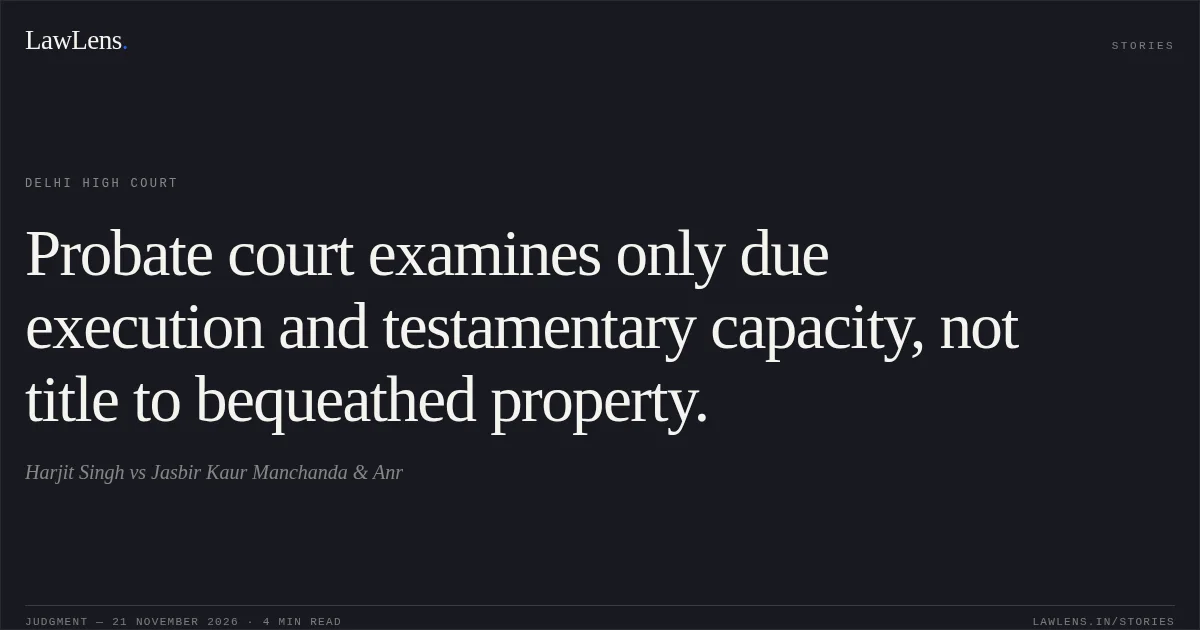
¶ 1A Probate Court determines only the genuineness and due execution of a Will and the testator's testamentary capacity, and does not adjudicate title or ownership of bequeathed property.
¶ 20Parvathi Nairthi v. Laxmi Nairthy (2026 SCC OnLine SC 911): exclusion of natural heirs alone is not a suspicious circumstance unless accompanied by factors affecting the Will's genuineness or due execution.
¶ 14Pentakota Satyanarayana v. Pentakota Seetharatnam ((2005) 8 SCC 67): a beneficiary's mere presence or active participation does not by itself cast doubt on testamentary capacity or genuineness.
¶ 17Section 42(c) of the Partnership Act, 1932: a firm dissolves on a partner's death unless the partners contract otherwise, with Clause 13(c) of the Deed treated as such a contract.
¶ 19Addanki Narayanappa v. Bhaskara Krishtappa (1966 SCC OnLine SC 6): capital brought into a partnership ceases to be the individual partner's trading asset and becomes a partnership asset.
¶ 20Provisions in the judgment · 5 · Linked ones open on LawLens
Indian Succession Act, 1925 Section 384Section 299
Indian Partnership Act, 1932 Section 5Section 14Section 42
04Reasoning
Dr. Ahluwalia's testimony did not establish incapacity on or near 24.03.1998. He had issued no certificate of mental incapacity, had noticed memory loss only two or three times, found it temporary, and saw no need for specialist referral.
¶ 12–13No medical record supported the claim of incapacity, so the Court affirmed the Probate Court's finding of sound mind.
¶ 13The bequest benefited the propounder, who did not accompany the testator at execution. Sukhwant Singh's presence and alleged participation could not vitiate the Will, particularly since the propounder later executed a Will and Release Deed in his favour, more than 15 months after execution.
¶ 16–17The exclusion of the three sons was not suspicious by itself.
¶ 14Applying Section 42(c) and Clause 13(c), the Court held, prima facie, that the firm continued after the testator's death, so the propounder as a legal representative could take his interest.
¶ 19The property was DDA-allotted to the testator and his partnership status was undisputed. Title and ownership questions fall outside the probate appeal and must be agitated in appropriate proceedings.
¶ 20The Court expressly stated that its observations on the partnership property were prima facie, made only for deciding the appeal, and would not bind later proceedings.
¶ 2105Holding
The Probate Court's findings on testamentary capacity, due execution, and the Will's validity were free from perversity or illegality, and the bequest's legality could not defeat a grant of letters of administration.
¶ 13, 17, 20, 22The appeal was dismissed and the impugned judgment dated 04.12.2009, granting letters of administration to the propounder, was upheld.
¶ 22The pending CM Appl. 2178/2014 was disposed of in the same terms.
¶ 23The observations on the partnership-property question remain prima facie and do not bind future proceedings on title.
¶ 21Original Court PDF
Harjit SinghvsJasbir Kaur Manchanda & Anr
Click to open original judgment
Original judgment, available to read, download and summarize on LawLens.in