01Facts
The respondents participated in the Combined Higher Secondary Level Examination, 2020 for appointment as Junior Secretariat Assistants.
Although the examination results were declared on 7 December 2022, their results were kept in abeyance on suspicion of impersonation.
p. 3 · ¶ 4In Vikash Kumar Sain v. SSC, the Central Administrative Tribunal directed that provisional offers of appointment be issued, subject to the outcome of an inquiry, and required a show-cause notice before any adverse action based on the inquiry report.
pp. 3–4 · ¶ 6The respondents were thereafter provisionally appointed.
pp. 4–5 · ¶ 7–8An inquiry conducted by Ernst & Young described their candidatures as “highly doubtful”; however, it did not record a positive finding that they had impersonated another person or had not undertaken the examination themselves.
p. 8 · ¶ 18Show-cause notices were issued under Rule 5(1)(a) of the Central Civil Services (Temporary Service) Rules, 1965, and, after considering their replies, the petitioners cancelled their provisional appointments and terminated their services on 13 August 2025.
pp. 4–6 · ¶ 8–9The respondents challenged the termination before the Tribunal.
p. 7 · ¶ 10The Tribunal set aside the show-cause notices and termination orders, directed reinstatement with continuity of service and consequential benefits, and granted liberty to the petitioners to initiate proceedings in accordance with law.
p. 7 · ¶ 10–11The Union of India challenged that decision before the High Court.
02Issues
i.Whether the respondents’ provisional appointments could be cancelled and their services terminated merely on the basis of an inquiry report stating that their candidatures were “highly doubtful”, without a positive finding of impersonation or non-participation in the examination.
pp. 8–10 · ¶ 18–23ii.Whether the Tribunal was correct in requiring a full-fledged inquiry complying with the principles of natural justice before any adverse action could be taken.
pp. 10–11 · ¶ 24–27iii.Whether the petitioners could be permitted to undertake fresh proceedings, and if so, what procedural safeguards were required.
p. 11 · ¶ 28–3003Law Applied
The Court applied the terms of the Tribunal’s earlier order dated 22 April 2024, under which the appointments were provisional and subject to the outcome of the inquiry; an adverse finding could lead to cancellation, but only after issuance of a show-cause notice.
pp. 3–4 · ¶ 6, 19It also considered Rule 5(1)(a) of the CCS (Temporary Service) Rules, 1965, which permits termination of a temporary Government servant by written notice.
pp. 4–6 · ¶ 8–9The power could not be used to cancel candidature on the basis of a mere unsubstantiated doubt where the action was founded on alleged misconduct or impersonation.
pp. 4–6 · ¶ 18–22The Court further applied the principle that an administrative decision producing adverse civil consequences must be based on a definite and legally sustainable finding.
p. 11 · ¶ 28–3004Reasoning
The High Court held that the earlier Tribunal order did not require a full-fledged adversarial inquiry, since that order had expressly contemplated an inquiry conducted without the respondents’ participation and prescribed a show-cause notice as the relevant safeguard.
pp. 10–11 · ¶ 26–27Nevertheless, the petitioners could not treat the Ernst & Young report’s statement that the candidatures were “highly doubtful” as equivalent to a finding of impersonation or examination fraud.
p. 9 · ¶ 20–22The doubt remained unresolved both in the show-cause notices and in the final termination orders.
p. 9 · ¶ 20–22Since the provisional appointments were subject to the outcome of the inquiry, cancellation could follow only upon a positive finding that the respondents were not the actual examinees or had otherwise committed the alleged misconduct.
As no such finding existed, the termination orders were unsustainable.
The Court, however, clarified that the petitioners remained entitled to conduct fresh proceedings under the earlier Tribunal order, subject to disclosure of the material relied upon and a personal hearing before any adverse conclusion.
p. 11 · ¶ 28–3005Holding
The writ petitions were disposed of without interfering with the Tribunal’s decision setting aside the show-cause notices and termination orders.
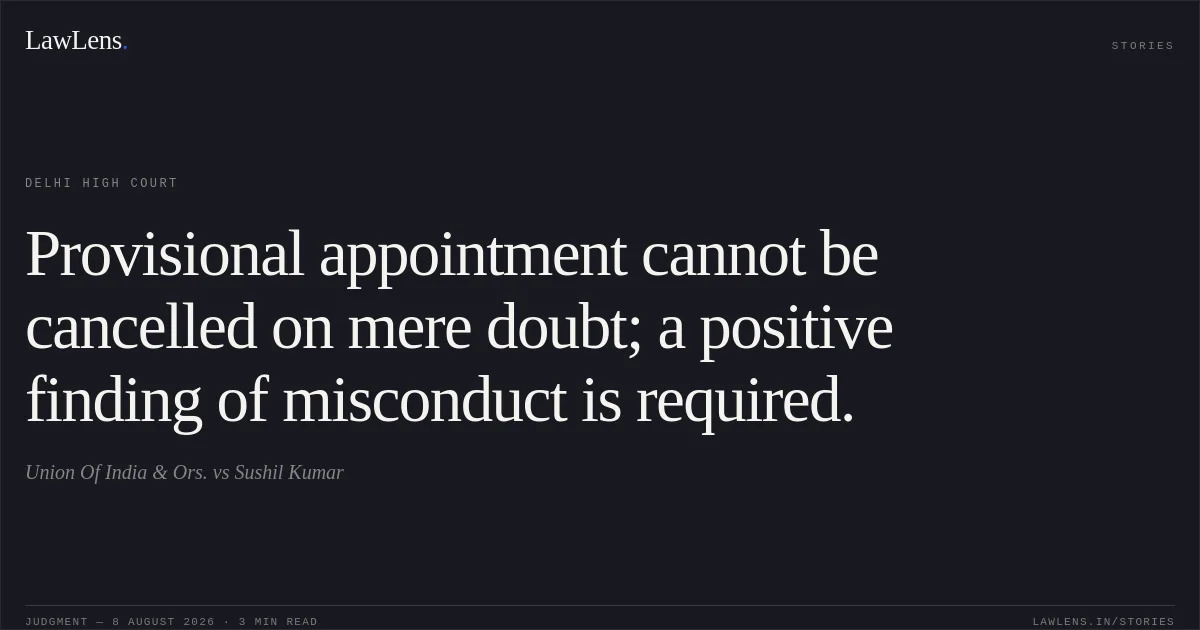
p. 10 · ¶ 23 · p. 12 · ¶ 31The Court held that the respondents’ appointments could not be cancelled merely because their candidatures were “highly doubtful”; a positive finding regarding impersonation or non-participation in the examination was necessary.
pp. 8–10 · ¶ 18–22The petitioners were granted liberty to proceed afresh in accordance with the Tribunal’s order dated 22 April 2024.
p. 11 · ¶ 28–30If they initiated such proceedings, they were required to disclose the adverse material to the respondents and provide them an opportunity of personal hearing before reaching any adverse conclusion.
p. 11 · ¶ 28–30The respondents’ further legal remedies were expressly reserved.
p. 12 · ¶ 32Original Court PDF
Union Of India & Ors.vsSushil Kumar
Click to open original judgment
Original judgment, available to read, download and summarize on LawLens.in