01Facts
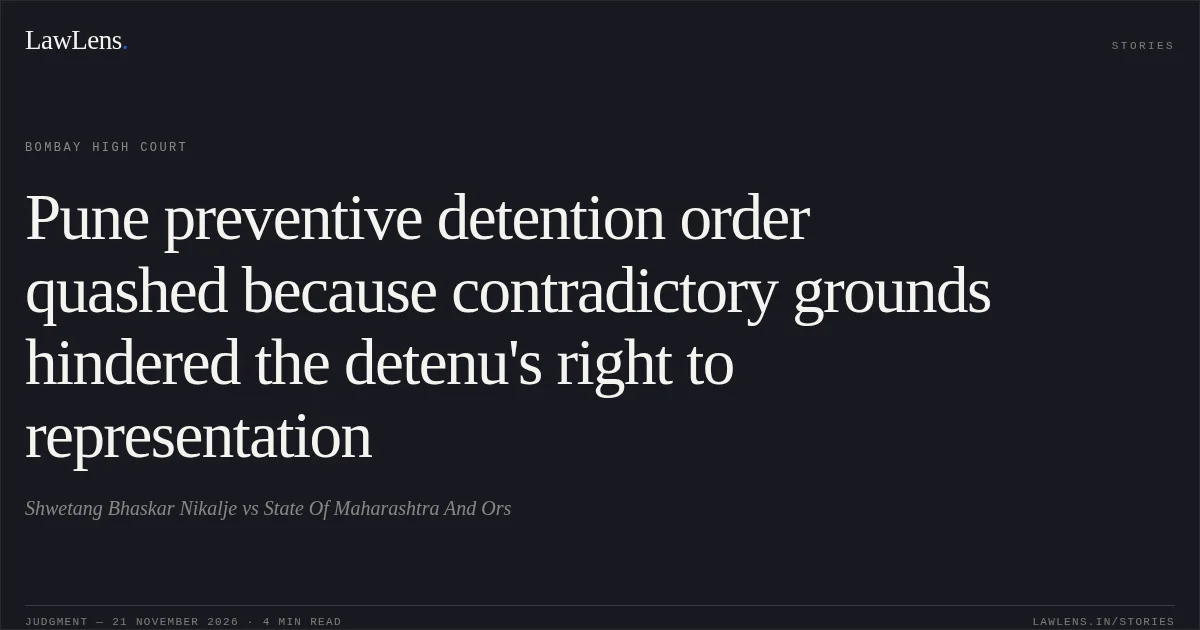
The Petitioner challenged a detention order dated 4 February 2026 passed by the Commissioner of Police, Pune (Respondent No. 2) under the Maharashtra Prevention of Dangerous Activities Act, 1981 ("MPDA Act"), together with a committal order of the same date, under which he was detained in Bhandara District Prison.
¶ 1Among the multiple grounds raised, counsel restricted the challenge to one: that the Grounds of Detention were internally contradictory as to the material on which the Detaining Authority based its satisfaction.
¶ 3The Grounds of Detention describe the Petitioner as a "weapon-wielding, dangerous recidivist" and a "dangerous person" under Section 2(b-1) of the MPDA Act.
¶ 5The Grounds of Detention list three past offences (16 April 2018 to 25 May 2025) and three preventive actions (Chapter Cases of 2015, 2021 and 2023), an externment order and a bond.
¶ 6 · ¶ 6 (p.4–5)The Grounds of Detention rely on C.R. No. 205 of 2025 (Faraskhana PS, registered 7 November 2025) and C.R. No. 507 of 2025 (Bharti Vidyapeeth PS, registered 15 November 2025), along with in-camera statements of witnesses 'A' and 'B'.
¶ 5 · ¶ 6 · ¶ 7–11In C.R. No. 205 of 2025 the Petitioner was arrested on 17 December 2025 and granted bail on 3 January 2026; the chargesheet has been filed and the trial is pending.
¶ 7The alleged incidents occurred on 3 and 5 November 2025.
¶ 8 · ¶ 10 · ¶ 11The Respondent-State's APP contended that the Detaining Authority relied only on paragraphs 5 and 6, and that the references to past offences were merely background.
¶ 4The Detaining Authority's para. 8 records reliance only on paras. 5.1, 5.2, 6.1 and 6.2.
¶ 1202Issues
i.1. Whether the Grounds of Detention are contradictory as to whether the subjective satisfaction rests on past offences and preventive actions (paras. 2–3) or only on the recent offences and in-camera statements (paras. 5–6, 8), such that the basis of the detention is unclear.
¶ 13 · ¶ 16ii.2. Whether such confusion prejudices the Petitioner's right to make an effective representation under Article 22(5) of the Constitution, and whether the Detaining Authority's reliance on stale or past instances vitiates the order.
¶ 1603Law Applied
The Court applied the definitions in Section 2(b-1) of the MPDA Act, which defines a "dangerous person" as one who habitually commits, attempts, or abets offences under Chapter XVI or XVII of the IPC or Chapter V of the Arms Act, 1959.
¶ 14The Court applied Section 2(a)(iv), which requires that a dangerous person's activities affect, or are likely to affect, adversely the maintenance of public order.
¶ 14Both ingredients must be satisfied before a person can be termed dangerous.
¶ 15The right to representation under Article 22(5) includes the right to a complete, effective and meaningful representation; preventive detention is a summary action without trial, so the facts and material forming the subjective satisfaction must be clear, present, and not stale, and must not rest on acts that the ordinary law can effectively address.
¶ 16Provisions in the judgment · 9 · Linked ones open on LawLens
Bharatiya Nyaya Sanhita, 2023 Section 352Section 351Section 3Section 140Section 127
Arms Act, 1959 Section 4Section 3Section 25
Code of Criminal Procedure, 1973 Section 110
04Reasoning
The Court read paragraphs 2, 3 and 8 of the Grounds together.
¶ 13Paragraph 2 concludes that the Petitioner is a dangerous person on the basis of his history, and paragraph 3 sets out past offences and preventive actions, indicating that the Detaining Authority addressed the Section 2(b-1) and 2(a)(iv) ingredients there.
¶ 13 · ¶ 15Paragraph 8, however, states that reliance was placed only on paragraphs 5.1, 5.2, 6.1 and 6.2.
¶ 12 · ¶ 15The Court found that the Detaining Authority had in substance relied on past instances while declaring that it relied only on recent ones, so it was unclear on what material the subjective satisfaction was reached.
¶ 16Because the Detenu could not identify the basis of the detention with clarity, the Court held that his right to make an effective representation was prejudiced.
¶ 16The Court emphasised that the satisfaction must rest on present material, and not on stale grounds or on conduct that the ordinary criminal law can address, a concern that bears on the reliance on 2018–2025 offences and 2015–2023 preventive actions.
¶ 16The Court did not decide the merits of whether the Petitioner is a dangerous person.
05Holding
The contradictory Grounds of Detention, which left unclear whether the satisfaction rested on past offences and preventive actions or only on paras. 5 and 6, deprived the Petitioner of an effective representation under Article 22(5), and the Detention Order therefore cannot be sustained.
¶ 16The Rule was made absolute in terms of prayer clause (a) for quashing the Detention Order dated 4 February 2026 (D.O. No. CRIME/PCB/DET/FARASKHANA/NIKALJE/106/2026).
¶ 17(i)The Court directed that the Petitioner be released forthwith, if not required in any other case, and disposed of the Petition.
¶ 17(ii) · ¶ 17(iii)Original Court PDF
Shwetang Bhaskar NikaljevsState Of Maharashtra And Ors
Click to open original judgment
Original judgment, available to read, download and summarize on LawLens.in