01Facts
On 15.09.2015, the deceased, a 22-year-old diploma holder in civil engineering, was riding his motorbike (KA-15-J-8816) from Ankaravalli towards Sagar when an Ambika bus (KA-20-C-6197) coming from the opposite direction collided with it near Bandige village on Sagar Road. He sustained grievous injuries and died.
¶ 2The deceased was allegedly working in a private construction company and earning Rs.18,000 per month, as shown by a salary certificate marked Ex-P21.
¶ 3, 6The Motor Accident Claims Tribunal (Additional MACT-XIII, Soraba, MVC No. 81/2017) awarded Rs.29,86,000 with 6% interest, including Rs.29,16,000 for loss of dependency.
¶ 3, 9The insurer appealed. Its grounds were that (a) the income was unproved because the employer was not examined, (b) a 50% future prospects addition was wrong and 40% should apply, and (c) the deceased held no driving licence.
¶ 5The claimant contended that Ex-P21 proved income and that the absence of a licence was no ground to deny relief.
¶ 6The judgment records the claim petition as filed by the deceased's father.
¶ 3Respondent No.1 is described as the widow of late Nazeer Sab.
The discrepancy between the claim petition's filing by the deceased's father and the description of Respondent No.1 as the widow is not addressed in the judgment.
02Issues
i.1. Whether the Tribunal erred in adopting a monthly income of Rs.18,000 based solely on the salary certificate (Ex-P21), where the employer was not examined.
¶ 5, 7ii.2. Whether the Tribunal erred in adding 50% towards future prospects, and whether 40% was the correct addition for a deceased not employed in a recognised/permanent sector.
¶ 5, 8iii.3. Whether the deceased's lack of a driving licence warranted a finding of contributory negligence and a corresponding reduction in the insurer's liability.
¶ 5, 7, 803Law Applied
Section 173(1) of the Motor Vehicles Act, 1988, under which the appeal was filed.
¶ 1A document such as a salary certificate must be substantiated, and the employer's examination is material where it is not produced.
¶ 5, 7The Supreme Court's decision in National Insurance Co. Ltd. v. Pranay Sethi holds that future prospects are to be added at a percentage tied to the nature of employment, here 40% for a deceased not working in a recognised sector.
¶ 8The absence of a driving licence is a crucial factor for the Tribunal in apportioning and fixing liability, and 30% contributory negligence is appropriate.
¶ 7, 8The multiplier-based computation (annual income × multiplier, with future prospects and a personal-expenses deduction of 50%) as reflected in the court's formula.
¶ 8Provisions in the judgment · 1 · Linked ones open on LawLens
Motor Vehicles Act, 1988 Section 173
04Reasoning
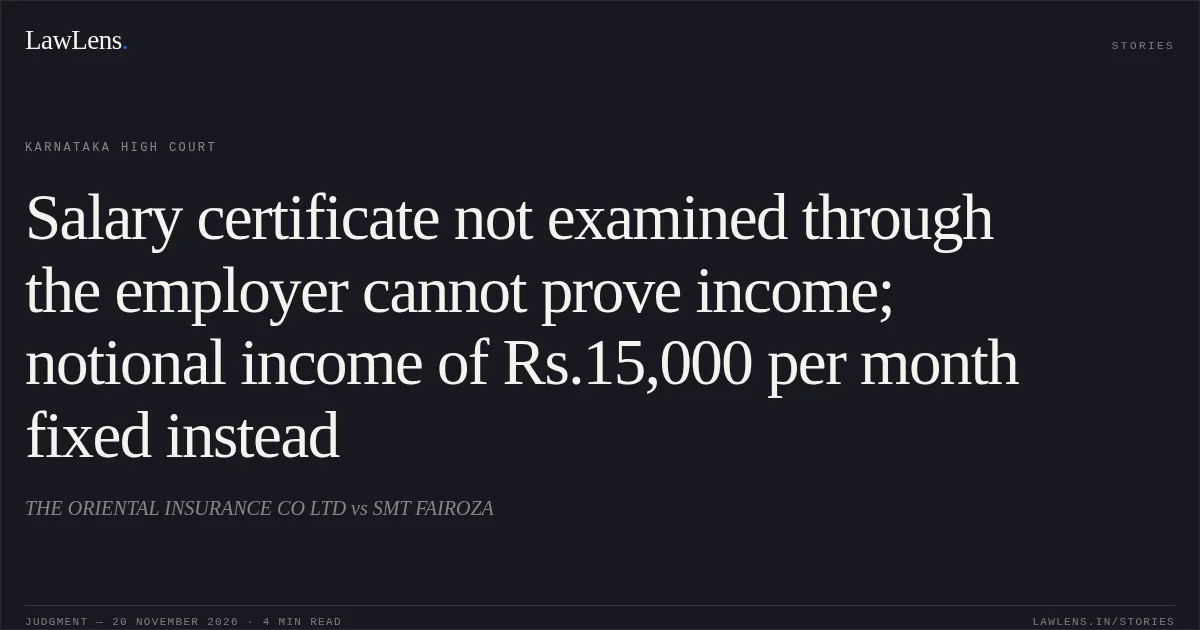
Ex-P21 showed the deceased was a consultant drawing Rs.18,000 per month, but the employer was not examined to prove it. The court therefore reduced the notional income to Rs.15,000 per month, taking into account the deceased's diploma in civil engineering.
¶ 7Because the deceased had no driving licence, the court held the Tribunal had failed to fix liability correctly and that the insurer's liability could not be fixed entirely on it. It assigned 30% contributory negligence to the deceased.
¶ 7, 8Since the deceased was not employed in a recognised sector, the court applied 40% future prospects under Pranay Sethi in place of the Tribunal's 50%.
¶ 8Applying the formula at para. 8 (Rs.15,000 × 12 + 40%, less 50%, × multiplier of 18), the court arrived at Rs.22,68,000 for loss of dependency, against the Tribunal's Rs.29,16,000.
¶ 8, 9The court did not apply the 30% contributory negligence reduction to the loss-of-dependency figure. The tabulated total therefore appears to reflect no deduction for contributory negligence, despite the finding at para. 8. This inconsistency is not explained in the judgment.
¶ 8, 9The court retained the Tribunal's awards for loss of estate (Rs.15,000), consortium (Rs.40,000) and funeral expenses (Rs.15,000).
¶ 9The judgment does not address the 6% interest awarded by the Tribunal.
05Holding
The Tribunal erred in relying on an unproved income of Rs.18,000 and in applying 50% future prospects, and the absence of a driving licence required a finding of 30% contributory negligence.
¶ 7, 8The court re-determined compensation at Rs.23,38,000 (Rs.22,68,000 for loss of dependency, Rs.15,000 for loss of estate, Rs.40,000 for consortium and Rs.15,000 for funeral expenses), against Rs.29,86,000 awarded by the Tribunal.
¶ 9The appeal was allowed in part and the award was modified accordingly.
¶ 10(i)–(ii)The Insurance Company was directed to deposit 70% of the compensation within eight weeks of receipt of the certified copy.
¶ 10(iii)The Registry was directed to communicate the order to the Tribunal and transmit the records, and any excess deposit is to be refunded to the appellant.
¶ 10(iv)–(v)Original Court PDF
THE ORIENTAL INSURANCE CO LTDvsSMT FAIROZA
Click to open original judgment
Original judgment, available to read, download and summarize on LawLens.in