01Facts
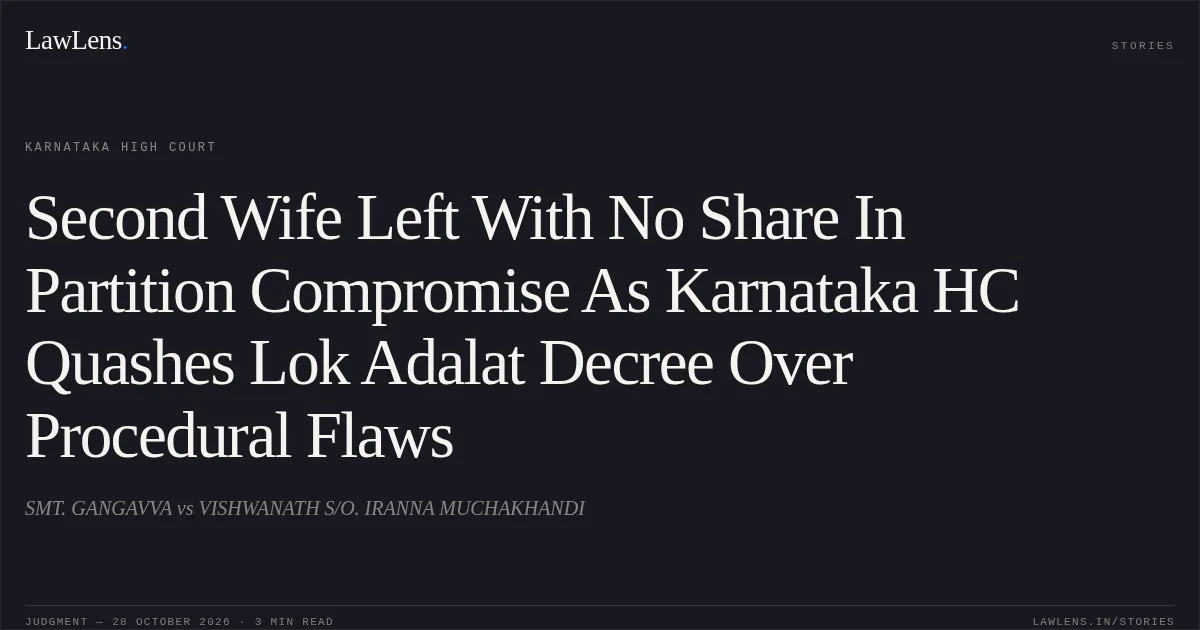
Respondent No. 1 filed a partition suit concerning six properties formerly belonging to Iranna, arraying the petitioner, the children of her husband’s first marriage, and her husband’s two sisters as defendants.
pp. 2–4Before summons were issued, the matter was advanced; counsel appeared for all defendants and a compromise petition was filed.
pp. 2–4The trial court recorded that it had read the terms to the parties, accepted the compromise, and referred the matter to the Lok Adalat, which passed a compromise decree on 11 July 2026.
pp. 2–4, 7–9The petitioner challenged the decree, asserting that she had not understood or agreed to the terms, which relinquished her entire share, and that the compromise and Lok Adalat procedure were legally defective.
pp. 4–6The compromise petition contained six pages, but the parties signed only the final page; the Lok Adalat order sheet bore the Judicial Conciliator’s signature but not the Advocate Conciliator’s.
p. 9, 1902Issues
i.1. Whether the compromise decree was liable to be set aside for non-compliance with statutory requirements.
p. 7ii.2. Whether the parties were legally required to sign every page of the compromise petition.
p. 703Law Applied
Section 89 CPC requires the court to identify a suitable ADR process and, where Lok Adalat is chosen, to refer the matter in accordance with Section 20(1) of the Legal Services Authorities Act, 1987; the Act’s Sections 19–21 govern Lok Adalat proceedings and awards.
pp. 9–11Under Afcons Infrastructure Ltd. v. Cherian Varkey Construction Co. (P) Ltd., the court must follow the prescribed referral process and, if a settlement results, examine it with Order XXIII Rule 3 CPC in mind.
pp. 11–13Order XXIII Rule 3 requires a lawful written compromise signed by the parties and judicial scrutiny of its terms.
p. 14Regulation 17 of the National Legal Services Authority (Lok-Adalats) Regulations, 2009 requires the parties’ signatures or thumb impressions and the Lok Adalat members’ countersignatures for an award.
p. 18Although the law does not require signatures on every page of a compromise petition, signing each page is a prudent safeguard against allegations of alteration or lack of assent.
pp. 19–20, 24Provisions in the judgment · 7 · Linked ones open on LawLens
Code of Civil Procedure, 1908 Section 11Section 89
Legal Services Authorities Act, 1987 Section 19Section 20Section 21
Arbitration and Conciliation Act, 1996 Section 64Section 74
04Reasoning
The trial court treated the petition as one under Section 89 CPC, but it had already read and accepted the compromise before referring the matter to the Lok Adalat merely for formal acceptance.
pp. 8–13The court had not followed the Section 89 referral procedure, including the required stage and consideration of ADR options; this also created uncertainty about whether the compromise was being recorded under Section 89 or Order XXIII Rule 3.
pp. 8–13, 16Further, the Lok Adalat record did not bear the Advocate Conciliator’s signature, contrary to the applicable requirements, and the same order sheet was used for both the trial court and Lok Adalat proceedings.
pp. 9, 17–18Although signing every page is not a legal precondition, the petitioner alleged that she had not understood the compromise; the clause relinquishing her entire share appeared on a page she had not signed, and the record did not specifically establish that the terms had been explained to her in a language she understood.
pp. 20–24Given the complete relinquishment of her property entitlement, the court found that this allegation could not be dismissed and that the compromise had not been adequately scrutinised.
pp. 20–2405Holding
The High Court answered the issues in favour of the petitioner.
pp. 24–25It allowed the writ petition, quashed the compromise decree dated 11 July 2026 in O.S. No. 348/2026, and remitted the matter to the trial court for disposal in accordance with law.
pp. 24–25The parties remained free to enter into a fresh settlement if they chose.
pp. 24–25Original Court PDF
SMT. GANGAVVAvsVISHWANATH S/O. IRANNA MUCHAKHANDI
Click to open original judgment
Original judgment, available to read, download and summarize on LawLens.in