01Facts
The appellant sought information under the Right to Information Act, 2005
p. 2The information was not furnished
pp. 2–3Instead of pursuing the statutory appellate remedies under the Act, she submitted a representation to the police authorities seeking permission to go on a hunger strike at the entrance of the Tiruppur District Collectorate from 19.5.2025 until the information was provided
p. 2 · p. 4The representation was not considered, and she filed W.P. No. 17478 of 2025
p. 2The learned Single Judge initially made an observation but ultimately dismissed the writ petition by order dated 11.6.2025
p. 2The appellant filed this intra-Court appeal under Clause 15 of the Letters Patent, contending that the dismissal was erroneous
p. 2The respondents were the State (through the Commissioner of Police, Superintendent of Police and Inspector of Police, Veerapandi) and the Dharapuram Municipality
pp. 1–202Issues
i.1. Whether a person whose RTI application remains unanswered may bypass the statutory appellate remedies under the RTI Act and seek police permission to stage a hunger strike at a District Collectorate to compel disclosure
pp. 3–4ii.2. Whether the right to peaceful protest under Article 19(1)(a) and (b) of the Constitution extends to an indefinite hunger strike at the entrance of a public office
pp. 4–5iii.3. Whether the order of the learned Single Judge dismissing W.P. No. 17478 of 2025 warrants interference in appeal
p. 503Law Applied
The Court relied on the RTI Act, 2005, treating it as a special statute providing a "complete and efficacious statutory mechanism" for redressal of grievances over non-disclosure, under which a first appeal lies to the appellate authority and a second appeal lies to the competent authority
pp. 3–4 · p. 5The judgment does not specify the relevant sections. It relied on Article 19(1)(a) and (b) of the Constitution, recognising peaceful protest as a facet of those freedoms, but holding that the right is subject to reasonable restrictions and confers no unfettered right to an indefinite hunger strike, particularly at the entrance of a public office where it obstructs public access and administrative functioning
pp. 4–5The Court also applied the principle that a special statutory remedy cannot be bypassed to exert pressure on public authorities through coercive methods
p. 5No precedents were cited
Jurisdiction was invoked under Clause 15 of the Letters Patent
p. 104Reasoning
The Court first noted that the appellant chose to invoke the RTI Act but, upon non-disclosure, did not exhaust the first and second appeal remedies the Act provides. Instead, she sought police permission for a hunger strike, which the Court treated as an attempt to coerce public authorities outside the statutory scheme. Because the RTI Act itself supplied an efficacious remedy for the very grievance, the Court held that non-disclosure did not give the appellant a justified basis to seek permission for a protest
pp. 3–4 · p. 4On the constitutional question, the Court accepted that peaceful protest is protected under Article 19(1)(a) and (b) but held that this protection is qualified. An indefinite hunger strike at the entrance of a District Collectorate, which impedes public access and administrative work, falls outside what the right protects, and the Court found that bypassing a complete statutory mechanism to pressure officials could not be countenanced
pp. 4–5 · p. 5Having rejected both the appellant's grounds, the Court found no error in the Single Judge's reasoning
p. 505Holding
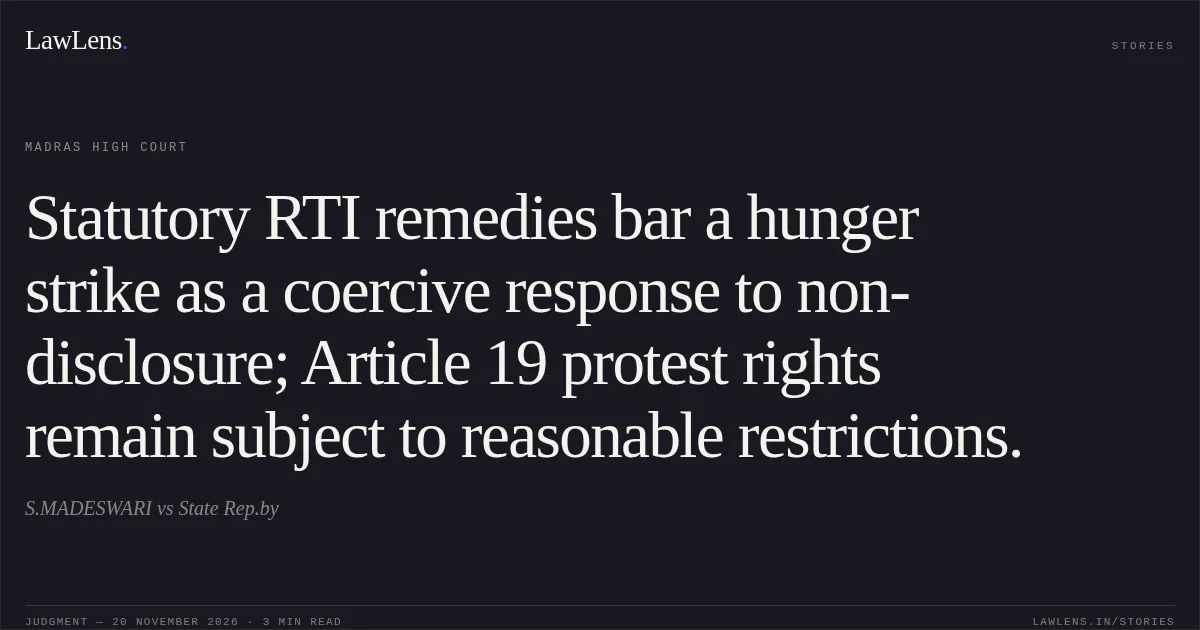
The Court answered the first and second issues against the appellant. A person denied RTI information must pursue the remedies under the RTI Act rather than seek permission for an indefinite hunger strike at a public office, and Article 19(1)(a) and (b) does not extend to such a protest
pp. 4–5On the third issue, the Court held there was no error or infirmity in the Single Judge's order dated 11.6.2025
p. 5The writ appeal was dismissed without costs, and the connected miscellaneous petition was closed
p. 5Original Court PDF
S.MADESWARIvsState Rep.by
Click to open original judgment
Original judgment, available to read, download and summarize on LawLens.in