01Facts
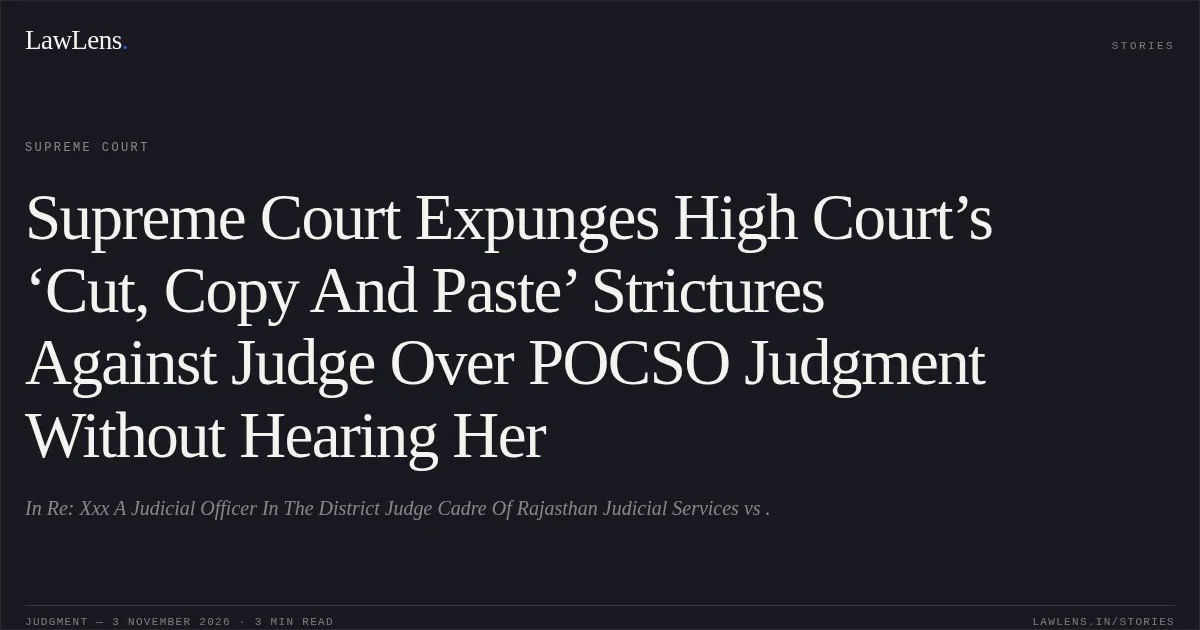
The appellant, a District Judge in the Rajasthan Judicial Services, conducted separate trials arising from the same FIR against an adult accused and a child in conflict with law, as required by Section 23 of the Juvenile Justice (Care and Protection of Children) Act, 2015.
¶ 7–11In judgments delivered on the same day, overlapping extracts of evidence and numerical details were inadvertently included in the judgment concerning the child.
¶ 7–11On the child’s suspension-of-sentence application, the High Court criticised the appellant for allegedly using a “cut, copy and paste” method, recorded adverse remarks, and directed that the order be placed in her ACR and that she receive training in judgment writing.
¶ 12–13The appellant appealed seeking expungement of those remarks and directions.
¶ 1402Issues
i.1. Whether the High Court could record adverse remarks and strictures against the appellant-Judicial Officer on the judicial side without first giving her an opportunity to explain the circumstances.
¶ 16, 24ii.2. Whether the adverse remarks and related directions concerning training and placement of the High Court’s order in the appellant’s ACR should be expunged.
¶ 20–2603Law Applied
Article 227 of the Constitution vests High Courts with supervisory jurisdiction over subordinate courts, which should be exercised to guide and strengthen the district judiciary.
¶ 5, 20The principles of natural justice, particularly audi alteram partem, require that a Judicial Officer be given an opportunity to explain before adverse remarks concerning their conduct are recorded.
¶ 16, 24Relying on Kaushal Singh v. State of Rajasthan, In Re: ‘K’, A Judicial Officer, and Sonu Agnihotri v. Chandra Shekhar, the Court reiterated that criticism of a judicial order must be distinguished from adverse comments on a Judicial Officer’s personal conduct or calibre, and that concerns about an officer’s conduct may be addressed on the administrative side after the officer has an opportunity to respond.
¶ 22Shuvendu Saha v. State of West Bengal supports the use of a remark slip for concerns about a judgment or proceedings, for consideration by the administrative Judge or Chief Justice.
¶ 25Provisions in the judgment · 5 · Linked ones open on LawLens
Protection of Children from Sexual Offences Act, 2012 Section 3Section 4
Juvenile Justice (Care and Protection of Children) Act, 2015. Section 15Section 18Section 23
04Reasoning
The Supreme Court considered the appellant’s explanation that the trials involved substantially overlapping witnesses and evidence, that the Special Court had limited resources, and that the sole stenographer’s leave required part of the judgment to be dictated to a clerk; the resulting errors were described as bona fide and did not affect the judgment’s substance or outcome.
¶ 17–19The Court held that, even if an error had occurred, the High Court should not have characterised it as dereliction of duty or made adverse remarks without first hearing the appellant.
¶ 20–25The remarks and directions also risked serious career consequences and were inconsistent with the High Court’s role as guardian of the district judiciary.
¶ 20–2505Holding
The Court held that the adverse remarks in paragraphs 9–11 of the High Court’s order and the directions in paragraphs 17–18 concerning training and placement of the order in the appellant’s ACR were unsustainable.
¶ 26–28It expunged and set aside those remarks and directions, allowed the appeal, and directed that a copy of its order be sent to the Registrar General of the Rajasthan High Court for placement before the Chief Justice.
¶ 26–28Original Court PDF
In Re: Xxx A Judicial Officer In The District Judge Cadre Of Rajasthan Judicial Servicesvs.
Click to open original judgment
Original judgment, available to read, download and summarize on LawLens.in