01Facts
SEBI treated PACL's investment schemes as an unregistered Collective Investment Scheme and, in 1999, directed PACL to register or wind up.
¶ 2–3The Rajasthan High Court quashed the notices, but the Supreme Court set aside that judgment on 26.02.2013 and remanded for de novo adjudication, treating the 1999 notices as show-cause notices.
¶ 3SEBI held PACL was running an unregistered CIS and directed refund of investor monies and winding up; the Securities Appellate Tribunal upheld this.
¶ 4On 02.02.2016 the Court constituted the Justice (Retd.) R.M. Lodha Committee to liquidate land assets and refund investors.
¶ 5The Committee examined records for 2,032 units at Sectors 100 and 104, Mohali, and 1,078 units at Bathinda, many sold before 02.02.2016.
¶ 7Following Court directions and an auditor-assisted verification, the Committee filed a report on 19.04.2025 classifying claimants into five categories, which the Amici Note followed.
¶ 8–10The Court accepted the Committee's categorisation of allottees on the basis of bank records.
¶ 12Category III claimants sought to pay balances at market or circle rates, or to receive refunds with interest.
¶ 21Category IV claimants, who paid in cash or after the freezing date, challenged the no-refund recommendation and sought adjudication or civil remedies.
¶ 25, 29The Court had earlier, by order dated 02.05.2016, restrained civil courts and authorities from entertaining proceedings against the Committee and SEBI.
¶ 2702Issues
i.1. Whether the Committee's five-fold categorisation of allottees, based on mode and timing of payment, is appropriate.
¶ 12ii.2. Whether Category I allottees (full payment through banking channels) are entitled to sale deeds/NOCs and possession certificates.
¶ 14–15iii.3. Whether Category II allottees (more than 50% paid through banking channels) may be treated as sold upon payment of the balance and internal development charges, with default consequences.
¶ 16–18iv.4. Whether Category III allottees (less than 50% paid through banking channels) should be given further payment opportunities at market rates, or refunded with interest.
¶ 20–24v.5. Whether Category IV allottees (cash payments, or post-02.02.2016 payments) are entitled to allotment or refund, or may pursue civil remedies.
¶ 25–31vi.6. Whether Category V allottees (who sold their allotments during pendency) should be treated according to their original category.
¶ 33–34vii.7. Whether the further IAs claiming Category I status should be adjudicated.
¶ 35–3603Law Applied
The Court's power to dispose of the matter rests on its extraordinary jurisdiction, assumed in 2016.
¶ 22Recovery and sale-certificate directions are issued through the Recovery Officer under Section 28A of the SEBI Act, 1992.
¶ 15The governing regulatory background is the SEBI (Collective Investment Schemes) Regulations, 1999, under which PACL's schemes were held to be an unregistered CIS.
¶ 2–3The Court's principle of restitution is that monies paid should be returned with reasonable interest, and that proceedings should not become suits for specific performance or public-law restitution.
¶ 22–23The order of 02.05.2016 bars civil courts and authorities from entertaining proceedings against the Committee, its members, and SEBI, but does not bar suits against PACL itself.
¶ 27–28Provisions in the judgment · 1
Securities and Exchange Board of India Act, 1992 Section 28A
04Reasoning
The Court accepted the Committee's categorisation on the strength of bank records verified by chartered accountants.
¶ 12It treated Category I as sold and directed sale certificates and possession certificates within eight weeks.
¶ 14–15For Category II, it adopted a pay-to-complete model: the balance and development charges are to be paid within 30 days, after which sale or NOC issues, with default leading to refund under the Category III mechanism.
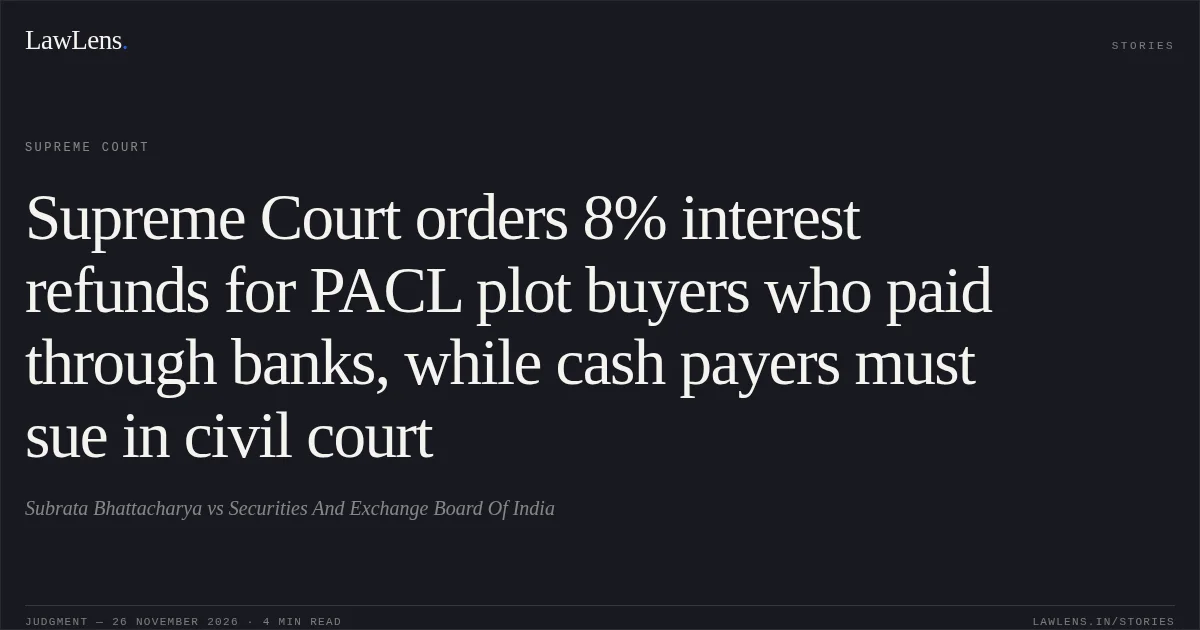
¶ 17–18For Category III, the Court rejected the Amici's options of further payment at market rates and the Committee's no-interest refund, and chose a refund with 8% interest payable within three months of a successful auction. Its reasons were the long delay since 2016, the risk of prolonged title disputes, and the need to avoid leaving the respondents without recovery.
¶ 22–24Category IV cash payments could not be verified in the proceedings, so the Court rejected the IAs for allotment or refund. It preserved the right to sue in the civil court for recovery or declaration, reconciling this with the 2016 bar by limiting it to statutory and monitoring entities.
¶ 26, 28, 30Category IV post-freezing banking payments were placed on the same footing as Category III.
¶ 31–32Category V claimants were assigned the treatment of their original category.
¶ 3405Holding
The Court held the Committee's five-category classification appropriate.
¶ 12Category I: The Recovery Officer under Section 28A of the SEBI Act is to issue sale/NOC certificates and possession certificates within eight weeks.
¶ 15Category II: The Committee is to issue balance statements within eight weeks; allottees are to pay within 30 days through banking channels; sale/NOC certificates follow within eight weeks; defaulting plots are to be treated as unsold and refunded as in Category III.
¶ 18Category III: The Committee is to refund the audited amount with 8% interest within three months of a successful auction, which fully satisfies the claim.
¶ 24Category IV (cash): The IAs for allotment or refund are rejected; claimants may file civil suits for recovery or declaration, and the matter is listed for hearing the Amici and SEBI and for clarification of para. 13 of the 02.02.2016 order.
¶ 30Category IV (post-02.02.2016 banking payments) and Category II post-freeze payers: Refund with 8% interest within three months of auction, in full satisfaction of the claim.
¶ 31–32Category V: Claims are to be decided under the category the allottee would have belonged to but for the sale.
¶ 34Other IAs: The Committee is to verify the Category I claims, subject to SEBI's objections, and pass appropriate orders.
¶ 36Original Court PDF
Subrata BhattacharyavsSecurities And Exchange Board Of India
Click to open original judgment
Original judgment, available to read, download and summarize on LawLens.in