01Facts
The informant lodged an FIR alleging that the applicant committed a wrongful act with his minor daughter.
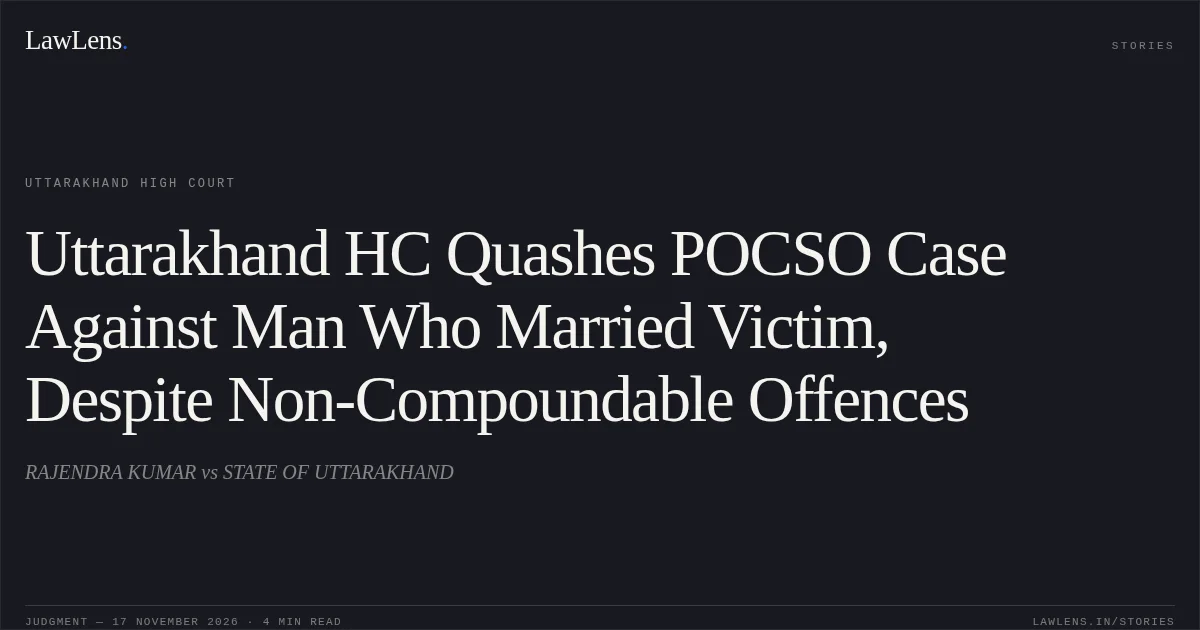
¶ 4Following investigation, a chargesheet was filed. The case is registered as Case Crime No. 02 of 2025 at P.S. Thana Munsyari, District Pithoragarh, and is pending as Special Session Trial No. 37 of 2025 for offences under Section 64 of the B.N.S.S. (as stated in the judgment) and Sections 3/4 of the POCSO Act, 2012.
¶ 4The applicant contends that the parties were in a love relationship, that the physical relationship was consensual, and that the victim's statement under Section 183 B.N.S.S. supports this.
¶ 5-6The victim's date of birth is recorded as 18.07.2007, which, read with the alleged offences, indicates she was a minor at the time of the alleged conduct (this is an inference from the stated date of birth, not an express finding).
¶ 7The parties solemnized their marriage on 12.10.2026 under Hindu rites, and the marriage was registered under the Uniform Civil Code. They now live together as husband and wife.
¶ 7The applicant and respondent nos. 2 and 3 filed a joint compounding application (I.A. No. 1 of 2026), supported by affidavits, stating that the dispute is settled and that the complainant does not intend to prosecute.
¶ 8Through video conferencing, the victim confirmed the settlement, the marriage, and her unwillingness to pursue the proceedings.
¶ 9The State opposed the application, arguing that the offences are serious and non-compoundable under the POCSO Act, but did not dispute the marriage or the compounding application.
¶ 1002Issues
i.1. Whether the High Court may exercise its inherent powers under Section 528 B.N.S.S. to quash criminal proceedings in respect of non-compoundable offences, including those under the POCSO Act, on the basis of a compromise and subsequent marriage between the accused and the victim.
¶ 10, 13ii.2. Whether continuation of the criminal proceedings would serve any fruitful purpose or amount to an abuse of the process of the court, given that the parties are married, cohabiting, and the victim does not wish to pursue the case.
¶ 12, 15-1603Law Applied
Section 528 B.N.S.S., the corresponding provision to Section 482 Cr.P.C., preserves the High Court's inherent power to prevent abuse of the process of any court or to secure the ends of justice. The judgment refers to this provision as "582 B.N.S.S." at para. 13, which appears to be a typographical error.
¶ 13This power may extend to quashing proceedings for non-compoundable offences where the dispute is essentially personal and continuation would amount to abuse of process.
¶ 13Gian Singh v. State of Punjab, (2012) 10 SCC 303, permits quashing where the dispute is predominantly personal or matrimonial and has been amicably resolved, provided quashing secures the ends of justice.
¶ 14Narinder Singh v. State of Punjab, (2014) 6 SCC 466, requires the court to assess whether continuation would be futile and would not serve the ends of justice. Parbatbhai Aahir v. State of Gujarat, (2017) 9 SCC 641, affirms the wide amplitude of inherent power to prevent abuse of process or secure justice, having regard to the nature of the offence and the circumstances.
¶ 14Provisions in the judgment · 6 · Linked ones open on LawLens
Bharatiya Nagarik Suraksha Sanhita, 2023 Section 64Section 183Section 528
Protection of Children from Sexual Offences Act, 2012 Section 3Section 4
Code of Criminal Procedure, 1973 Section 482
04Reasoning
The Court accepted that the offences were non-compoundable but held that this did not bar relief.
¶ 13The Court treated the dispute as arising from a personal relationship between the applicant and the respondents. It found the compromise voluntary, genuine, and free from coercion or undue influence, based on the physical presence of the complainant and victim before the Court and their categorical statements.
¶ 12The Court noted that the parties had solemnized a marriage after attaining majority, that they were cohabiting, and that the State did not dispute the marriage or the compromise. On these facts, it held that continuing the prosecution would serve no fruitful purpose and would harm the parties' matrimonial life.
¶ 10, 12, 15Applying the principles in Gian Singh, Narinder Singh, and Parbatbhai Aahir, the Court concluded that quashing secured the ends of justice and prevented abuse of process. The judgment does not expressly address the child-victim status at the time of the offence, the weight of the victim's Section 183 B.N.S.S. statement, or the POCSO Act's compoundability bar and statutory protections for child victims.
¶ 14, 1605Holding
This is a fit case for exercising inherent powers under Section 528 B.N.S.S. to secure the ends of justice and prevent abuse of process, despite the non-compoundable nature of the offences.
¶ 13, 16The Court allowed the compounding application (I.A. No. 1 of 2026) and quashed the entire proceedings of Special Session Trial No. 37 of 2025 (Case Crime No. 02 of 2025, P.S. Thana Munsyari, District Pithoragarh) pending before the Special Sessions Judge, Pithoragarh, and allowed the C-528 application.
¶ 17-19Pending applications, if any, were disposed of.
¶ 20Original Court PDF
RAJENDRA KUMARvsSTATE OF UTTARAKHAND
Click to open original judgment
Original judgment, available to read, download and summarize on LawLens.in