01Facts
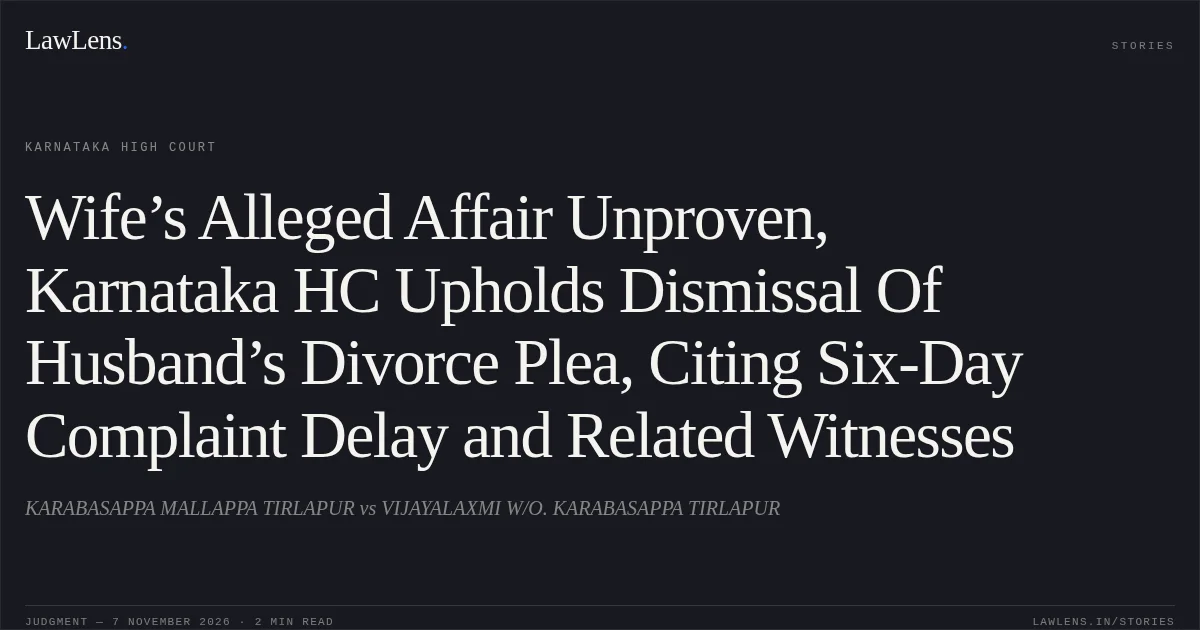
The husband appealed the Family Court’s dismissal of his petition for divorce, which alleged cruelty and adultery by the wife.
pp. 2–4He claimed that she had an affair with Musthakali and that he and two relatives caught them together on 22 May 2018.
pp. 2–4The wife denied the allegations and contended that the husband and his family had subjected her to cruelty.
pp. 2–4The Family Court dismissed the petition, finding the adultery allegation not maintainable because the alleged adulterer had not been joined and concluding that the husband had not proved his allegations.
pp. 2–4The wife did not appear in the appeal despite service of notice.
p. 502Issues
i.Whether the Family Court’s dismissal of the divorce petition warranted interference on the grounds of adultery and cruelty
p. 5 · ¶ 8 · pp. 6–11 · ¶ 11–19ii.Whether the adultery claim was not maintainable because the alleged adulterer had not been joined as a party
pp. 6–7 · ¶ 1203Law Applied
Section 13(1)(i) of the Hindu Marriage Act, 1955 provides adultery as a ground for divorce; Section 13(1)(ia) provides cruelty as a ground.
An alleged adulterer is a proper, but not necessary, party to proceedings under Section 13(1)(i), as stated in Arunkumar Agarwal v. Radha Arun and reiterated in N. Vijaykumar v. Latha @ Sangeetha.
pp. 6–7 · ¶ 12Under Section 112 of the Indian Evidence Act, 1872, a child born during a valid marriage is presumed legitimate; the husband must establish non-access to rebut that presumption.
p. 10 · ¶ 18The Court also referred to Chennigaiah v. Smt. Lakkamma @ Laxmamma and V. Anandappa v. V. Shivaraju.
p. 4, 10 · ¶ 5, 18Provisions in the judgment · 6 · Linked ones open on LawLens
Family Courts Act, 1984 Section 19
Hindu Marriage Act, 1955 Section 13
Indian Penal Code, 1860 Section 392Section 497Section 114Section 34
04Reasoning
The High Court held that the Family Court erred in treating non-joinder of the alleged adulterer as making the petition not maintainable, since he was only a proper party.
pp. 6–7 · ¶ 12However, the adultery allegation was not proved: the husband had not witnessed the incident, the complaint was lodged six days later, and the alleged eyewitnesses were his relatives.
pp. 8–10 · ¶ 14–16The criminal case arising from the complaint had ended in acquittals.
pp. 8–10 · ¶ 14–16The wife’s pregnancy and the husband’s unsupported assertion that the child resulted from adultery did not rebut the presumption of legitimacy under Section 112; the husband failed to establish non-access.
pp. 10–11 · ¶ 18The evidence also did not substantiate the pleaded cruelty.
p. 11 · ¶ 1905Holding
The Court answered the question of interference in the negative and dismissed the appeal.
p. 11 · ¶ 19 · p. 12, orderIt confirmed the Family Court’s judgment dated 21 June 2019 dismissing the divorce petition and made no order as to costs.
p. 11 · ¶ 19 · p. 12, orderOriginal Court PDF
KARABASAPPA MALLAPPA TIRLAPURvsVIJAYALAXMI W/O. KARABASAPPA TIRLAPUR
Click to open original judgment
Original judgment, available to read, download and summarize on LawLens.in