01Facts
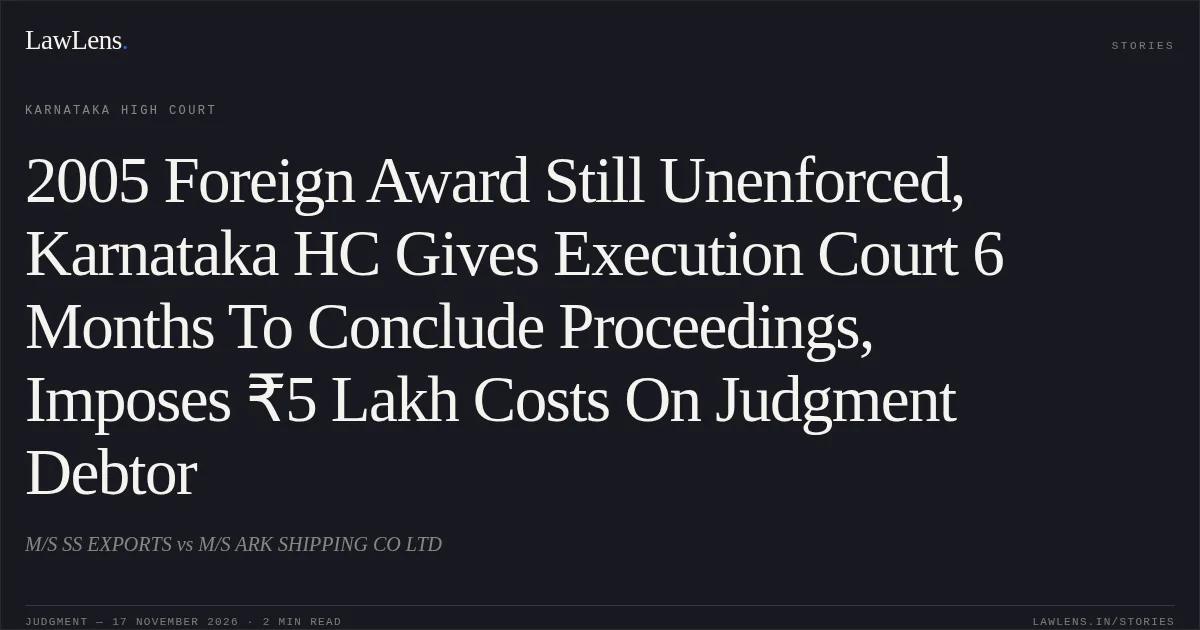
The decree-holder, a Korean company, instituted execution proceedings in Bengaluru in 2005 to enforce a foreign arbitral award through a Power of Attorney holder.
¶ 2, 7–8 · pp. 3–4, 11–14After earlier challenges to enforcement were rejected, the judgment-debtor filed I.A. No. 14 under Order III Rule 2 read with Sections 47 and 151 CPC, contending that no Board Resolution authorising the execution proceedings or the Power of Attorney had been produced.
¶ 7–8 · pp. 11–14The Executing Court dismissed the application on 1 July 2026.
¶ 7–8 · pp. 11–14The judgment-debtor challenged that order under Article 227 of the Constitution.
¶ 2, 7–8 · pp. 3–4, 11–1402Issues
i.1. Whether the alleged absence of a Board Resolution or other proof of corporate authority furnished a legally sustainable ground to terminate or stay the execution proceedings.
¶ 9 · pp. 15–18ii.2. Whether the Executing Court’s dismissal of the application warranted interference under Article 227.
¶ 11, 15 · pp. 19–21, 26–2703Law Applied
Order III Rules 1 and 2 CPC permit parties to act through recognised agents, including persons authorised by Power of Attorney; the provisions regulate representation and do not determine the decree-holder’s substantive entitlement to enforcement.
¶ 9 · pp. 15–16Section 47 CPC requires the Executing Court to determine questions between the parties relating to execution, discharge or satisfaction of the decree, but not every procedural objection to representation amounts to a challenge to enforceability.
¶ 10 · pp. 18–19Under United Bank of India v. Naresh Kumar, (1996) 6 SCC 663, a defect in corporate authorisation is not necessarily fatal and may, in appropriate circumstances, be ratified.
¶ 9 · p. 17The Court also relied on Salem Advocate Bar Association, T.N. v. Union of India, (2005) 6 SCC 334, and Vinod Seth v. Devinder Bajaj, (2010) 8 SCC 1, concerning realistic costs and discouraging frivolous or vexatious litigation.
¶ 14 · pp. 25–26Provisions in the judgment · 3 · Linked ones open on LawLens
Code of Civil Procedure, 1908 Section 47Section 151
Arbitration and Conciliation Act, 1996 Section 48
04Reasoning
The Court treated the objection as one concerning the authority of the representative, rather than the award-holder’s substantive right to enforce the award.
¶ 9–10 · pp. 15–19It held that Order III Rule 2 does not invariably require a separately authenticated Board Resolution in the form demanded by the judgment-debtor; the relevant inquiry is whether authority was conferred and can be established by legally acceptable material.
¶ 9–10 · pp. 15–19The Power of Attorney had remained on record since 2005, while the objection was raised nearly two decades later, after repeated challenges to enforcement had failed.
¶ 7–8 · pp. 12–14The Court found no demonstrated material defect that justified terminating or suspending execution, and held that any curable defect would not automatically invalidate the proceedings.
¶ 11 · pp. 19–21Given the award’s prolonged non-enforcement and the successive proceedings, the Court also considered costs appropriate.
¶ 12–14 · pp. 21–2605Holding
The High Court dismissed the writ petition, finding no ground to interfere with the Executing Court’s order.
¶ 15 · pp. 26–27It imposed costs of ₹5,00,000, payable to the award-holder within four weeks, and directed the Executing Court to prioritise the matter, avoid unnecessary adjournments, and conclude the execution proceedings within six months, strictly in accordance with law.
¶ 15 · pp. 26–27Original Court PDF
M/S SS EXPORTSvsM/S ARK SHIPPING CO LTD
Click to open original judgment
Original judgment, available to read, download and summarize on LawLens.in