01Facts
The State appealed the respondents’ acquittal of charges under Sections 302 read with 34 of the Indian Penal Code, 1860, arising from the death of Maniben after she sustained burn injuries.
¶ 1–3The prosecution alleged that, following a dispute over mangoes, two accused restrained Maniben while a third poured kerosene on her and set her alight.
¶ 1–3The prosecution case rested principally on a dying declaration recorded by an Executive Magistrate, which implicated the respondents.
¶ 18, 24The trial court acquitted them, and the High Court considered whether that acquittal should be reversed.
¶ 6–7, 1102Issues
i.Whether the dying declaration was sufficiently reliable to sustain a conviction, notwithstanding the absence of a medical fitness opinion and the circumstances affecting its credibility.
¶ 9, 24–28ii.Whether the trial court’s acquittal disclosed an error warranting appellate interference.
¶ 29–3203Law Applied
Section 302 read with Section 34 IPC governs murder committed with common intention; Section 378 CrPC provides for an appeal against acquittal.
¶ 1, 3Under Laxman v. State of Maharashtra, a medical certificate of fitness is not an absolute prerequisite to accepting a dying declaration if the evidence otherwise establishes that the declarant was fit to make it.
¶ 9Under Paniben v. State of Gujarat, a truthful and voluntary dying declaration may sustain a conviction without corroboration, but a suspicious or infirm declaration should not be relied upon without corroboration; the court must consider whether it resulted from tutoring or prompting.
¶ 26Irfan @ Naka v. State of Uttar Pradesh identifies relevant factors in assessing a declaration’s truthfulness, voluntariness, recording, consistency and possible influence.
¶ 27On an appeal against acquittal, the appellate court may review the evidence, but must account for the reinforced presumption of innocence; where two reasonable views are possible, the acquittal should not be disturbed.
¶ 29–31Provisions in the judgment · 6 · Linked ones open on LawLens
Code of Criminal Procedure, 1973 Section 378Section 209Section 313
Indian Penal Code, 1860 Section 302Section 34Section 35
04Reasoning
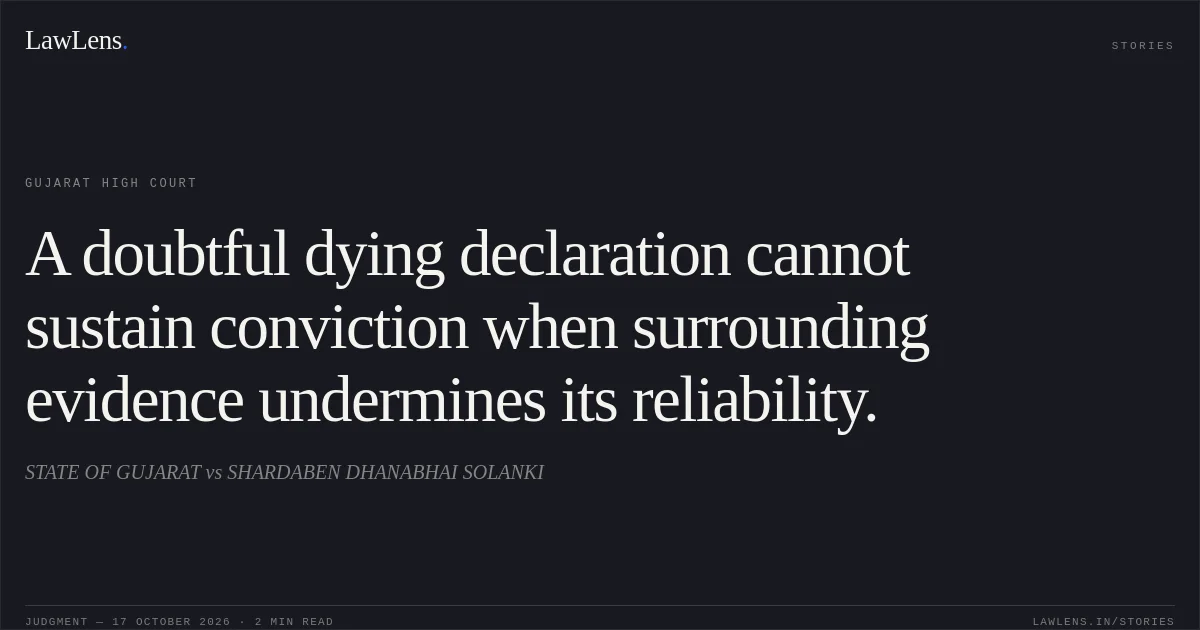
The Court accepted that the absence of a medical fitness opinion alone did not invalidate the declaration, but found that its reliability was undermined by the admitted interpolation in the answer to Question 6, the presence of a girl during recording, and evidence that Maniben had sustained burns while cooking.
¶ 18–19, 22, 24–25The treating doctor testified that Maniben had not named an assailant when giving the incident history, while the post-mortem doctor accepted that the injuries could have been self-inflicted.
¶ 18–19, 22, 24–25Although the medical record described the burns as homicidal, the Court assessed that entry alongside the other evidence and concluded that the declaration did not inspire sufficient confidence to be the sole basis for conviction.
¶ 25Given these doubts and the double presumption of innocence following acquittal, the Court found no basis to interfere with the trial court’s view.
¶ 28–3205Holding
The Court held that the prosecution had not proved the respondents’ guilt beyond reasonable doubt and that the trial court had committed no error in acquitting them.
¶ 32–33The State’s appeal was dismissed, the acquittal dated 27 February 1998 was confirmed, and any bail and bail bonds were discharged.
¶ 34Original Court PDF
STATE OF GUJARATvsSHARDABEN DHANABHAI SOLANKI
Click to open original judgment
Original judgment, available to read, download and summarize on LawLens.in