01Facts
The applicants sought a direction requiring the Official Assignee to execute sale deeds for Plots 25–29, relying on an agreement of sale said to have been made by their predecessors-in-interest with the insolvents and on payment of the full consideration of Rs.20 lakh.
¶ 1, 4–5 · pp. 1–3The insolvents supported the claim, but the Official Assignee disputed it, pointing to the unregistered agreement, the absence of proof that the cheque had been encashed, inconsistencies in the applicants’ evidence, and the timing of the alleged transaction in relation to the insolvency proceedings.
¶ 7–10 · pp. 4–5The Court considered the application and dismissed it.
¶ 11–16 · pp. 5–702Issues
i.1. Whether the applicants established a basis for directing the Official Assignee to execute sale deeds for the scheduled plots on the strength of the alleged sale agreement and payment of consideration.
¶ 1, 12–14 · pp. 1, 5–6ii.2. Whether the evidence and circumstances surrounding the alleged sale supported the applicants’ claim, or raised a concern that it was collusive and intended to defeat creditors.
¶ 9–10, 15 · pp. 4–703Law Applied
The application invoked Order II Rule I of the Presidency Towns Insolvency Rules and Sections 17, Rules 3 and 4, of the Presidency Towns Insolvency Act, as stated in the prayer.
p. 1The judgment does not cite or formulate a specific statutory test or rely on any precedent. Its decision rests on the Court’s assessment of the documentary and oral evidence, including whether the alleged consideration was proved and whether the circumstances supported the applicants’ claim.
¶ 13–15 · pp. 6–7Provisions in the judgment · 3 · Linked ones open on LawLens
Presidency-Towns Insolvency Act, 1909 Section 17Section 3Section 4
04Reasoning
The Court found that the agreement recited payment by a cheque dated more than six months before the agreement, but contained no recital that the cheque had been encashed, and the applicants produced no evidence of encashment.
¶ 13–14 · p. 6It also noted the absence of an explanation for why no sale deed had been pursued after the alleged full payment.
¶ 14 · p. 6The insolvency schedule identified the applicants’ predecessors-in-interest as secured creditors over Plots 22–26, including Plots 25 and 26 covered by the application; considered alongside the applicants’ evidence and admissions concerning the timing of the agreement and the proposed return of money, this supported the Court’s concern that the claim was collusive and could prejudice other creditors.
¶ 9–10, 15 · pp. 4–705Holding
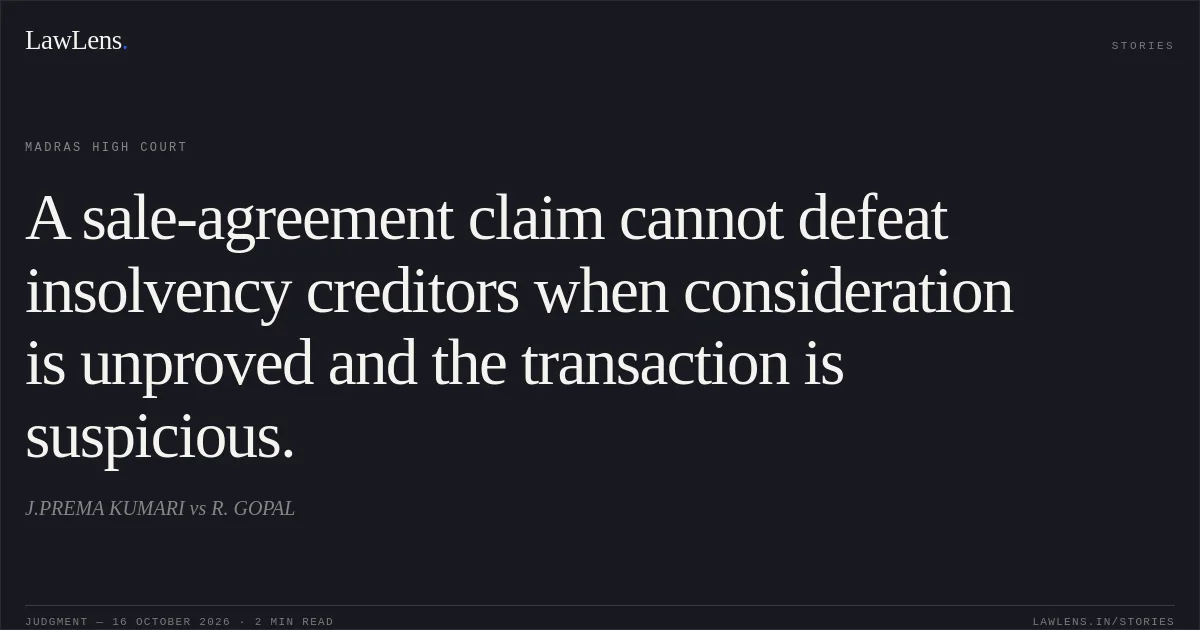
The Court held that the applicants had not established sufficient grounds for the requested conveyances.
¶ 16 · p. 7It dismissed the application, with no order as to costs.
¶ 16 · p. 7Original Court PDF
J.PREMA KUMARIvsR. GOPAL
Click to open original judgment
Original judgment, available to read, download and summarize on LawLens.in