01Facts
The respondent was tried under Section 302 of the Indian Penal Code for allegedly causing his wife’s death by kicking and punching her during a quarrel on 4 July 1996
¶ 2–3The deceased’s non-cognizable complaint to an Executive Magistrate, and a later complaint by her brother-in-law, described the assault and injuries to her face
¶ 7–8The post-mortem recorded internal head injuries, but the viscera examination could not establish the cause of death because the samples had decomposed
¶ 9–11The trial court acquitted the respondent; the State appealed under Section 378 of the Code of Criminal Procedure, 1973
¶ 102Issues
i.1. Whether the evidence, including the deceased’s non-cognizable complaint and the brother-in-law’s account, established that the respondent’s assault caused the deceased’s death beyond reasonable doubt.
¶ 5–8, 12–13ii.2. Whether the trial court’s acquittal was a possible view of the evidence and should therefore be upheld on appeal.
¶ 13–1603Law Applied
Section 378 of the Code of Criminal Procedure empowers an appellate court to review and reappreciate evidence in an appeal against acquittal, but the acquittal reinforces the presumption of innocence; if the trial court’s view is reasonably possible, the appellate court should not substitute another view (*Chandrappa v. State of Karnataka*, (2007) 4 SCC 415, quoted at para. 14; *H.D. Sundara v. State of Karnataka*, (2023) 9 SCC 581, quoted at para. 15).
¶ 14–15The charge was under Section 302 of the Indian Penal Code
¶ 2The judgment considered the deceased’s complaint as evidence of the alleged assault, but did not set out a separate legal test governing dying declarations
¶ 5–7Provisions in the judgment · 2 · Linked ones open on LawLens
Code of Criminal Procedure, 1973 Section 378
Indian Penal Code, 1860 Section 302
04Reasoning
The deceased’s complaint supported the allegation that the respondent had assaulted her, but it also stated that she dodged a blow and struck her face against a wall
¶ 7, 12Although the post-mortem recorded internal head injuries, the viscera report did not establish the cause of death, and the Court found no proved correlation between the alleged assault and the death
¶ 9–13In those circumstances, the trial court’s conclusion was a possible view, with no perversity warranting appellate intervention
¶ 13–1605Holding
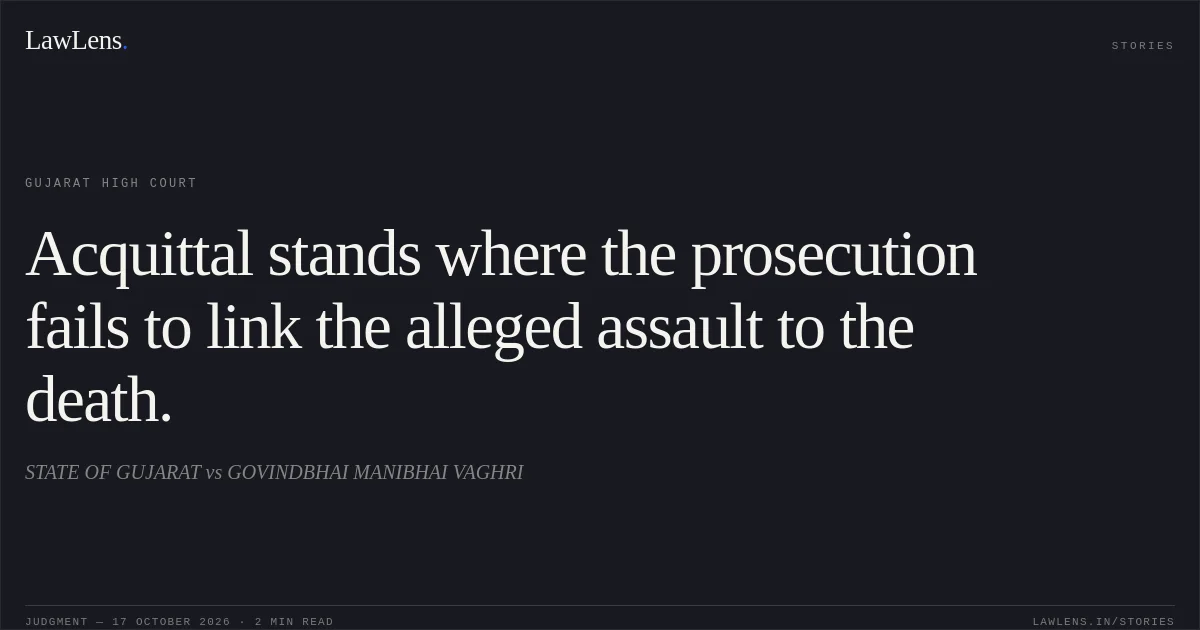
The Court held that the evidence did not establish a sufficient connection between the alleged assault and the deceased’s death, and that the trial court’s acquittal disclosed no perversity
¶ 13, 16The State’s appeal was dismissed, and the record and proceedings were directed to be returned to the trial court
¶ 16Original Court PDF
STATE OF GUJARATvsGOVINDBHAI MANIBHAI VAGHRI
Click to open original judgment
Original judgment, available to read, download and summarize on LawLens.in