01Facts
The petitioner is the Hereditary Trustee and High Priest of Sri Myalara Lingeshwara Swamy Devastana, Mylara
¶ 2The Deputy Commissioner, Vijayanagara, in exercise of power under s. 25-B(6)(iii) of the Karnataka Hindu Religious Institutions and Charitable Endowments Act, 1997 ("the Act"), declared Respondent No. 5 an Archaka.
¶ 3The Deputy Commissioner further appointed him Pradhana Archaka under s. 9 of the Act
¶ 3The petitioner's appeal was dismissed by the Commissioner on 26.12.2024, without addressing the inapplicability of s. 9
¶ 3The petitioner contended that the Pradhana Archaka appointment was unsustainable
¶ 4Respondent No. 5 conceded that the petitioner is the Hereditary Trustee and that the impugned order, despite the erroneous reference to s. 9, should be read only as declaring his hereditary Archaka status
¶ 5Respondent No. 5 relied on the petitioner's own description as "Pradhana Archaka" in the Deputy Commissioner's proceedings
¶ 6The petitioner clarified that the institution has no office of Pradhana Archaka, the Hereditary Trustee being the spiritual head
¶ 7Both sides agreed that the petitioner is the Hereditary Trustee and that management, including appointment of Archakas, vests in him
¶ 9The judgment refers to the Deputy Commissioner's order as dated 02.08.2022, while the prayer clause refers to 3-11-2022, and the discrepancy is not resolved in the judgment
¶ 202Issues
i.1. Whether the Deputy Commissioner could appoint Respondent No. 5 as Pradhana Archaka under s. 9 of the Act in an institution managed exclusively by a Hereditary Trustee.
¶ 4 · ¶ 12ii.2. Whether the Commissioner's declaration of Respondent No. 5 as a hereditary Archaka under s. 25-B(6)(iii) of the Act is sustainable.
¶ 1303Law Applied
Section 25-A(1) of the Act provides that no committee of management shall be constituted for notified institutions managed exclusively by hereditary trustees, and that management power vests in the hereditary trustee.
¶ 10Section 9(1) of the Act provides that a committee of management, with the Commissioner's approval, appoints archakas, and the proviso permits succession to hereditary posts.
¶ 11Section 9(2) provides that where more than one Archaka is appointed, the senior performs as Pradhana Archaka.
¶ 11Section 9 must be read with s. 25-A, so that the Commissioner's appointment power under s. 9 arises only where the institution is not managed by a hereditary trustee.
¶ 12Section 25-B(6)(iii) vests in the Commissioner the power to decide whether an Archaka holds office on a hereditary basis.
¶ 4 · ¶ 13Provisions in the judgment · 2 · Linked ones open on LawLens
HINDU RELIGIOUS INSTITUTIONS AND CHARITABLE ENDOWMENTS ACT, 1997 Section 9Section 25
04Reasoning
Because the institution is managed exclusively by the petitioner as Hereditary Trustee, management and appointment power vests in him under s. 25-A, and no committee of management exists to act under s. 9.
¶ 9 · ¶ 12The Deputy Commissioner's appointment of Respondent No. 5 as Pradhana Archaka under s. 9 was therefore without jurisdiction, and the Commissioner's appellate confirmation of it could not stand.
¶ 12 · ¶ 15The court did not accept the respondent's argument that the mis-citation of s. 9 was immaterial.
¶ 13Instead, it limited the order to the declaratory portion, which falls within s. 25-B(6)(iii) and is therefore sustained.
¶ 13 · ¶ 16The court did not expressly rely on the petitioner's self-description as "Pradhana Archaka" or on his clarification that no such office exists. Its reasoning rests on the statutory scheme and the parties' concession regarding management.
¶ 6 · ¶ 7 · ¶ 905Holding
The Deputy Commissioner's appointment of Respondent No. 5 as Pradhana Archaka under s. 9 is unsustainable, as s. 9 must be read with s. 25-A and does not apply to a Hereditary Trustee-managed institution.
¶ 12The declaration of Respondent No. 5 as hereditary Archaka under s. 25-B(6)(iii) is sustained.
¶ 13The writ petition is partly allowed.
¶ 14The Deputy Commissioner's order dated 02.08.2022, to the extent of appointing Respondent No. 5 as Pradhana Archaka under s. 9 and as confirmed by the Commissioner's order dated 26.12.2024, is quashed.
¶ 15The remaining order is to be read only as declaring Respondent No. 5 the hereditary Archaka.
¶ 16Any future appointment of an Archaka must comply with s. 25-A.
¶ 17Original Court PDF
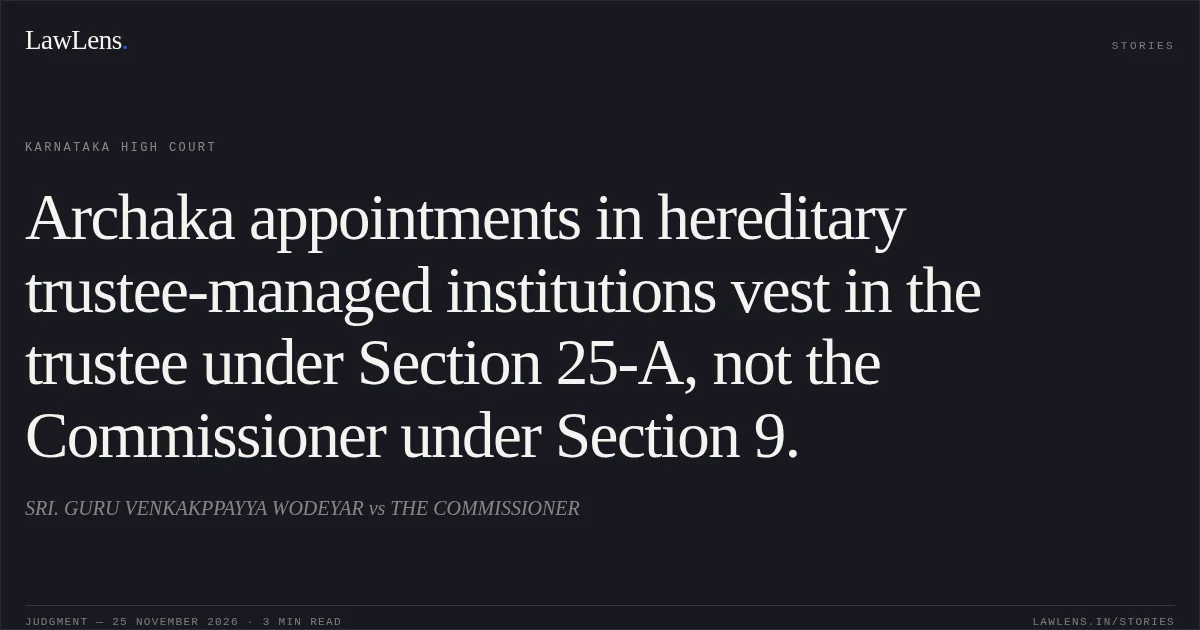
SRI. GURU VENKAKPPAYYA WODEYARvsTHE COMMISSIONER
Click to open original judgment
Original judgment, available to read, download and summarize on LawLens.in