01Facts
On 12.05.2001, a routine electricity checking team, led by Deputy Engineer M.R. Hathi and including Line Inspector R.J. Joshi and helpers, visited the railway staff quarters at Gavadka and found the petitioner present.
¶ 3The team allegedly found the wire ends removed and about 50 metres of black wire connected directly to an L.T. line near a factory.
¶ 3The prosecution alleged unauthorised tapping and theft of electricity, and a bill of Rs. 7,594.37 was raised.
¶ 3.1The complaint was lodged, a charge-sheet was filed, and the charge was framed at Exh. 9. The accused pleaded not guilty.
¶ 3.2The Trial Court (3rd Addl. Senior Civil Judge and J.M.F.C., Amreli, judgment dated 05.05.2009, Criminal Case No. 886 of 2001) convicted him under Section 39 of the Indian Electricity Act, 1910, and sentenced him to three months' simple imprisonment and a fine of Rs. 1,000, with ten days in default.
¶ 3.3The Appellate Court (Criminal Appeal No. 16 of 2009, judgment dated 31.03.2010) dismissed the appeal.
¶ 3.4The defence argued that the prosecution failed to prove ownership or occupation of the premises. Two prosecution witnesses turned hostile, the complainant lacked personal knowledge, the complaint was delayed by four days, the Deputy Engineer admitted to having no proof of ownership, and no independent witness was examined.
¶ 4.1–4.6The respondent contended that the concurrent findings were not perverse and that revisional interference was limited under Sections 438 and 442 BNSS.
¶ 5.1During the pendency of the revision, PGVCL's suit for Rs. 94,167 was decreed. The accused appealed (R.C.A. No. 4 of 2009), and the appeal was withdrawn on settlement after he deposited the entire amount. The receipt was verified by the APP.
¶ 602Issues
i.1. Whether the prosecution established, beyond reasonable doubt, that the accused dishonestly abstracted or used energy under Section 39 of the Indian Electricity Act, 1910, given the alleged infirmities in proof of occupation, the complaint, and the panchnama. (Framed in the parties' submissions; the Court did not separately adjudicate this issue.)
¶ 4, 5.1ii.2. Whether the offence is compoundable and whether the subsequent settlement and deposit of the entire amount justify quashing the conviction and sentence.
¶ 6–903Law Applied
Section 39 of the Indian Electricity Act, 1910, penalises dishonest abstraction, consumption or use of energy with imprisonment up to three years, or fine not less than Rs. 1,000, or both. It also provides a rebuttable presumption of dishonest abstraction where an unauthorised artificial means is proved.
¶ 7Section 135 of the Electricity Act, 2003 (theft of electricity) and Section 152 of that Act, which permits the Appropriate Government or its authorised officer to accept a compounding sum for theft-of-electricity offences, notwithstanding the BNSS.
¶ 8Revisional interference with concurrent findings of fact is limited, as the respondent submitted under Sections 438 and 442 BNSS.
¶ 5.1The judgment cites no judicial precedent.
Provisions in the judgment · 4 · Linked ones open on LawLens
Bharatiya Nagarik Suraksha Sanhita, 2023 Section 438Section 442
Electricity Act, 2003 Section 135Section 152
04Reasoning
The Court recorded the defence's evidentiary challenges and the respondent's reliance on concurrent findings. It did not evaluate the evidence, make a finding on ownership or occupation, or explain why the concurrent findings were perverse or illegal.
¶ 4.1–4.6, 5.1The disposal rests instead on subsequent developments. The Court noted that the offence was admittedly a first offence.
¶ 7The Court accepted that the entire amount claimed by PGVCL had been deposited, as shown by a receipt verified by the APP, and that the dispute had been amicably resolved.
¶ 6, 9On that basis, the Court held the offence compoundable and found that continuing the conviction "would serve no useful purpose".
¶ 9The judgment does not explain how the compounding provision in Section 152 of the 2003 Act, which governs offences under that Act, applies to a conviction under Section 39 of the 1910 Act. Nor does it address the BNSS revisional-jurisdiction argument beyond recording it.
¶ 8, 5.105Holding
The Court did not decide whether the prosecution proved the offence under Section 39 beyond reasonable doubt.
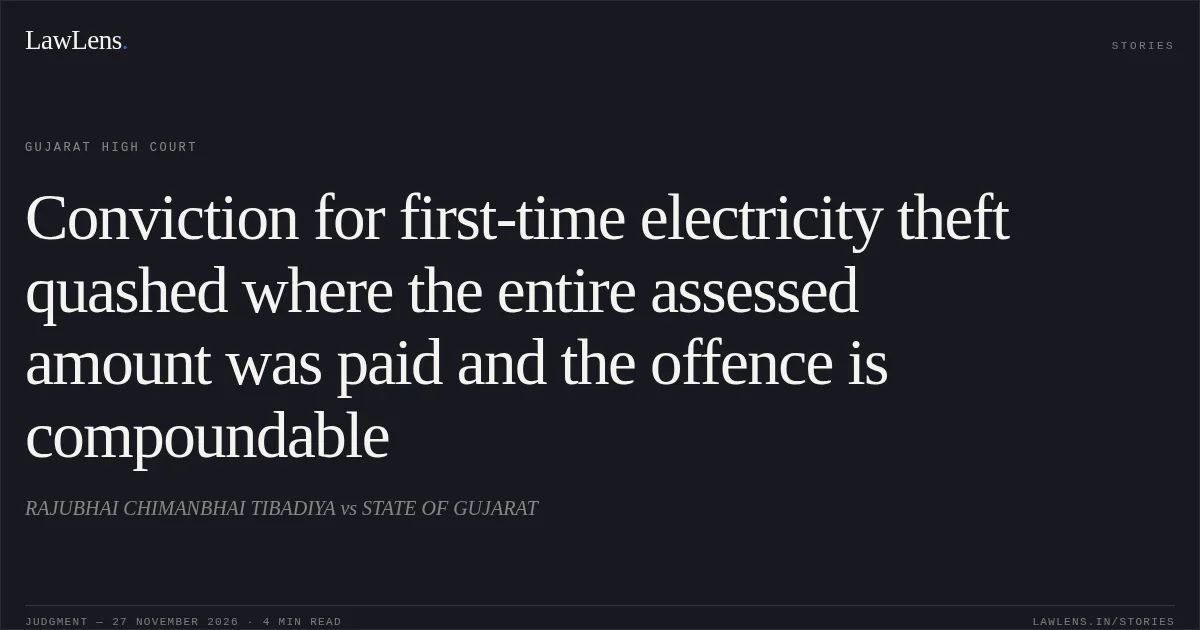
¶ 4–5, 7–9The Court held that, because the offence was a first offence, the amount claimed had been fully deposited, and the dispute had been settled, the offence was compoundable and continuation of the conviction served no purpose.
¶ 9–10The revision is allowed. The judgment of 05.05.2009 in Criminal Case No. 886 of 2001 and the appellate judgment of 31.03.2010 in Criminal Appeal No. 16 of 2009 are quashed and set aside. The bail bond is discharged, any paid fine is to be refunded in accordance with law, and the record is to be returned to the Courts below.
¶ 10–11Original Court PDF
RAJUBHAI CHIMANBHAI TIBADIYAvsSTATE OF GUJARAT
Click to open original judgment
Original judgment, available to read, download and summarize on LawLens.in