01Facts
The petitioner is the registered owner of a TVS Jupiter 125 scooter (RTO Reg. No. GJ-07-ES-6102).
The prosecution seized the vehicle for an offence under the Gujarat Prohibition Act, 1949, and registered C.R. No. 11191018260259/2026.
¶ 3The petitioner sought release under Articles 226 and 227 of the Constitution and the court's inherent powers under Section 497 of the Bharatiya Nagarik Suraksha Sanhita, 2023 (BNSS).
¶ 1–2 · pp. 1–2The vehicle is financed by IDFC First Bank, which issued a No Objection Certificate dated 04.04.2026 permitting release to the petitioner.
¶ 5 · p. 2The petitioner relied on Sunderbhai Ambalal Desai v. State of Gujarat, AIR 2003 SC 638, on the problem of seized vehicles deteriorating at police stations.
¶ 5, 8 · pp. 2–4The learned APP objected on the basis of the confiscation provisions of the Prohibition Act but did not dispute the High Court's power under Article 226 to order release at any time.
¶ 6 · pp. 2–3The court noted that a coordinate bench had released an identical vehicle in Musa Khan Jat v. State of Gujarat (SCR.A/7190/2017).
¶ 7 · p. 302Issues
i.1. Whether the High Court, under Articles 226/227 of the Constitution, can order release of a vehicle seized under the Gujarat Prohibition Act despite the confiscation provisions of that Act.
¶ 5–6 · pp. 2–3ii.2. Whether Section 98(2) of the Gujarat Prohibition Act, 1949 operates as an absolute bar to interim release of a seized vehicle pending trial, such that the court may not order release under Section 497 BNSS (Section 451 CrPC).
¶ 9 · p. 4iii.3. Whether release may be granted subject to conditions securing the vehicle's availability for trial and its value.
¶ 11–13 · pp. 4–503Law Applied
Articles 226 and 227 of the Constitution were relied upon as the source of the court's wide discretionary power to order release, a position the APP did not contest.
pp. 2–3The court followed the coordinate bench decision in Musa Khan Jat v. State of Gujarat (SCR.A/7190/2017) on identical facts.
¶ 7 · p. 3Sunderbhai Ambalal Desai v. State of Gujarat, AIR 2003 SC 638, holds that seized vehicles should not be kept at police stations for long periods and that the Magistrate should pass immediate orders for return, on bond and guarantee for production if required, pending the final hearing.
¶ 8 · pp. 3–4M/s ABC Express v. State of Gujarat, 2026 LiveLaw (SC) 885, holds that Section 98(2) of the Gujarat Prohibition Act, 1949 is not an absolute embargo on interim release of a seized vehicle, and that courts may pass custody orders under Section 451 CrPC (Section 497 BNSS).
¶ 9 · p. 4Provisions in the judgment · 3 · Linked ones open on LawLens
Bharatiya Nagarik Suraksha Sanhita, 2023 Section 497
Gujarat Prohibition Act, 1949. Section 98
Code of Criminal Procedure, 1973 Section 451
04Reasoning
The confiscation provisions of the Prohibition Act did not bar relief, since the High Court's Article 226 power was undisputed and the Supreme Court in ABC Express had read Section 98(2) as non-absolute.
¶ 6, 9Because the petitioner had produced a bank NOC and the vehicle had been in police custody since the seizure, the court found that continued detention served no purpose and that the reasoning in Sunderbhai applied.
¶ 5, 8The court followed Musa Khan Jat for consistency in identical cases.
¶ 7To protect the State's interest in the vehicle as a trial exhibit and in any eventual confiscation, the court imposed a set of safeguards: a solvent surety equal to the vehicle's value stated in the FIR, a no-transfer undertaking, production on direction, and confiscation upon any subsequent offence.
¶ 11Pre-release photographs and a panchanama, to form part of the charge-sheet papers, preserved the vehicle's condition as evidence.
¶ 12The RTO notice restrained transfer until trial ends, subject to any order of the trial court.
¶ 1305Holding
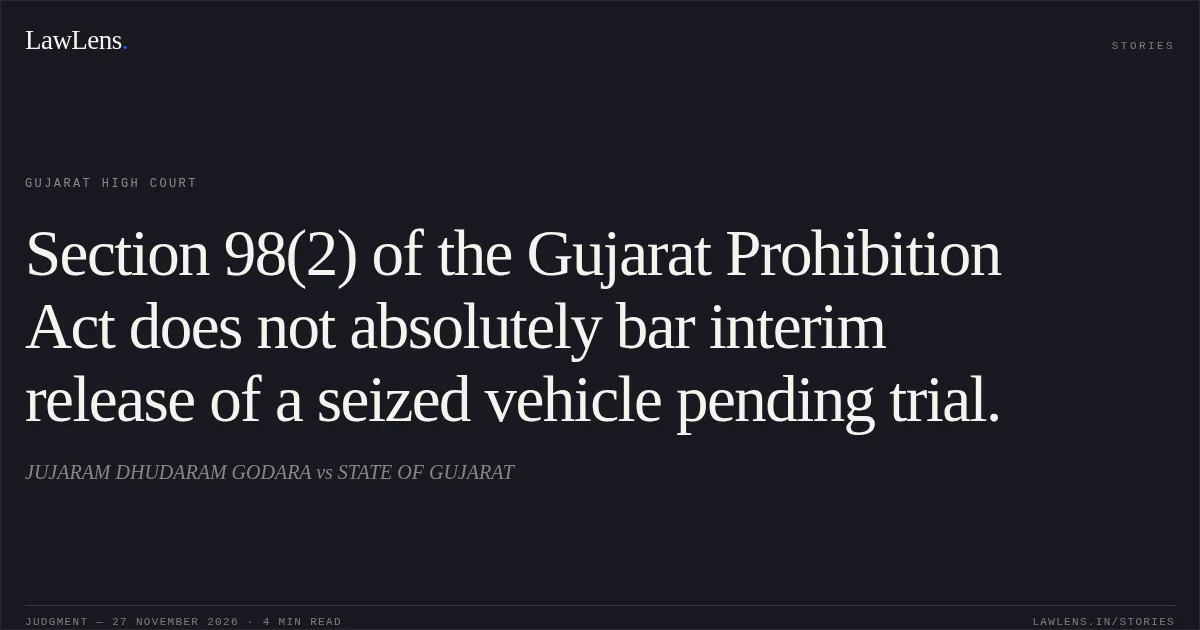
The court holds that Section 98(2) of the Gujarat Prohibition Act, 1949 does not absolutely bar interim release of a seized vehicle pending trial, and that the High Court may order release under Articles 226/227 and Section 497 BNSS, as the Supreme Court held in ABC Express.
¶ 9The petition is allowed and the rule is made absolute. The trial court or concerned authority is directed to release the scooter on conditions: (i) a solvent surety equal to the FIR value; (ii) an undertaking not to transfer until final disposal of trial; (iii) production as directed; and (iv) confiscation upon any subsequent offence. Before release, the police must photograph the vehicle from all sides at the petitioner's cost and draw a panchanama, which forms part of the charge-sheet papers. The RTO must record the transfer restraint.
¶ 10, 11, 12, 13, 14Original Court PDF
TALPADA JAGDISHBHAI RAMESHBHAIvsSTATE OF GUJARAT
Click to open original judgment
Original judgment, available to read, download and summarize on LawLens.in