01Facts
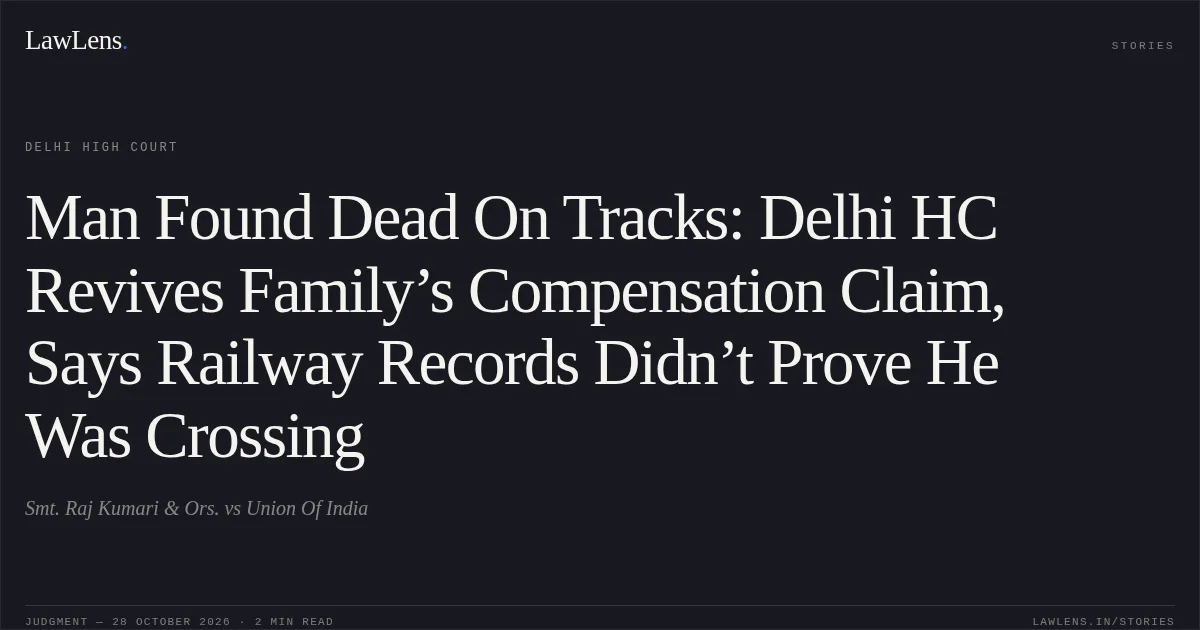
The appellants, the deceased’s parents and brother, claimed that Kushal Kumar had purchased a ticket and was travelling from Dadri to Aligarh on 11 November 2017 when he accidentally fell from a passenger train near Khurja and died
pp. 1–2The Railways contested the claim, relying on the absence of a recovered ticket, the location of the body on the UP main line, and the medical and railway records as suggesting that the deceased had been run over by an unidentified train
pp. 2–3The Railway Claims Tribunal dismissed the claim, questioning the deceased’s bona fide passenger status and the account of AW-2, Rahul
p. 2The appellants challenged that decision under Section 23 of the Railway Claims Tribunal Act, 1987
p. 102Issues
i.Whether the deceased was a bona fide passenger despite the non-recovery of a journey ticket.
pp. 3–4 · ¶ 7ii.Whether the deceased’s death was attributable to an “untoward incident” within the meaning of the Railways Act, 1989.
p. 3 · ¶ 703Law Applied
Section 123(c) of the Railways Act, 1989 includes the accidental falling of a passenger from a train carrying passengers within the definition of an “untoward incident”; Section 124-A provides for no-fault compensation for death or injury resulting from such an incident, subject to its specified exceptions.
p. 5 · ¶ 10Under Union of India v. Rina Devi, non-recovery of a ticket is not by itself conclusive: once claimants establish foundational facts indicating bona fide travel, the claim is assessed on the attending circumstances and the preponderance of probabilities, with the burden shifting to the Railways to rebut it.
pp. 3–4 · ¶ 8The Court also cited Lata v. Union of India and Sukhabhai Nanjibhai Makwana v. Union of India on assessing bona fide passenger status.
p. 4 · ¶ 9The Court also cited Surendra Prasad Verma v. Union of India, Dharmvir v. Union of India and Reshma v. Union of India in considering delayed discovery, the circumstances of a railway accident, and the applicable no-fault scheme.
pp. 6–7 · ¶ 13–14The precise mechanics of an accident need not be proved by eyewitness testimony where the evidence and surrounding circumstances establish the occurrence on a preponderance of probabilities.
p. 7 · ¶ 15Provisions in the judgment · 2 · Linked ones open on LawLens
Railway Claims Tribunal Act, 1987 Section 23
Railways Act, 1989 Section 123
04Reasoning
The Court held that the missing ticket could not, by itself, disprove bona fide travel, particularly given the appellants’ consistent account that the ticket was lost in the incident; the doubts about AW-2 also had to be considered alongside the entire record.
pp. 3–4 · ¶ 8–9The railway records established that the deceased’s body was found on the track and that he had sustained fatal injuries, but did not establish that he had been run over while crossing the track or otherwise present for a purpose unrelated to train travel.
p. 5 · ¶ 11The body’s location, the estimated time since death, and the fact that it was discovered the following morning did not conclusively establish the manner or timing of death.
pp. 5–6 · ¶ 11–13Applying the statutory no-fault scheme and the preponderance-of-probabilities standard, the Court rejected the Tribunal’s reliance on those circumstances as sufficient grounds to dismiss the claim.
pp. 6–7 · ¶ 14–1505Holding
The Court set aside the Tribunal’s judgment and allowed the appeal.
p. 7 · ¶ 16–17It remanded the matter to the Tribunal to assess the compensation payable in accordance with law and directed that the amount be disbursed within two months of receipt of the order; the matter was directed to be listed before the Tribunal on 24 February 2027.
p. 7 · ¶ 16–17Original Court PDF
Raj Kumar & Ors.vsUnion Of India
Click to open original judgment
Original judgment, available to read, download and summarize on LawLens.in