01Facts
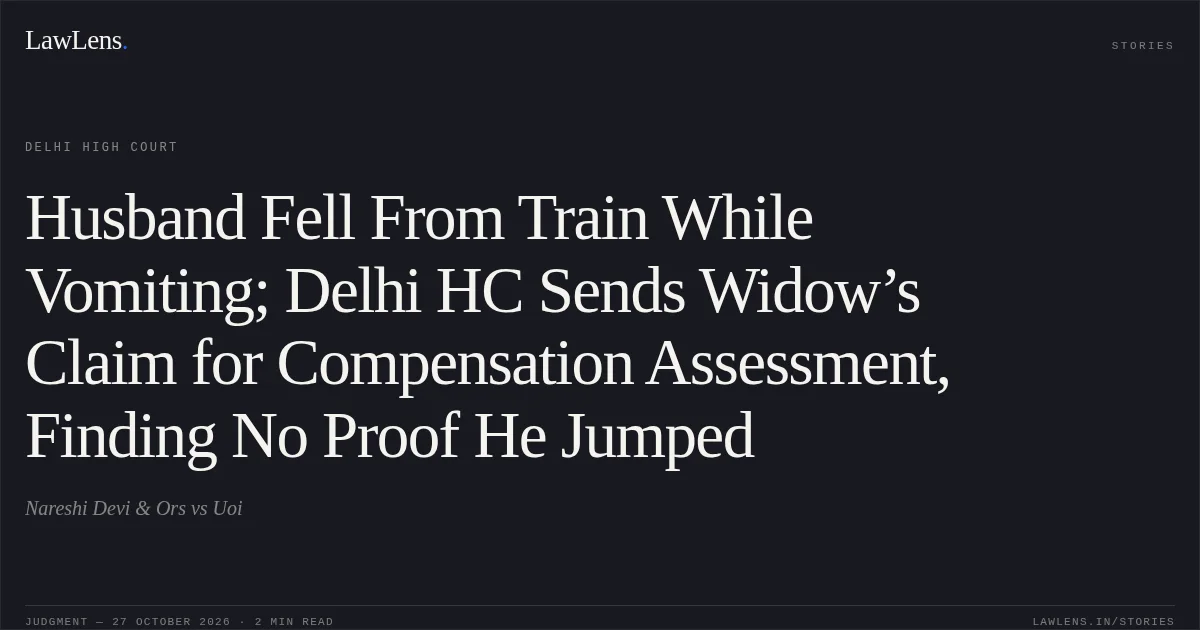
On 17 February 2015, Girraj Prasad was travelling with his wife and minor son on Train No. 12904 from Hazrat Nizamuddin to Gangapur City.
p. 2 · ¶ 2–3The Railway Claims Tribunal accepted that he was a bona fide passenger but dismissed the claim, finding that he had either acted negligently by going to the train’s gate to vomit despite available facilities, or had jumped from the train due to his mental state.
p. 2 · ¶ 2–3His wife appealed under Section 23 of the Railway Claims Tribunal Act, 1987.
p. 1 · ¶ 102Issues
i.1. Whether the evidence established that the deceased’s death resulted from an accidental fall from a moving train, rather than conduct falling within an exception under Section 124-A of the Railways Act, 1989.
p. 3 · ¶ 6ii.2. Whether the deceased’s alleged negligence in going to the train’s gate to vomit, or the unverified report that he had jumped, established intentional self-injury or a criminal act.
pp. 3–5 · ¶ 7–1103Law Applied
Section 124-A of the Railways Act, 1989 imposes no-fault liability for an untoward incident, subject to the statutory exceptions.
p. 4 · ¶ 10As explained in Jameela v. Union of India, (2010) 12 SCC 443, and Union of India v. Rina Devi, (2019) 3 SCC 572, mere negligence or imprudence by a passenger does not, by itself, amount to self-inflicted injury; the exception requires an intentional act and cannot be invoked merely because greater care might have avoided the incident.
p. 4 · ¶ 10 · p. 5 · ¶ 11Provisions in the judgment · 1 · Linked ones open on LawLens
Railway Claims Tribunal Act, 1987 Section 23
04Reasoning
The DRM report recorded that the deceased felt unwell, went to the gate to vomit, and fell from the moving train; its attribution of the incident to carelessness was an assessment of his conduct, not evidence that he deliberately jumped.
p. 3 · ¶ 7The Form-I entry attributing a statement about a jump to the deceased’s wife was based on information conveyed by a gateman who was not shown to have witnessed the fall, and no respondent’s witness proved the alleged statement or jump.
p. 4 · ¶ 8Even if the deceased could have used a washbasin or toilet, that omission did not establish intentional self-injury or a criminal act.
pp. 4–5 · ¶ 9–11The ticket, railway records, DRM account, and absence of direct evidence of a deliberate jump cumulatively supported an accidental fall.
p. 5 · ¶ 1205Holding
The Court held that the material did not establish that the deceased intentionally caused his injury or committed a criminal act, and that the Tribunal erred in denying the claim on that basis.
p. 5 · ¶ 11–12It set aside the Tribunal’s judgment and remanded the matter for assessment of compensation in accordance with law, directing disbursement within two months of receipt of the order; the appeal was allowed and disposed of.
pp. 5–6 · ¶ 13–14Original Court PDF
Nareshi Devi & OrsvsUoi
Click to open original judgment
Original judgment, available to read, download and summarize on LawLens.in