01Facts
The petitioner, a life member of Sri Sri Hari Mandir, Nalbari, challenged a resolution dated 22.07.2023 dissolving the Mandir's Executive Committee and placing its affairs under the Deputy Commissioner through an ad hoc committee.
¶ 2By amendment, the petitioner also challenged the Special General Body Meeting of 12.08.2023, amendments to the Constitution, the ad hoc committee, and the subsequent election of an Executive Committee.
¶ 3The petitioner contended that the Mandir is a religious denomination protected under Article 26 and that the District Administration lacked authority to take over its affairs.
¶ 4–6, 11The State contended that the Executive Committee's three-year tenure expired on 22.03.2022, that no General Body Meeting was convened thereafter, and that the society's registration lapsed on 24.03.2022.
¶ 17, 35–36Two life members approached the Deputy Commissioner, an inquiry was conducted, and the inquiry report was placed before the 22.07.2023 meeting.
¶ 38–39The 12.08.2023 meeting, chaired by the Deputy Commissioner, amended the Constitution, admitted additional life members, and constituted an ad hoc committee.
¶ 47–48An election was held on 29.10.2023, and the society was re-registered on 29.10.2024.
¶ 55–56The petitioner did not attend the 12.08.2023 meeting.
¶ 5402Issues
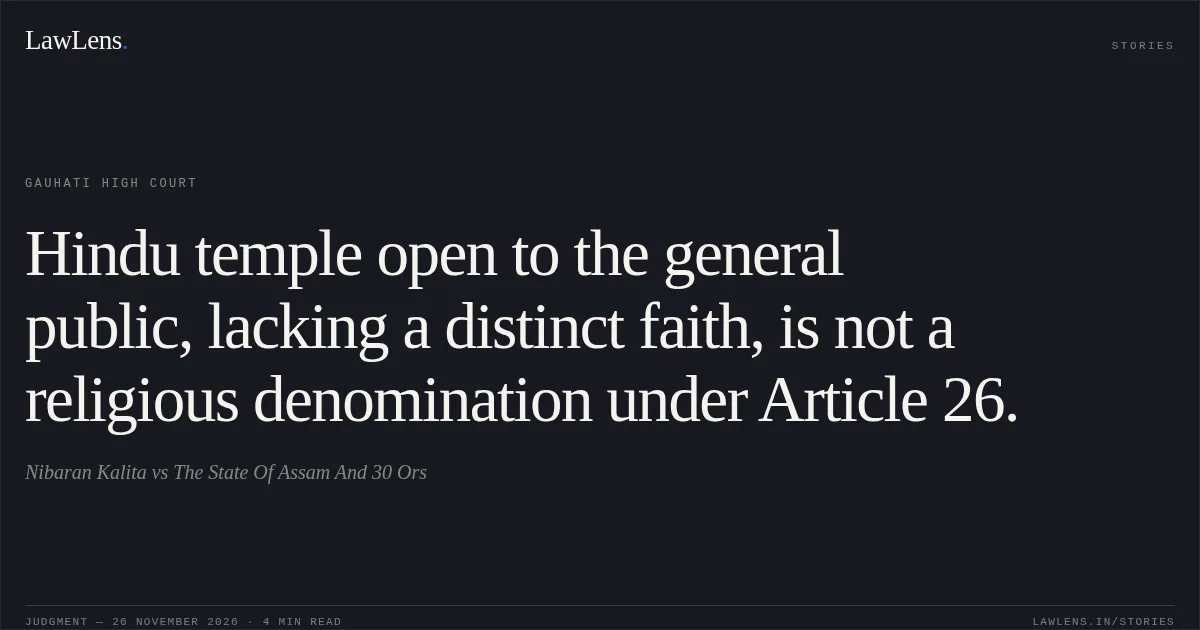
i.1. Whether Sri Sri Hari Mandir or its managing body constitutes a "religious denomination" entitled to protection under Article 26 of the Constitution of India.
¶ 19, 33ii.2. Whether the Deputy Commissioner had lawful authority to dissolve the Executive Committee and assume control of the Mandir's affairs by resolution dated 22.07.2023.
¶ 42–46iii.3. Whether the Special General Body Meeting of 12.08.2023, the constitutional amendments, the ad hoc committee, and the subsequent election are liable to be set aside in writ jurisdiction.
¶ 47–5903Law Applied
Article 26 of the Constitution protects a "religious denomination" in managing its religious affairs and property, subject to law.
¶ 19, 25Commissioner, Hindu Religious Endowments, Madras v. Sri Lakshmindra Thirtha Swamiar of Sri Shirur Mutt (AIR 1954 SC 282) holds that a denomination requires a common faith, organisation and distinctive name, and may exist within Hinduism.
¶ 20–21S.P. Mittal v. Union of India (AIR 1983 SC 1) requires all three characteristics (common faith, common organisation, distinctive name) to be established together.
¶ 22–23Durgah Committee, Ajmer v. Syed Hussain Ali (AIR 1961 SC 1402) distinguishes denominational members from mere participants in religious activities.
¶ 24Under Article 26(d), administration of property is subject to law, and secular administration is distinct from religious matters.
¶ 25Clause 18 of the pre-amended Constitution requires a two-thirds majority of members present and agenda inclusion.
¶ 16, 51Election disputes concerning membership, electoral rolls and conduct of internal elections ordinarily fall outside writ jurisdiction under Article 226.
¶ 58A request by members cannot confer statutory power on a Deputy Commissioner that the law does not vest in him.
¶ 4204Reasoning
The Mandir is a place of Hindu worship, but the petitioner failed to show a distinct denominational faith.
¶ 28–30Clauses 14 and 15 of the Constitution open membership and festivals to the wider Hindu community, and the objects extend to secular, charitable and multi-community purposes.
¶ 28–30The Court found no material showing a distinct sect, sampradaya or doctrine, so the common organisation and name could not satisfy the test.
¶ 31–32The authorities could not remain indifferent to members' complaints, given the expired tenure and lapsed registration, but these circumstances conferred no statutory power to dissolve the committee or take permanent control.
¶ 41–42, 45The resolution of 22.07.2023 was read as an interim measure to ensure continuity and facilitate reconstitution, not a permanent takeover, and the petitioner did not show deprivation of any subsisting right.
¶ 44–46The Deputy Commissioner's presidency did not make the resolutions of the 12.08.2023 meeting executive decisions, since the minutes showed the members themselves deliberated and resolved.
¶ 47–50No proof was found that the two-thirds requirement under Clause 18 was unmet, or that the quorum under the unamended Constitution was lacking; the petitioner's non-attendance was noted.
¶ 51–54The challenge to the subsequent election and amendments raised disputed questions of membership, electoral rolls and records requiring evidence, which were not suited to writ review.
¶ 57–58Given that the earlier committee's tenure had expired and the members had constituted a new managing body, disturbing the arrangement was not warranted.
¶ 6005Holding
Issue 1 is answered in the negative: the petitioner did not establish that Sri Sri Hari Mandir or its managing body is a religious denomination under Article 26.
¶ 33On Issue 2, the resolution of 22.07.2023 was upheld as an interim measure, and the expiry of tenure and lapse of registration did not confer permanent authority on the Deputy Commissioner.
¶ 42–46On Issue 3, no ground was made out to interfere with the 12.08.2023 proceedings, the constitutional amendments, the ad hoc committee, or the 2023 election, which involve disputed factual questions.
¶ 54–59The writ petition is dismissed. The dismissal confers no permanent authority on the district administration over the Mandir, the amendments and election remain open to challenge before the competent forum, and the petitioner may approach that forum.
¶ 61–63Original Court PDF
Nibaran KalitavsThe State Of Assam And 30 Ors
Click to open original judgment
Original judgment, available to read, download and summarize on LawLens.in