01Facts
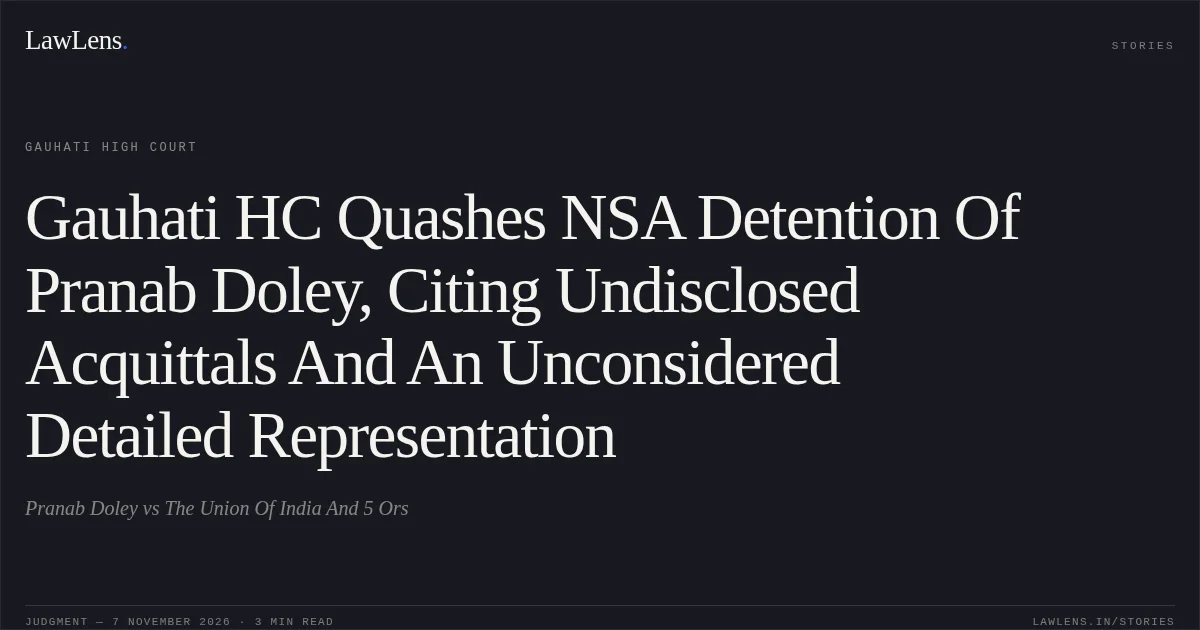
The petitioner challenged his detention under Section 3(2) of the National Security Act, 1980 (“NSA”), ordered on 30 July 2026.
pp. 5–14 / para. 2–4The grounds relied on 13 criminal cases, alleged protest-related violence, foreign travel and foreign-exchange remittances.
pp. 5–14 / para. 2–4The petitioner asserted that he had been acquitted in nine cases, discharged in one, and that other proceedings were stayed, pending evidence, or under investigation.
pp. 5–14, 21–22 / paras. 2–4, 13(a)–(b)He was granted bail on 29 July 2026; the detention order followed the next day.
pp. 17–19 / paras. 10(a)–(d)After submitting a handwritten representation on 4 August, he obtained access to family and counsel pursuant to a court order and submitted a further representation on 10 August.
pp. 14–16, 28–31 / paras. 5–7, 15The State rejected the first representation, but the second was not considered.
pp. 14–16, 28–31 / paras. 5–7, 1502Issues
i.1. Whether the detention order was vitiated by the failure to disclose the status of the criminal cases, including acquittals and discharge, to the detaining authority.
pp. 21–26 / para. 13ii.2. Whether non-supply of material relied on for detention, and vague allegations, denied the petitioner an effective opportunity to make a representation.
pp. 26–28 / para. 14iii.3. Whether failure to consider the petitioner’s further representation dated 10 August 2026 vitiated his continued detention.
pp. 28–31 / para. 15iv.4. Whether the foreign travel and remittances relied on by the authorities had a live and proximate connection to the alleged prejudicial activities.
pp. 31–32 / para. 16v.5. Whether the detention order was sustainable given the authorities’ failure to consider whether ordinary criminal law was sufficient to address the alleged conduct.
p. 33 / para. 1803Law Applied
Article 22(5) of the Constitution and Section 8(1) of the NSA safeguard a detenu’s right to be informed of the grounds of detention and to make an effective representation; material relied on for detention must therefore be disclosed.
Under Section 3(2), preventive detention requires a properly formed subjective satisfaction, which is vitiated if material facts likely to affect that satisfaction are withheld or ignored.
Relying on *Dharamdas Shamlal Agarwal v. Police Commissioner*, (1989) 2 SCC 370, the Court reiterated that non-placement of material facts, including acquittals, may invalidate the detention order.
pp. 23–25 / para. 13(g)The Court also relied on *Satyapriya Sonkar v. Superintendent, Central Jail, Naini*, 1999 SCC OnLine All 1628, for the proposition that a detenu may make successive representations and that the appropriate authorities must consider them.
pp. 29–31 / para. 15(d)–(e)Preventive detention must also retain a live and proximate link to the alleged prejudicial conduct.
pp. 31–32 / para. 16Provisions in the judgment · 39 · Linked ones open on LawLens
National Security Act, 1980 Section 3Section 8Section 10Section 12Section 14
Indian Penal Code, 1860 19 provisions
Section 34Section 109Section 141Section 142Section 143Section 147Section 188Section 283Section 285Section 294Section 302Section 307Section 332Section 341Section 353Section 376Section 447Section 448Section 506Disaster Management Act, 2005 Section 51
Bharatiya Nyaya Sanhita, 2023 14 provisions
Section 61Section 62Section 74Section 121Section 132Section 190Section 191Section 221Section 294Section 308Section 324Section 326Section 329Section 35104Reasoning
The Court found that the detention materials did not disclose the petitioner’s acquittals and discharge, and the State did not establish that the relevant case statuses had been placed before the detaining authority.
pp. 22–26 / para. 13(c)–(i)The State’s later assertion that witnesses had turned hostile or been intimidated was neither included in the grounds nor supported by material supplied to the petitioner.
pp. 22–26 / para. 13(c)–(i)The authorities supplied FIRs but not charge-sheets or other relied-on investigation materials; other allegations, including road blockades and damage to public property, lacked particulars. These omissions impaired the petitioner’s ability to make an effective representation.
pp. 26–28 / para. 14The Court treated the 10 August representation, made after access to family and counsel, as the petitioner’s detailed representation and held that its non-forwarding and non-consideration were fatal to continued detention.
pp. 28–31 / para. 15The foreign travel and remittances were not linked to anti-State activity or the petitioner’s protest conduct, and the authorities failed to explain the delay or establish a continuing nexus.
pp. 31–32 / para. 16The Court further observed that the detaining authority had not applied its mind to whether ordinary criminal law was insufficient.
p. 33 / para. 1805Holding
The Court allowed the petition, holding that the detention was vitiated by reliance on stale cases without disclosure of their status, non-supply of relevant material, failure to consider the further representation, and the absence of a live nexus between the foreign travel/remittances and the alleged prejudicial conduct.
pp. 32–33 / paras. 17–20It quashed the detention order and grounds of detention dated 30 July 2026 and directed that the petitioner be released from preventive detention forthwith.
p. 34 / para. 21Original Court PDF
Pranab DoleyvsThe Union Of India And 5 Ors
Click to open original judgment
Original judgment, available to read, download and summarize on LawLens.in