01Facts
The Assessee provided software design, development and maintenance services to associated enterprises. For AY 2009–10, the Transfer Pricing Officer (TPO) rejected or excluded certain comparables and made a transfer-pricing adjustment.
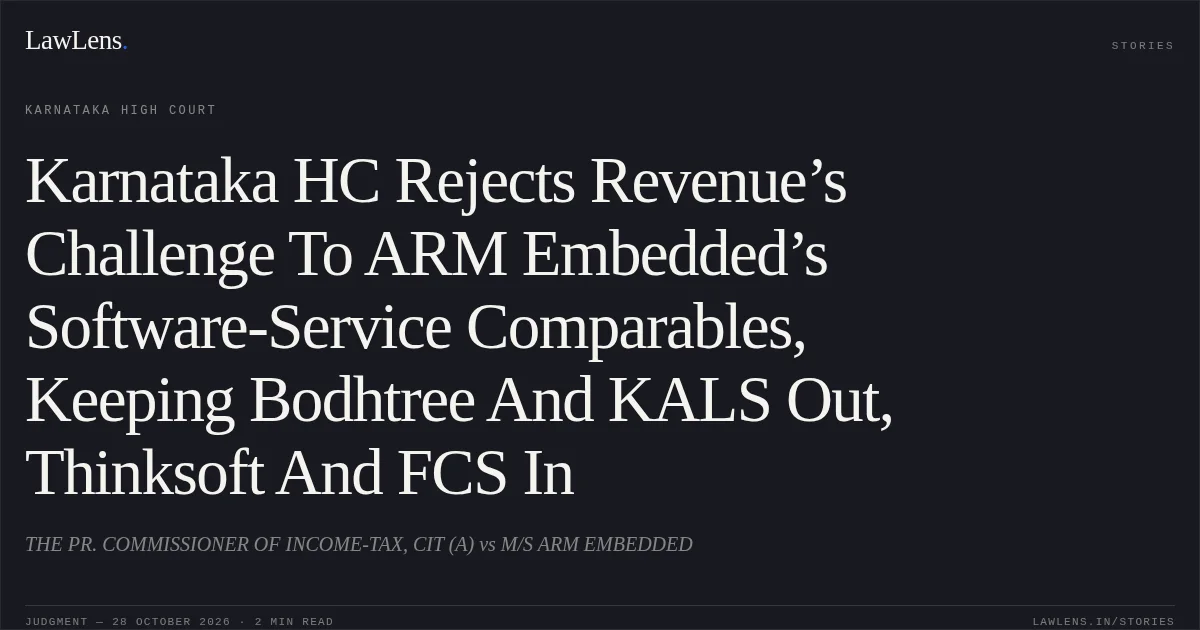
On appeal, the ITAT excluded Bodhtree Consulting Ltd. and KALS Information Systems Ltd. from the comparables, and directed the inclusion of Thinksoft Global Services Ltd. and FCS Software Solutions Ltd.
The Revenue appealed under Section 260A of the Income-tax Act, 1961. Although the appeal had initially been admitted on a Section 10A deduction question, the parties stated that the admitted question was recorded incorrectly; the Court accordingly considered the two transfer-pricing questions identified in its earlier order.
¶ 4–5, 9–1402Issues
i.Whether the ITAT was justified in excluding Bodhtree Consulting Ltd. and KALS Information Systems Ltd. as comparables on the ground that they were functionally different from the Assessee?
p. 9 / para. 15ii.Whether the ITAT was justified in including Thinksoft Global Services Ltd. and FCS Software Solutions Ltd. as comparables despite the TPO’s reliance on their other income and working-capital adjustments?
p. 6 / para. 9 · pp. 18–19 / para. 2603Law Applied
Section 260A of the Income-tax Act permits an appeal to the High Court on a substantial question of law.
In transfer-pricing matters, the selection of comparables and assessment of functional comparability are generally factual matters; such findings may warrant intervention where they are unsupported by relevant material or are perverse.
¶ 18, 25, 31Sections 92CA and the transfer-pricing rules, including Rule 10B, govern determination of the arm’s-length price and comparability analysis.
The Court also relied on SAP Labs India Private Limited v. Income Tax Officer, which clarified that transfer-pricing issues may raise substantial questions of law where the Act or rules have not been followed.
¶ 11–12The comparability findings are not disturbed merely because the Revenue disagrees with the ITAT’s assessment, where those findings are reasoned and supported by the record.
¶ 18, 25, 31Provisions in the judgment · 5
Income Tax Act, 1961 Section 260ASection 143Section 144CSection 92CASection 10A
04Reasoning
As to Bodhtree and KALS, the ITAT relied on material showing that Bodhtree was engaged in software products and consultancy, and had abnormal profits, while KALS derived revenue from both software development and software products.
¶ 16–24The High Court found these to be relevant factual grounds for treating the companies as functionally different from the Assessee’s software-development services, and not perverse; decisions of other High Courts and tribunals supported that conclusion.
¶ 16–24As to Thinksoft and FCS, the ITAT examined their accounts and found that their principal revenues arose from software services, while the identified interest and other income was not material relative to those revenues.
¶ 27–31The High Court held that the ITAT’s reasoned findings of functional similarity could not be characterised as perverse.
¶ 27–3105Holding
The Court held that neither the exclusion of Bodhtree and KALS nor the inclusion of Thinksoft and FCS gave rise to a substantial question of law.
¶ 25, 31–33It dismissed the Revenue’s appeal and disposed of any pending applications.
¶ 25, 31–33Original Court PDF
THE PR. COMMISSIONER OF INCOME-TAX, CIT (A)vsM/S ARM EMBEDDED
Click to open original judgment
Original judgment, available to read, download and summarize on LawLens.in