01Facts
The plaintiffs sued for declaration and permanent injunction over Bl. No. 479/2A (4 acres 23 guntas, Hanchinal Village, Saundatti Taluk), claiming title under a registered sale deed dated 31.07.1989 from defendant No.1.
¶ 3Defendant No.1 died on 24.11.2023 during pendency of the suit, leaving defendant Nos. 1(a), 2 and 3 as Class-I heirs.
¶ 3Thereafter, defendants 2 to 4 found joint cultivation difficult and decided to seek partition.
¶ 3The counter-claimant applicant filed I.A. No. 16 under Order VI Rule 17 read with Section 151 CPC to amend the counter claim by (i) deleting the deceased counter-claimant from the cause title, (ii) pleading the death and the cause of action for partition, (iii) revising court fee and valuation, and (iv) adding a prayer for 1/3 share each and partition by metes and bounds.
¶ 4The plaintiffs objected to the application.
¶ 3The Trial Court (Principal Civil Judge and JMFC, Saundatti) allowed the application on 05.06.2024 on payment of costs of Rs. 5,000 and directed filing of the amended counter claim by 06.06.2024.
¶ 5The plaintiffs challenged this order under Articles 226 and 227 of the Constitution.
¶ 602Issues
i.1. Whether the application to amend the counter claim to seek partition, filed nearly nine years after the counter claim was filed, is belated and barred by the proviso to Order VI Rule 17 CPC for want of due diligence.
¶ 7, 8, 12ii.2. Whether the proposed amendment changes the nature and character of the counter claim or introduces a new cause of action.
¶ 8, 14iii.3. Whether the questions of counter-claimant No.2's entitlement to partition and the limitation applicable to the claims of counter-claimant Nos. 3 and 4 can be decided at the stage of Order VI Rule 17.
¶ 7, 10, 17iv.4. Whether the Trial Court's order warrants interference in writ jurisdiction.
¶ 11, 1503Law Applied
The proviso to Order VI Rule 17 CPC bars amendments after commencement of trial unless due diligence is shown, and the general rule is that amendments necessary for determining the real controversy must be allowed on just terms.
¶ 5, 11, 12The six-factor test in Revajeetu Builders v. Narayanaswamy (Supreme Court) asks whether the amendment is imperative, bona fide, non-prejudicial, necessary to avoid injustice, and character-altering, and whether a fresh suit would be time-barred; these factors are illustrative, and amendments must be neither refused if bona fide nor permitted if mala fide.
¶ 12In Basavaraj v. Indira (Supreme Court), an amendment changing the nature of a suit may be impermissible.
¶ 12, 13In Kenchegowda v. Siddegowda (Supreme Court), partition cannot be granted by amendment in a declaration suit where all joint family properties and co-sharers are not before the court.
¶ 12, 14In K.K. Veluswamy (Supreme Court) and Leela Devi (Karnataka High Court), the convention against entertaining applications after reserving judgment is not a straitjacket and admits exceptions to meet the ends of justice under Section 151 CPC.
¶ 16Sections 6 and 8 of the Hindu Succession Act, 1956 form the source of the succession-based cause of action.
¶ 18Provisions in the judgment · 4 · Linked ones open on LawLens
Code of Civil Procedure, 1908 Section 151Section 54
04Reasoning
The Court held the application was not belated because the need for amendment arose only on the death of counter-claimant No.1 on 24.11.2023. Before that, there was no occasion to seek partition, so due diligence was not in question and the proviso was not a bar.
¶ 12The Court distinguished Basavaraj as concerning a suit for partition where the amendment sought a fresh declaration of a compromise decree after nearly five years.
¶ 13The Court distinguished Kenchegowda because the relief there was sought in a declaration suit without inclusion of all joint family properties or co-sharers, whereas here the amendment only pleads the devolution of the counter-claimants' shares.
¶ 14, 16Applying the Revajeetu factors, the Court found the amendment did not alter the basic structure of the suit or introduce a new cause of action, was necessary to prevent the counter claim from failing for defective pleading, and that refusal would risk injustice.
¶ 16, 18The Court acknowledged a delay and compensated it with costs of Rs. 5,000.
¶ 13, 18The Court noted that the applicant did not plead that due diligence was exercised, and that the partition cause of action existed during defendant No.1's lifetime under Section 6 of the Hindu Succession Act, yet treated the omission as inadvertence not fatal to the counter claim.
¶ 18Limitation and the merits of partition were treated as mixed questions of law and fact to be decided at final adjudication.
¶ 17, 18On writ review, the Court found the Trial Court's order detailed and reasoned, with no jurisdictional error or perversity warranting interference.
¶ 1505Holding
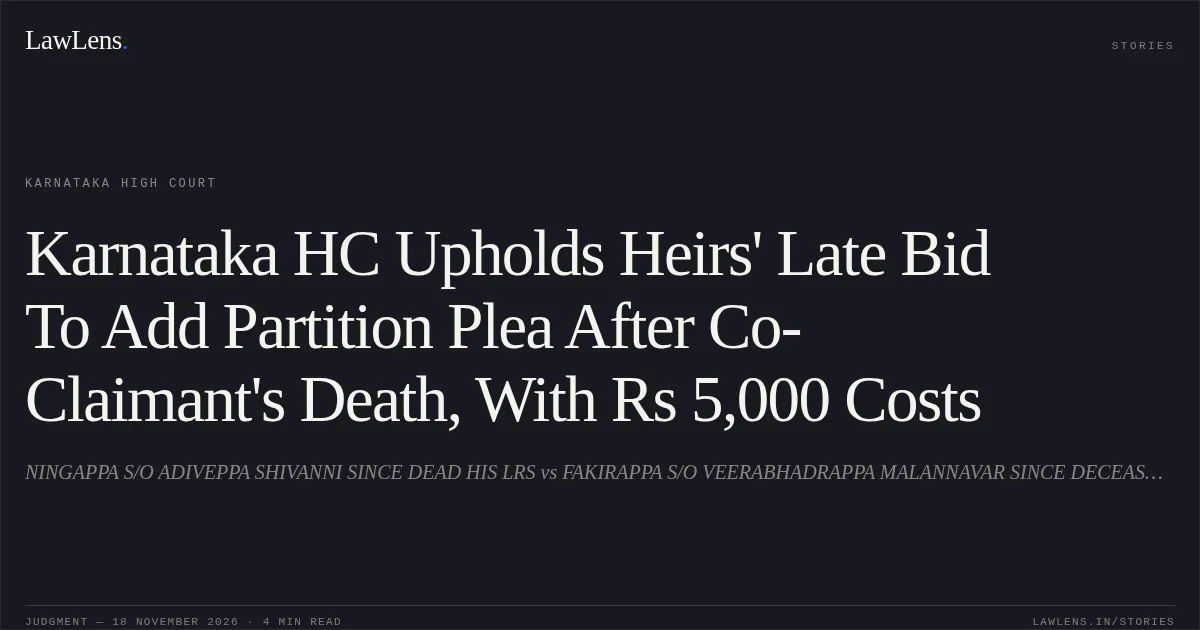
The Court answered the issues in favour of the counter-claimants. The amendment to the counter claim is permissible: it is not belated, does not change the nature of the suit or introduce a new cause of action, and is necessary for proper adjudication, subject to costs of Rs. 5,000.
¶ 12–14, 18Questions of limitation and entitlement to partition are left for decision on merits.
¶ 17The writ petition is dismissed, the order dated 05.06.2024 on I.A. No. 16 in O.S. No. 179/2014 is confirmed, and pending I.As are dismissed.
¶ 16Original Court PDF
NINGAPPA S/O ADIVEPPA SHIVANNI SINCE DEAD HIS LRSvsFAKIRAPPA S/O VEERABHADRAPPA MALANNAVAR SINCE DECEASED BY HIS LRS
Click to open original judgment
Original judgment, available to read, download and summarize on LawLens.in