01Facts
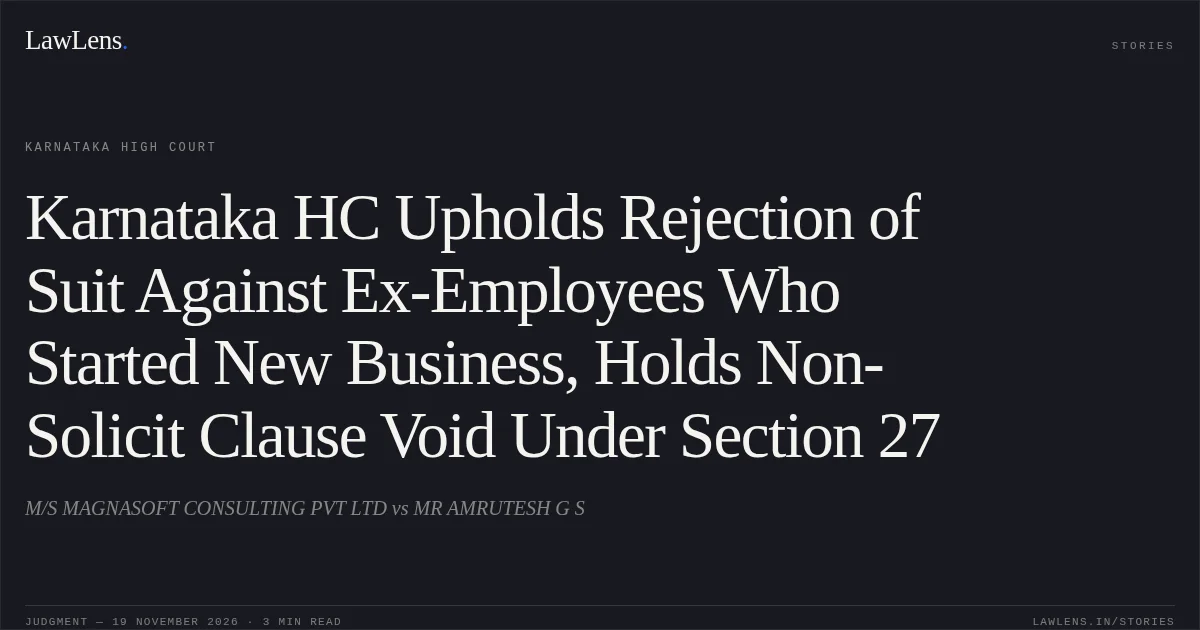
The plaintiff company employed Defendants 1–5 under appointment letters dated 2003–2013, and each executed an Employees Proprietary Information, Non-Compete and Inventions and Undertaking Agreement
¶ 15, 16Clause 6.2 of that agreement barred non-solicitation of the company's clients and employees for one year after cessation of employment, with damages as the remedy for breach
¶ 3, 21The defendants were relieved in April 2018. Defendant No. 6 was incorporated in April 2019, and legal notices were exchanged in May–June 2019
¶ 16The plaintiff alleged that the defendants stole its data and information during employment, used it to start a new business, and solicited its clients and employees
¶ 4, 15, 17The plaintiff sued for permanent injunctions and costs
¶ 18The defendants filed I.A. No. 5 under Order VII Rule 11(a) and (d) CPC, contending that there was no cause of action and that the suit was barred by law
¶ 4–6The Trial Court allowed the application on 17.12.2020 and rejected the plaint, holding that the restraint was contrary to Section 27 of the Indian Contract Act
¶ 1, 7–8The plaintiff appealed under Section 96 CPC. The defendants argued that the one-year covenant had long expired, that the restraint infringed Article 19(1)(g), and that the suit was illusory
¶ 11–1302Issues
i.1. Whether the defendants proved that the plaint disclosed no cause of action to institute the suit.
¶ 14(i)ii.2. Whether the plaintiff proved a cause of action for the injunctive relief claimed.
¶ 14(ii)iii.3. Whether the restraint sought by the plaintiff is void under Section 27 of the Indian Contract Act, rendering the suit not maintainable for want of cause of action.
¶ 14(iii)iv.4. Whether the Trial Court's order rejecting the plaint requires interference by the High Court.
¶ 14(iv)03Law Applied
Order VII Rule 11(a) and (d) CPC, under which a plaint may be rejected for want of cause of action or where the suit is barred by law
¶ 1, 6Section 27 of the Indian Contract Act, which voids every agreement restraining any person from exercising a lawful profession, trade or business, subject only to the sale-of-goodwill exception
¶ 20A non-solicitation covenant that restrains a former employee from starting a new business falls within Section 27
¶ 22Article 19(1)(g) of the Constitution, guaranteeing the freedom to carry on any occupation, trade or business, reinforces the invalidity of such restraint
¶ 12, 25The plaintiff's authorities, Madhav Prasad Aggarwal v. Axis Bank Ltd., Sejal Glass Ltd. v. Navilan Merchants Pvt. Ltd., and Wipro Ltd. v. Beckman Coulter International S.A., were held factually distinguishable
¶ 10, 24Provisions in the judgment · 2 · Linked ones open on LawLens
Code of Civil Procedure, 1908 Section 96
Indian Contract Act, 1872 Section 27
04Reasoning
The Court examined the plaint as a whole, treating its averments as true for Order VII Rule 11 purposes. It found that the plaint's core grievance was that former employees had started a competing business using knowledge and skills acquired during employment
¶ 15, 19, 25The plaint pleaded theft of data but was silent on what information was taken and how it was used in the new business. The Court therefore held that the plaint did not disclose a cause of action
¶ 23The relief sought, restraining the defendants from carrying on a new business, operated as a restraint of trade within Section 27, since a former employee's acquired skill and knowledge cannot be restricted through a non-solicitation clause
¶ 19, 22Although the one-year covenant had expired, the Court addressed its validity as a matter of law rather than resting on lapse of time
¶ 22The plaintiff's authorities were distinguished on their facts and held inapplicable
¶ 2405Holding
The Court answered Issues (i) and (iii) in the affirmative and Issues (ii) and (iv) in the negative. It held that the plaint discloses no cause of action and that the non-solicitation clause, to the extent it restrains the defendants' post-employment business, is void under Section 27 of the Indian Contract Act and violative of Article 19
¶ 22, 25The Regular First Appeal is dismissed, and the order dated 17.12.2020 in O.S. No. 5498/2019 rejecting the plaint under Order VII Rule 11 CPC is upheld
¶ 25–26Original Court PDF
M/S MAGNASOFT CONSULTING PVT LTDvsMR AMRUTESH G S
Click to open original judgment
Original judgment, available to read, download and summarize on LawLens.in