01Facts
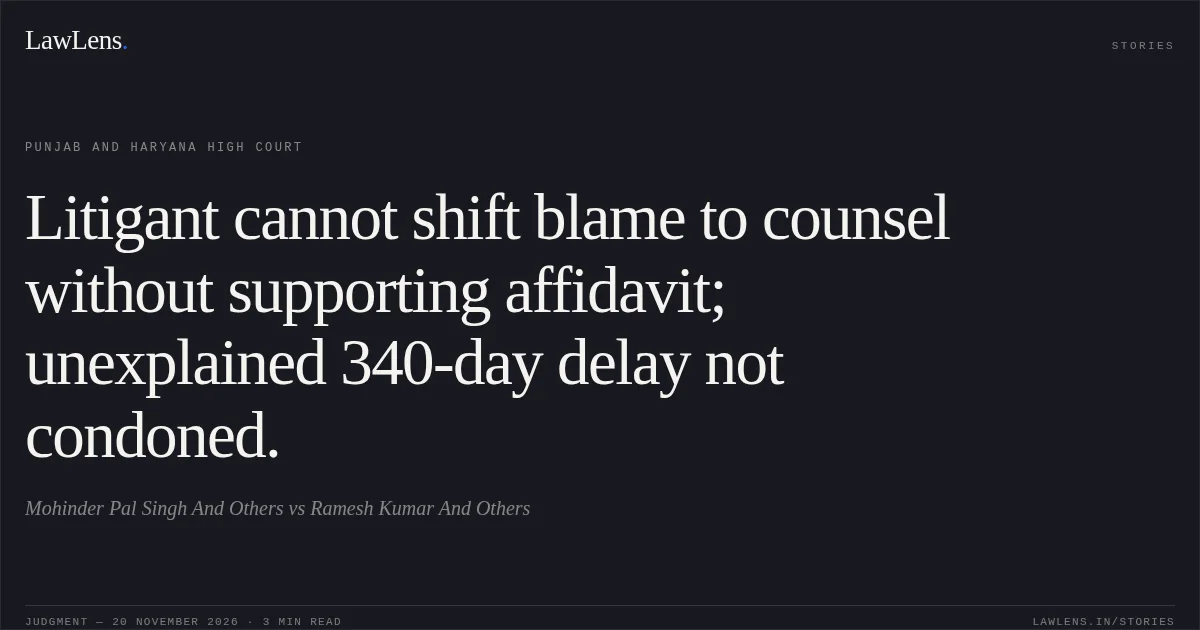
The applicants-appellants filed a Regular Second Appeal (RSA-3879-2026) against concurrent judgments and decrees of the Courts below, together with an application under Section 5 of the Limitation Act, read with Order XLI Rule 3A CPC, seeking condonation of a 340-day delay
¶ 1The applicants' case is that their counsel failed to communicate the judgment and decree of the Additional District Judge, Fazilka, and that they learned of it only on 26.09.2026
¶ 2They relied on Rafiq and Another v. Munshilal and Another (AIR 1981 SC 140) for the proposition that a litigant should not suffer for the default of counsel
¶ 2No affidavit from the erstwhile counsel was placed on record
¶ 4The explanation did not account for the entire 340-day period
¶ 402Issues
i.1. Whether the applicants have shown "sufficient cause" under Section 5 of the Limitation Act for condonation of the 340-day delay in filing the RSA
¶ 3, 3.1, 4, 4.2ii.2. Whether a litigant can be excused for delay on the ground that the lapse was attributable to his counsel's failure to communicate the decree
¶ 2, 4iii.3. Whether the main appeal is liable to be dismissed as barred by limitation under Section 3 of the Limitation Act
RSA · ¶ 203Law Applied
The Court began with Section 3 of the Limitation Act, which mandates dismissal of appeals filed beyond the prescribed period even where limitation is not pleaded, and Section 5, which confers a discretionary power to condone delay on proof of sufficient cause
¶ 3It relied on the Supreme Court's decision in Pathapati Subba Reddy v. Special Deputy Collector (LA), 2024 INSC 286, paras 9–26, which holds that Section 3 is to be construed strictly while Section 5 is construed liberally
¶ 3.1, 3.2"Sufficient cause" requires a cogent, bona fide and satisfactory explanation, and condonation is discretionary and may be refused for negligence or want of due diligence
¶ 3.1, 3.2The merits of the case are not considered at the condonation stage, and the liberal approach cannot be used to defeat substantive limitation
¶ 3.1, 3.2The duration of delay is not by itself decisive, but the qualitative adequacy of the explanation is
¶ 4.1The Rafiq principle (that a party should not suffer for counsel's default) was cited by the applicants but is subject to the requirement that the party itself show diligence
¶ 2, 4Provisions in the judgment · 22 · Linked ones open on LawLens
04Reasoning
The Court held that the applicants could not wholly shift responsibility to their counsel. A litigant is expected to remain reasonably vigilant and maintain periodic contact with counsel to monitor progress, and the burden of monitoring cannot be placed entirely on the advocate
¶ 4The Court found the applicants' claim uncorroborated, since no affidavit of the former counsel was filed to support non-communication
¶ 4Even if the claim were accepted, the explanation did not cover the full 340 days, leaving unexplained periods of inaction
¶ 4Applying the qualitative test, the Court found the explanation neither consistent nor continuous, and the grounds, taken cumulatively, did not establish sufficient cause
¶ 4.1The Court therefore declined to exercise discretion in the applicants' favour, which in turn left the RSA time-barred under Section 3
RSA · ¶ 205Holding
The applicants failed to establish sufficient cause for the 340-day delay, and the application under Section 5 of the Limitation Act, read with Order XLI Rule 3A CPC, is dismissed
¶ 4.2The Regular Second Appeal is dismissed in limine as barred by limitation, the Court finding that the applicants' failure to furnish a cogent, bona fide and satisfactory explanation disentitles them to indulgence. All pending miscellaneous applications stand disposed of
RSA · ¶ 2, 3The judgment does not expressly distinguish Rafiq, but the holding indicates that counsel's default does not excuse a litigant's own lack of diligence where the explanation is unsubstantiated and incomplete
¶ 4Original Court PDF
Mohinder Pal Singh And OthersvsRamesh Kumar And Others
Click to open original judgment
Original judgment, available to read, download and summarize on LawLens.in