01Facts
The dispute concerns 106 Kanal 02 Marla of agricultural land in village Kurana, Tehsil Israna, District Panipat.
¶ 2The plaintiffs, Rukman Devi and Savitri Devi (wives of defendant No. 1, Mansa), claimed a 2/3rd share based on a family settlement of May 1993 and a consent decree dated 08.03.1994 in Civil Suit No. 114 of 1994, under which Mansa retained 1/3rd.
¶ 3The plaintiffs challenged a release deed dated 12.02.2014 (Vasika No. 2118/1) executed by Mansa in favour of defendant No. 2, Satbir Singh (the appellant).
¶ 2–3The defendants denied the family settlement and the consent decree, alleging fraud and impersonation, and objected that the plaintiffs had earlier filed Civil Suit No. 174 of 2014 against the same release deed and withdrawn it without leave to refile.
¶ 4The earlier suit was filed on 25.03.2014 and withdrawn on 02.08.2014; the present suit was filed on 15.05.2014.
¶ 7, 11, 21The trial court decreed the suit on 07.04.2017, and the First Appellate Court dismissed the defendants' appeal on 13.12.2022.
¶ 1, 5–6The appellant then filed this second appeal under Section 100 CPC.
¶ 102Issues
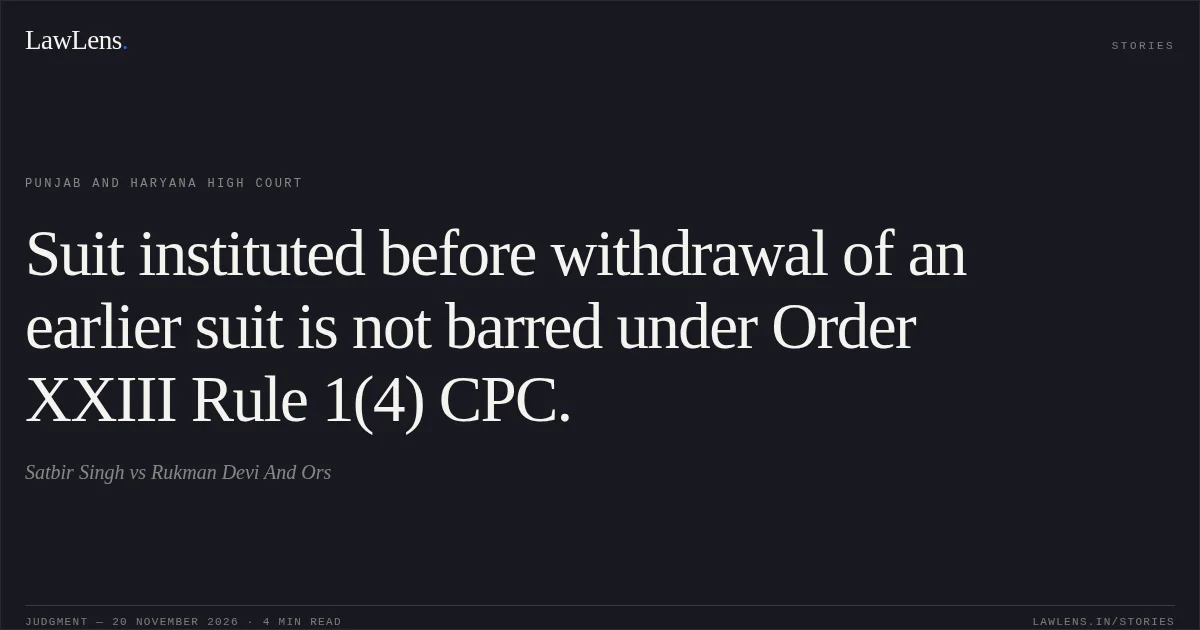
i.1. Whether the withdrawal of the earlier suit without liberty renders the subsequent suit barred under Order XXIII Rule 1(4) CPC.
¶ 18 · ¶ 19–24ii.2. Whether the subsequent suit is barred under Order II Rule 2 CPC for omitting to claim, in the earlier suit, the relief founded on the consent decree.
¶ 18 · ¶ 25–31iii.3. Whether the omission to disclose the consent decree dated 08.03.1994 in the earlier plaint undermines its genuineness and binding effect.
¶ 18 · ¶ 32–40iv.4. Whether a substantial question of law arises under Section 100 CPC warranting interference with concurrent findings.
¶ 43–4703Law Applied
Order XXIII Rule 1(3)–(4) CPC bars a fresh suit after withdrawal without permission, but its bar was treated as inapplicable to a suit already pending when the earlier suit was withdrawn.
¶ 19, 21–24Vimlesh Kumari Kulshrestha v. Sambhajirao (2008) 5 SCC 58 is relied upon for the distinction between suits instituted before and after withdrawal.
¶ 22Order II Rule 2 CPC bars splitting of claims arising from the same cause of action, as explained in Gurbux Singh v. Bhooralal, AIR 1964 SC 1810, and M/s Virgo Industries (Eng.) Pvt. Ltd. v. M/s Venturetech Solutions Pvt. Ltd., (2013) 1 SCC 625; the bar requires proof that the later suit omits a claim or relief, not merely an additional evidentiary ground.
¶ 26–28, 30On the decree, the distinction between decrees that create rights and those that merely declare pre-existing rights applies, relying on Bhoop Singh v. Ram Singh Major, (1995) 5 SCC 709, and Kale v. Deputy Director of Consolidation, (1976) 3 SCC 119.
¶ 39A consent decree binds the parties until lawfully set aside, and a transferor cannot convey better title than he holds.
¶ 38, 42Concurrent findings of fact are not disturbed under Section 100 CPC absent perversity, misreading of evidence, or substantial error of law, citing Hero Vinoth (Minor) v. Seshammal, (2006) 5 SCC 545.
¶ 43–44Provisions in the judgment · 1 · Linked ones open on LawLens
Code of Civil Procedure, 1908 Section 100
04Reasoning
The present suit was instituted on 15.05.2014, while the earlier suit was still pending, and the earlier suit was withdrawn only on 02.08.2014, so withdrawal did not retrospectively render the pending suit incompetent.
¶ 21, 24The two suits rested on different foundations: the earlier suit on ancestral character, the present one on the 1993 family settlement and 1994 decree.
¶ 23The plaintiffs had challenged the same release deed in both suits and sought substantially similar reliefs, so they had not withheld a distinct relief for later litigation; adding a further foundation of title did not establish the statutory ingredients of the bar.
¶ 29, 30Since the earlier suit was never decided on merits, neither res judicata nor splitting applied.
¶ 31The omission to plead the consent decree earlier was an inconsistency that did not, by itself, show fabrication. The court relied on certified copies (Ex. P3, P4), the record, testimony of advocates PW4 and PW5, and expert evidence (PW7) matching thumb impressions to admitted specimens.
¶ 33–35, 37Mansa never sought to set the decree aside, and the concurrent finding that the decree was declaratory of the 1993 settlement, not a first-time creator of title, was accepted.
¶ 38, 40Mansa could convey only his 1/3rd share, and the release deed was ineffective as to the plaintiffs' 2/3rd share.
¶ 41–42The appellant sought re-appreciation of evidence, which is impermissible under Section 100 CPC; no perversity was shown.
¶ 45–4605Holding
The subsequent suit is not barred under Order XXIII Rule 1(4) CPC because it was instituted before the earlier suit was withdrawn. Order II Rule 2 CPC does not apply because no distinct relief was omitted from the earlier suit.
¶ 21, 24, 29–31The consent decree dated 08.03.1994 is duly proved and binding, and the plaintiffs hold a 2/3rd share, so the release deed is not binding on them to that extent. No substantial question of law arises under Section 100 CPC.
¶ 40–42, 46–47The regular second appeal is dismissed, and the judgments and decrees of both lower courts are affirmed.
¶ 48Original Court PDF
Satbir SinghvsRukman Devi And Ors
Click to open original judgment
Original judgment, available to read, download and summarize on LawLens.in