01Facts
The fourth respondent had mortgaged the subject property to Indian Bank by deposit of title deeds on dates between 2009 and 2017.
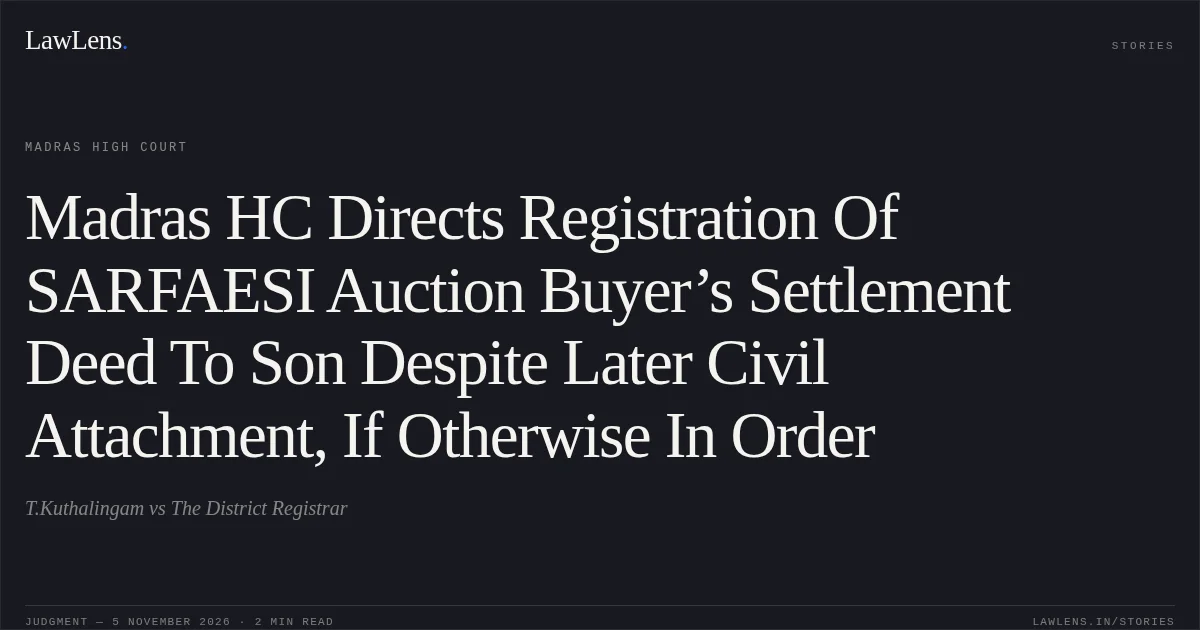
pp. 3–4 · ¶ 3After the loan became a non-performing asset, the Bank sold the property under the SARFAESI Act, and the petitioner purchased it at auction and received a sale certificate.
pp. 3–4 · ¶ 3When the petitioner presented a settlement deed in favour of his son for registration, the Sub-Registrar issued a refusal check slip citing an attachment in a civil suit brought by the fifth respondent against the fourth respondent.
p. 4 · ¶ 4The fifth respondent stated that, in execution of the decree, two cents of the property had been sold to a third party.
p. 5 · ¶ 6The petitioner challenged the refusal and sought registration of the deed and deletion of the attachment entry.
pp. 1–202Issues
i.Whether the Sub-Registrar could refuse registration of the petitioner’s settlement deed on the basis of an attachment in a civil suit, despite the Bank’s pre-existing mortgage and subsequent SARFAESI sale.
pp. 6–7 · ¶ 9–10ii.Whether the decree and execution sale relied on by the fifth respondent displaced the Bank’s pre-existing rights in the property.
p. 7 · ¶ 1103Law Applied
Section 26E of the SARFAESI Act gives a secured creditor priority in payment over other debts and claims, subject to the provision’s terms.
p. 6 · ¶ 10Under Section 64(2) read with Order XXXVIII Rule 10 of the Code of Civil Procedure, an attachment before judgment does not affect rights in property that existed before the attachment.
p. 6 · ¶ 9The Court also referred to Division Bench decisions concerning the priority of secured creditors under Section 26E, including Cholamandalam Investment and Finance Company Limited v. District Registrar and M/s. Siva Automotive Trading Private Limited v. Sub Registrar, Othakadai.
pp. 4–5 · ¶ 4Provisions in the judgment · 2 · Linked ones open on LawLens
Code of Civil Procedure, 1908 Section 64Section 38
04Reasoning
The Court found that the Bank’s mortgage, created before the civil suit and attachment, gave it a pre-existing right in the property.
p. 6 · ¶ 9–10Applying Section 26E and the CPC provisions on attachment, the Court held that the attachment could not defeat that right and that reliance on it to refuse registration was erroneous.
p. 6 · ¶ 9–10The Court further noted that the fifth respondent’s suit was based on a 1 July 2018 promissory note and was filed 43 days later; given the fourth respondent’s ex parte conduct, it concluded that the suit and execution sale appeared collusive and could not whittle out the Bank’s prior right.
p. 7 · ¶ 11It left the third party who purchased the two cents to pursue any remedy against the fourth and fifth respondents.
p. 7 · ¶ 1105Holding
The Court allowed the writ petition and set aside the refusal check slip dated 2 June 2026.
p. 7 · ¶ 12It directed the petitioner to re-present the settlement deed and the Sub-Registrar to proceed with registration if the document was otherwise in order.
p. 7 · ¶ 12The order did not expressly direct deletion of the attachment entry from the encumbrance certificate.
p. 7 · ¶ 12No order as to costs was made.
p. 7 · ¶ 12Original Court PDF
T.KuthalingamvsThe District Registrar
Click to open original judgment
Original judgment, available to read, download and summarize on LawLens.in