01Facts
The petitioner, wife of accused Letminthang Khongsai, challenged the Special Judge’s order remanding him to judicial custody in an NDPS case involving the alleged seizure of 67.19 kg of methamphetamine.
¶ 1–2.10The NCB stopped and detained the accused at about 3:00 a.m. on 25 September 2025; the search and seizure concluded at about 6:30 a.m. He was formally arrested at 1:30 p.m. and produced before the Special Judge on 26 September 2025, although the exact time of production was not stated.
¶ 2.4, 2.8–2.10, 8The petitioner argued that production occurred more than 24 hours after the accused’s liberty was first curtailed, violating Article 22(2) of the Constitution.
¶ 3–402Issues
i.Whether the 24-hour period under Article 22(2) begins when a person is first detained and their liberty curtailed, or only upon formal arrest.
¶ 11ii.Whether the accused’s production before the Special Judge on 26 September 2025 was beyond the 24-hour period and, if so, what relief should follow.
¶ 13–1503Law Applied
Article 22(2) of the Constitution requires an arrested and detained person to be produced before the nearest Magistrate within 24 hours, excluding only the time necessary for the journey from the place of arrest to the court.
¶ 11In Sri Sujit Das v. Union of India, 2026 INSC 1195, the Supreme Court held that this period runs from the time of detention when the person’s liberty is curtailed, not from the time of formal arrest; a breach requires release from custody, and the Magistrate must assess the period from the actual time of detention.
¶ 11The Court also relied on Section 58 of the BNSS, which requires that detention without judicial authority not exceed the statutory limit, and applied Sri Sujit Das’s holding that Kannan and Arun K. Thomas did not state the correct law on Article 22(2).
¶ 11–12Provisions in the judgment · 20 · Linked ones open on LawLens
Narcotic Drugs and Psychotropic Substances Act, 1985 Section 8Section 22Section 25Section 29Section 67Section 42Section 43Section 50
Bharatiya Nagarik Suraksha Sanhita, 2023 Section 528Section 43Section 58Section 179Section 35
Code of Criminal Procedure, 1973 Section 439Section 57Section 160Section 41
Customs Act,1962 Section 107Section 108
Prevention of Money-Laundering Act, 2002 Section 50
04Reasoning
The Court treated the NCB’s stopping and detention of the accused at 3:00 a.m. as the point at which his liberty was curtailed, rather than adopting the formal arrest time recorded in the arrest memo.
¶ 4, 13Applying Sri Sujit Das, it held that the 24-hour period therefore began at 3:00 a.m. on 25 September 2025.
¶ 14Although the record did not specify the production time, the Court inferred that production took place after 3:00 a.m. on 26 September, reasoning that it was unlikely the Special Judge would be sitting at that hour and that production would have occurred during court hours.
¶ 14It concluded that production was outside the constitutional period.
¶ 1505Holding
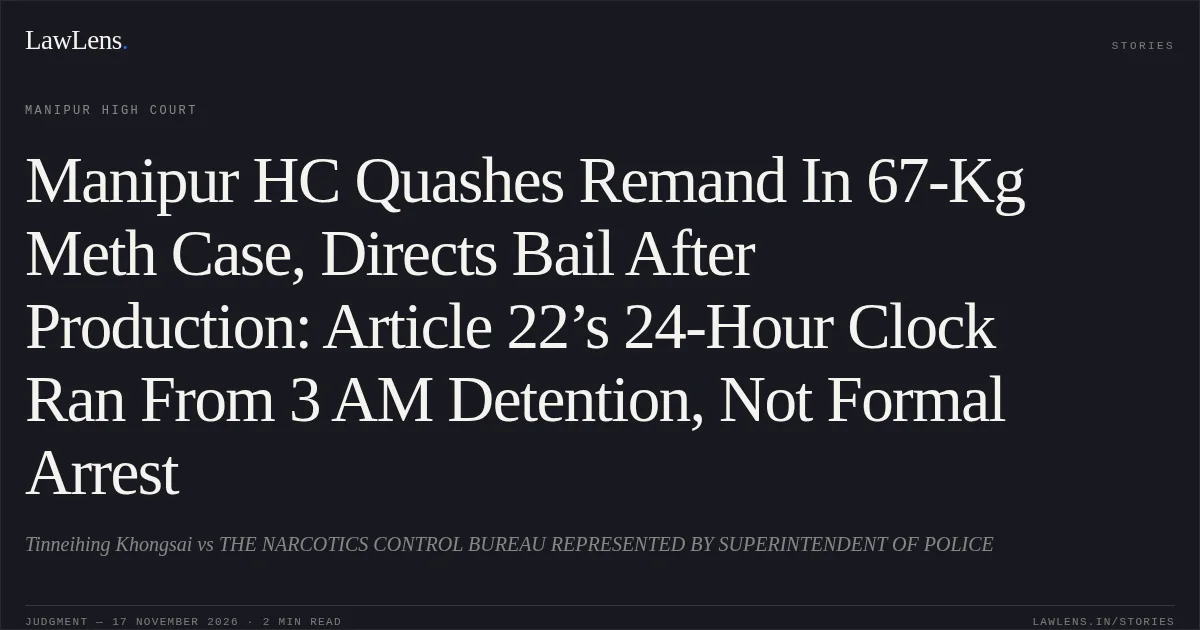
The Court held that the accused’s production before the Special Judge violated Article 22(2), rendering the remand order and his continued detention illegal.
¶ 15It quashed and set aside the remand order and directed that the accused be produced before the Special Judge within seven days, after which he was to be released on bail on such terms and conditions as the Special Judge considered appropriate.
¶ 15Original Court PDF
Tinneihing KhongsaivsTHE NARCOTICS CONTROL BUREAU REPRESENTED BY SUPERINTENDENT OF POLICE
Click to open original judgment
Original judgment, available to read, download and summarize on LawLens.in