01Facts
The petitioners had been engaged by the National Institute of Electronics and Information Technology (NIELIT) in project-related positions.
After NIELIT communicated that their services would be utilised only until 31 January 2024, they challenged the decision before the Central Administrative Tribunal (CAT).
By judgment dated 30 May 2025, the CAT directed an objective assessment of the need and vacancies relating to the positions for which they had been engaged.
p. 5 · ¶ 6NIELIT subsequently constituted a committee, which submitted a report dated 18 May 2026, and issued an order dated 4 June 2026 providing what it considered to be admissible arrears for November 2020 to January 2024.
pp. 5–6 · ¶ 7–9The petitioners and others initiated contempt proceedings, alleging non-compliance with the CAT’s judgment.
The CAT closed the proceedings, finding no violation and discharging the contempt notice.
p. 6 · ¶ 10The petitioners then challenged that closure order before the High Court, also disputing the committee’s assessment and the calculation of arrears.
p. 7 · ¶ 1102Issues
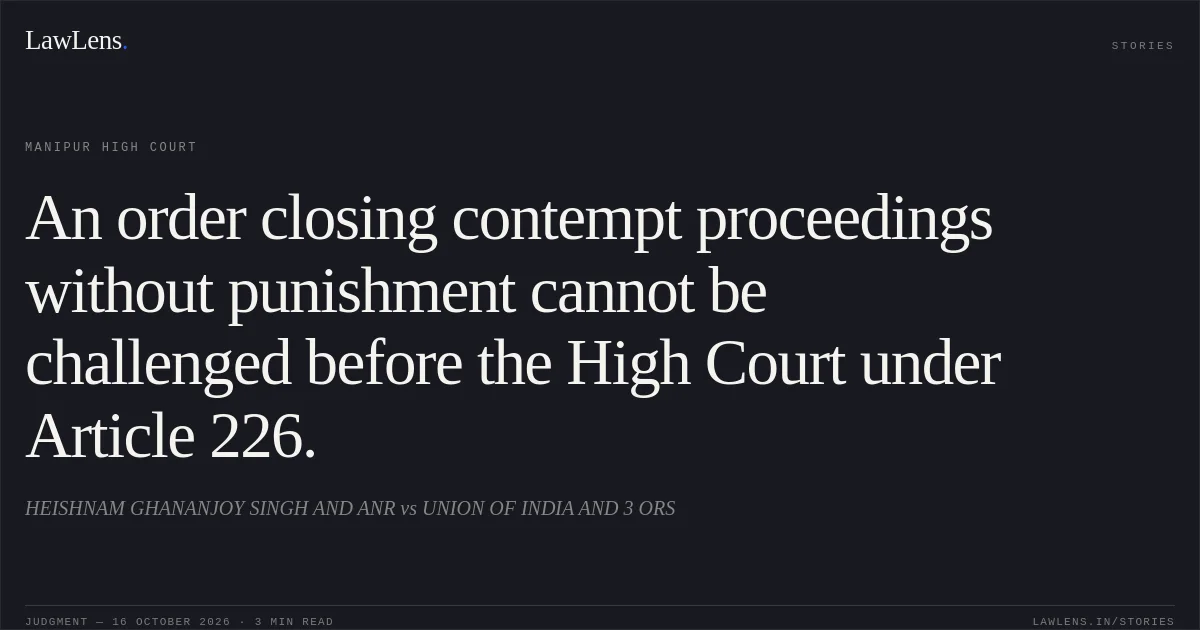
i.1. Whether an order closing contempt proceedings without imposing punishment may be challenged before the High Court under Article 226 of the Constitution
pp. 8–10 · ¶ 16ii.2. Whether dismissal of the challenge to the contempt-closure order precludes the petitioners from separately challenging NIELIT’s committee report and order before the CAT
pp. 10–12 · ¶ 17–1803Law Applied
Section 19 of the Contempt of Courts Act, 1971, permits an appeal against an order or decision imposing punishment for contempt; applying Midnapore Peoples’ Co-operative Bank Ltd. v. Chunilal Nanda, the Court stated that orders initiating or dropping contempt proceedings, or declining to punish, are generally not appealable under that provision.
pp. 8–10 · ¶ 16It also relied on Mohammed Hanish v. Kadakampally Manoj, which affirmed that principle, and Naresh Shridhar Mirajkar v. State of Maharashtra, concerning the availability of certiorari against judicial orders.
pp. 8–10 · ¶ 16Separately, Section 14 of the Administrative Tribunals Act, 1985, gives the CAT jurisdiction over service-related matters within its statutory remit, including the petitioners’ proposed challenge to the committee report and NIELIT’s order.
pp. 11–12 · ¶ 17–18Provisions in the judgment · 2 · Linked ones open on LawLens
Contempt of Courts Act, 1971 Section 19
Administrative Tribunals Act, 1985 Section 14
04Reasoning
The High Court treated the impugned order as a closure of contempt proceedings without punishment and held that, under the authorities cited, such an order could not be challenged through the present writ petition; it also considered that certiorari would not lie against a judicial order.
pp. 8–10 · ¶ 16However, it distinguished the contempt issue from the petitioners’ substantive objections to the later committee report and NIELIT order.
pp. 10–12 · ¶ 17Those decisions post-dated the CAT’s judgment and could give rise to a separate cause of action; moreover, the CAT had directed an assessment without prescribing its outcome or the amount payable.
pp. 10–12 · ¶ 17The Court therefore considered that the legality of the assessment and payment could be independently tested before the CAT under Section 14 of the Administrative Tribunals Act.
pp. 10–12 · ¶ 1705Holding
The High Court dismissed the writ petition and the connected miscellaneous case, holding that the contempt-closure order could not be assailed in the proceedings before it.
p. 12 · ¶ 18–19It preserved the petitioners’ right, if so advised, to challenge the committee report dated 18 May 2026 and NIELIT’s order dated 4 June 2026 before the CAT.
p. 12 · ¶ 18–19The CAT was directed to consider any such application on its merits and in accordance with law, uninfluenced by the dismissal of the writ petition.
p. 12 · ¶ 18–19Original Court PDF
HEISHNAM GHANANJOY SINGH AND ANRvsUNION OF INDIA AND 3 ORS
Click to open original judgment
Original judgment, available to read, download and summarize on LawLens.in