01Facts
The petitioner (husband) filed a criminal revision under Section 438 read with Section 442 of the Bharatiya Nagarik Suraksha Sanhita, 2023 (corresponding to Sections 397 and 401 CrPC), challenging the order dated 04.08.2025 of the Family Court-02, Central District, Tis Hazari, in MT No. 483/2022
¶ 1In a petition under Section 125 CrPC filed by his wife (respondent no. 1) and minor daughter (respondent no. 2), the Family Court directed the petitioner to pay interim maintenance of Rs. 4,500 per month to each of them
¶ 2The petitioner contended that he has been unemployed since 2023 and that respondent no. 1 earns around Rs. 1,00,000 per month
¶ 3 · pp. 1–2The petitioner's counsel relied on these bare assertions; the order itself records no specific finding on the petitioner's actual income beyond the minimum-wage basis discussed at [para. 9].
¶ 902Issues
i.1. Whether the High Court, exercising revisional jurisdiction, should interfere with an interim maintenance order under Section 125 CrPC on the ground that the husband is unemployed and the wife earns a substantial income
¶ 3 · p. 2 · ¶ 4 · p. 2ii.2. Whether the Family Court's fixation of interim maintenance, based on the minimum wages for a graduate in Delhi, is perverse or otherwise warrants interference at this stage
¶ 7 · p. 3 · ¶ 8 · p. 4 · ¶ 9 · p. 403Law Applied
Sections 438 and 442 BNSS (corresponding to Sections 397 and 401 CrPC) constitute the revisional framework.
¶ 1 · p. 1A revisional court does not reappreciate evidence in maintenance orders and may interfere only to correct a patent error of jurisdiction, and should not disturb such orders absent perversity, arbitrariness or illegality (Pyla Mutyalamma v. Pyla Suri Demudu, (2011) 12 SCC 189).
¶ 4 · p. 2 · ¶ 5 · pp. 2–3An interim maintenance order upheld as neither perverse nor unreasonable after considering the parties' financial affidavits (K.G. v. N.G., 2026 INSC 1215).
¶ 6 · p. 3Interim maintenance orders are interlocutory, based on prima facie assessment, and are interfered with only where patently illegal, perverse, or wholly arbitrary, including where unemployment of the husband is pleaded (Neelesh Srivastava v. Sukriti Srivastava, 2025:DHC:11291).
¶ 7 · p. 3Interference is limited to patent illegality, perversity, or manifest unreasonableness (Parwez Khan v. Shabnam Ara, 2025:DHC:11152).
¶ 8 · pp. 3–4Where a husband withholds financial particulars or pleads nil income, the Family Court may draw an adverse inference and impute a baseline earning capacity by reference to statutory minimum wages (Tasmeer Qureshi v. Asfia Muzaffar, 2025:DHC:9479, following Shamima Farooqui v. Shahid Khan, (2015) 5 SCC 705, and Rajnesh v. Neha).
¶ 9 · p. 4Provisions in the judgment · 5 · Linked ones open on LawLens
Bharatiya Nagarik Suraksha Sanhita, 2023 Section 438Section 442
Code of Criminal Procedure, 1973 Section 397Section 401Section 125
04Reasoning
The petitioner's plea of unemployment and the wife's alleged income of Rs. 1,00,000 per month did not establish any perversity or patent illegality in the impugned order, as the revisional court cannot reassess the evidentiary material on these points.
¶ 3–4 · pp. 2–3The Family Court fixed the amount by reference to the minimum wages for a graduate in Delhi, an approach found unobjectionable where the husband had not furnished reliable proof of actual income and an able-bodied person cannot defeat maintenance by withholding financial particulars. The petitioner's grievance rested on "certain peculiar factual aspects" not considered in the impugned order, which are better addressed before the Family Court than in revision. Accordingly, no ground for revisional interference under the narrow scope recognised in Pyla Mutyalamma, K.G., and Neelesh Srivastava was made out.
¶ 9 · p. 4 · ¶ 10 · p. 4 · ¶ 5–8 · pp. 2–405Holding
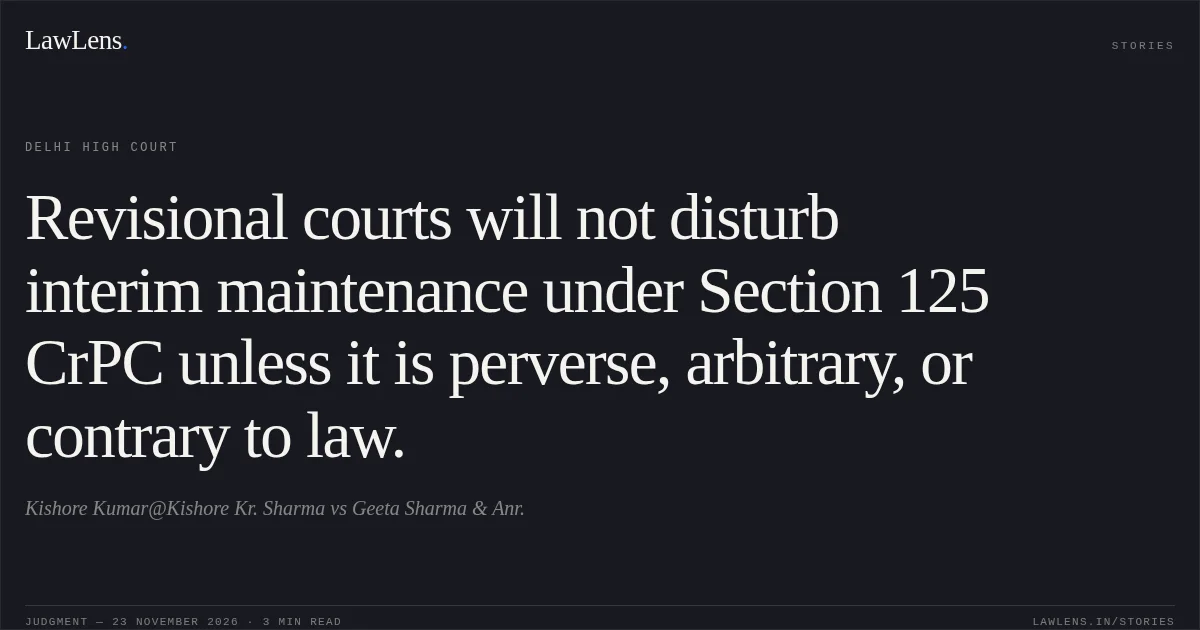
The Court declined to interfere with the interim maintenance order, holding that the Family Court's minimum-wage-based assessment is neither perverse nor arbitrary, and that the petitioner's unemployment plea does not warrant revisional intervention.
¶ 4–9 · pp. 2–4The petitioner is granted liberty to file an appropriate application before the Family Court seeking modification of the order based on the peculiar facts he has raised, which shall be considered on merits without influence from the Court's observations. The revision petition and pending applications stand disposed of in these terms.
¶ 10 · pp. 4–5 · ¶ 11 · p. 5Original Court PDF
Kishore Kumar@Kishore Kr. SharmavsGeeta Sharma & Anr.
Click to open original judgment
Original judgment, available to read, download and summarize on LawLens.in