01Facts
The parties married on 04.12.2014 under Hindu rites in Jhajjar, Haryana.
¶ 3The husband filed HMA No. 16/2021 for divorce on the ground of cruelty before the Family Court, Gurugram.
¶ 4On 21.10.2021, he stated he did not wish to proceed, and the petition was dismissed as withdrawn. He sought no liberty to file afresh, and none was granted under Order XXIII Rule 1(3) CPC.
¶ 5His withdrawal application stated that the parties had never resided together in Gurugram, so the court lacked territorial jurisdiction, and that they last resided at Najafgarh, Delhi.
¶ 19He then filed HMA No. 23/2022 under Sections 13(1)(ia) and (ib) HMA before the Family Court, Dwarka, on the same facts.
¶ 6The wife filed an application under Order VII Rule 11 read with Section 151 CPC, contending that the second petition was barred under Order XXIII Rule 1(4) CPC.
¶ 8–9By order dated 13.04.2026, the Family Court dismissed the application, analysing the matter on res judicata under Section 11 CPC without addressing Order XXIII Rule 1(4).
¶ 1, 9The wife appealed under Section 19 of the Family Courts Act, 1984.
¶ 1, 10The husband contended that the withdrawal was caused solely by the territorial defect and was not an abandonment of his claim.
¶ 1402Issues
i.1. Whether the Family Court erred in deciding the Order VII Rule 11 application on res judicata under Section 11 CPC, rather than on the bar under Order XXIII Rule 1(4) CPC on which it was founded.
¶ 2, 9, 11ii.2. Whether a subsequent divorce petition is barred under Order XXIII Rule 1(4) CPC where the earlier petition was withdrawn without liberty to refile, but the withdrawal was necessitated by a territorial jurisdictional defect and not by abandonment of the claim.
¶ 16–17, 19–2203Law Applied
Order XXIII Rule 1(1), (3) and (4) CPC permit withdrawal of a suit and bar a fresh suit on the same subject matter where the withdrawal is without permission under sub-rule (3).
¶ 17Sections 10(3) and 20 of the Family Courts Act, 1984 favour a conciliatory, less formal approach and give the Act overriding effect in matrimonial disputes.
¶ 18Section 151 CPC and the principle in Jet Ply Wood (P) Ltd. v. Madhukar Nowlakha (2006) 3 SCC 699 hold that where the CPC is silent, inherent powers may be invoked ex debito justitiae to secure substantive justice, and that procedural law is a handmaid of justice.
¶ 24–25The Division Bench decision in Nidhi Jain v. Ankit Jain, 2023 SCC OnLine Del 4369 applied the Order XXIII Rule 1(4) bar after the earlier petition had progressed to the petitioner's evidence and was abandoned on the ground of fatigue with litigation.
¶ 13, 28Order VII Rule 11 CPC is the procedural vehicle for rejection of a plaint.
¶ 8, 12Provisions in the judgment · 7 · Linked ones open on LawLens
Family Courts Act, 1984 Section 10Section 19Section 20
Code of Civil Procedure, 1908 Section 11Section 151
Hindu Marriage Act, 1955 Section 13Section 19
04Reasoning
The impugned order rested on res judicata, a ground not pleaded by the wife, but the Court proceeded to decide the Order XXIII Rule 1(4) question directly.
¶ 9, 17The Court accepted that the earlier petition was withdrawn without liberty and that the statutory bar was prima facie engaged.
¶ 19The withdrawal could not be read in isolation. The withdrawal application, which forms part of the record, showed that the husband sought to withdraw on the ground of territorial jurisdiction and did not intend to abandon the claim on merits.
¶ 19, 21The earlier proceedings had reached only the notice and appearance stage, with no evidence and no adjudication on cruelty.
¶ 27Applying Order XXIII Rule 1(4) to bar the claim would leave the substantive matrimonial dispute undecided, which the Court found particularly harsh on these facts.
¶ 22Relying on Jet Ply Wood, the Court held that a procedural bar should not defeat substantive justice where the withdrawal resulted from a bona fide mistake.
¶ 23–24The Court distinguished Nidhi Jain because the petition there had progressed substantially, whereas here the petition was withdrawn at the threshold because a court without jurisdiction could not proceed.
¶ 28Matrimonial disputes are to be decided on merits, not defeated by technical considerations.
¶ 23, 26Because the ends of justice favoured adjudication before the court with territorial jurisdiction, the second petition should not be rejected at the threshold.
¶ 29–30The Court found no infirmity in the impugned order, although its reasoning proceeds on the Order XXIII Rule 1(4) analysis rather than the res judicata ground relied on by the Family Court.
¶ 9, 3105Holding
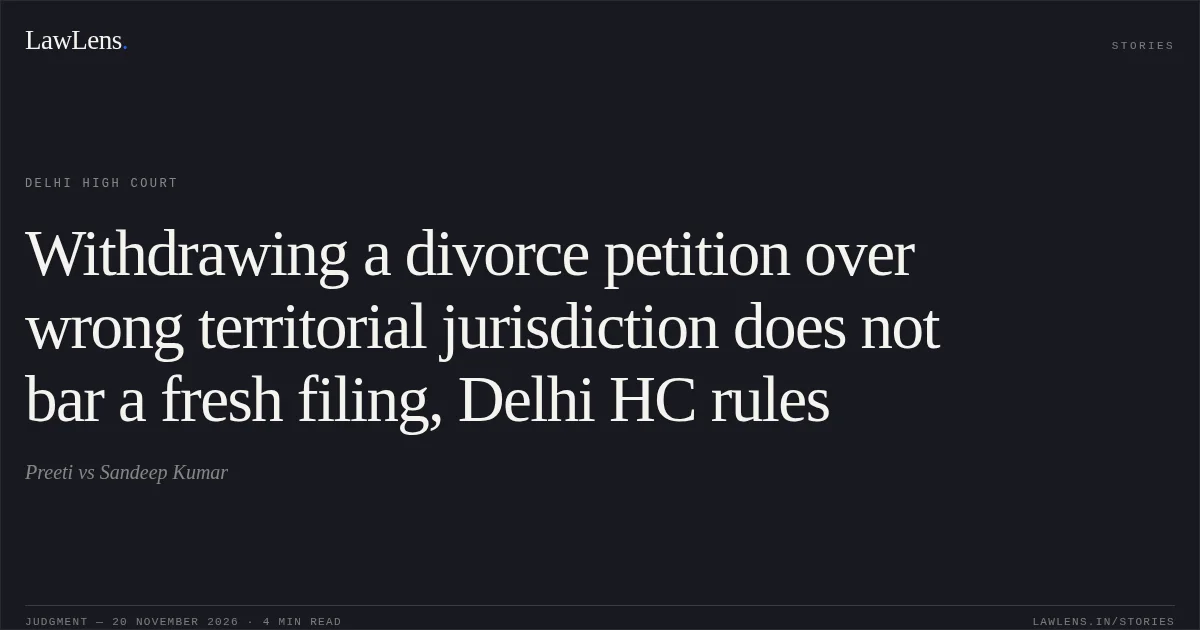
The second petition is not barred under Order XXIII Rule 1(4) CPC on the peculiar facts, because the earlier withdrawal was caused by a territorial defect, was not an abandonment of the claim, and occurred before any adjudication on merits.
¶ 21–22, 27, 30The subsequent petition ought not to be rejected under Order VII Rule 11 CPC at the threshold.
¶ 30The Family Court's order dated 13.04.2026 disclosed no infirmity warranting interference in appellate jurisdiction.
¶ 31The appeal and all pending applications were dismissed, with the husband's Section 13 HMA petition (HMA No. 23/2022) to proceed before the Family Court, Dwarka.
¶ 31–32No order as to costs is recorded.
Original Court PDF
PreetivsSandeep Kumar
Click to open original judgment
Original judgment, available to read, download and summarize on LawLens.in