01Facts
Chetnaben died after sustaining a head injury at her matrimonial home, approximately 20 months after her marriage.
¶ 2–3.7, 9–10Her husband’s father initially reported the incident as an accidental fall, and the deceased’s family members made no allegations of cruelty or dowry demand in their initial statements.
¶ 2–3.7, 9–10The deceased’s father later lodged a complaint alleging dowry demands, cruelty and abetment of suicide.
¶ 2–3.7, 9–10The Sessions Court acquitted the accused of offences under Sections 306, 498A and 114 of the IPC.
¶ 2–3.7, 9–10The State and the complainant appealed against the acquittal.
¶ 2–3.7, 9–10The High Court considered the evidence, including the witnesses’ statements and medical evidence, and the Sessions Court’s reasons for acquittal.
¶ 11–2202Issues
i.1. Whether the Trial Court erred in acquitting the accused
¶ 8ii.2. Whether the Trial Court committed an error of law or fact in appreciating the prosecution evidence
¶ 8iii.3. Whether the acquittal suffered from illegality or perversity warranting appellate interference
¶ 803Law Applied
Section 498A IPC criminalises a husband’s or relative’s subjection of a woman to “cruelty,” as defined in its Explanation; Section 306 IPC punishes abetment of suicide, and Section 107 IPC defines abetment through instigation, conspiracy or intentional aid.
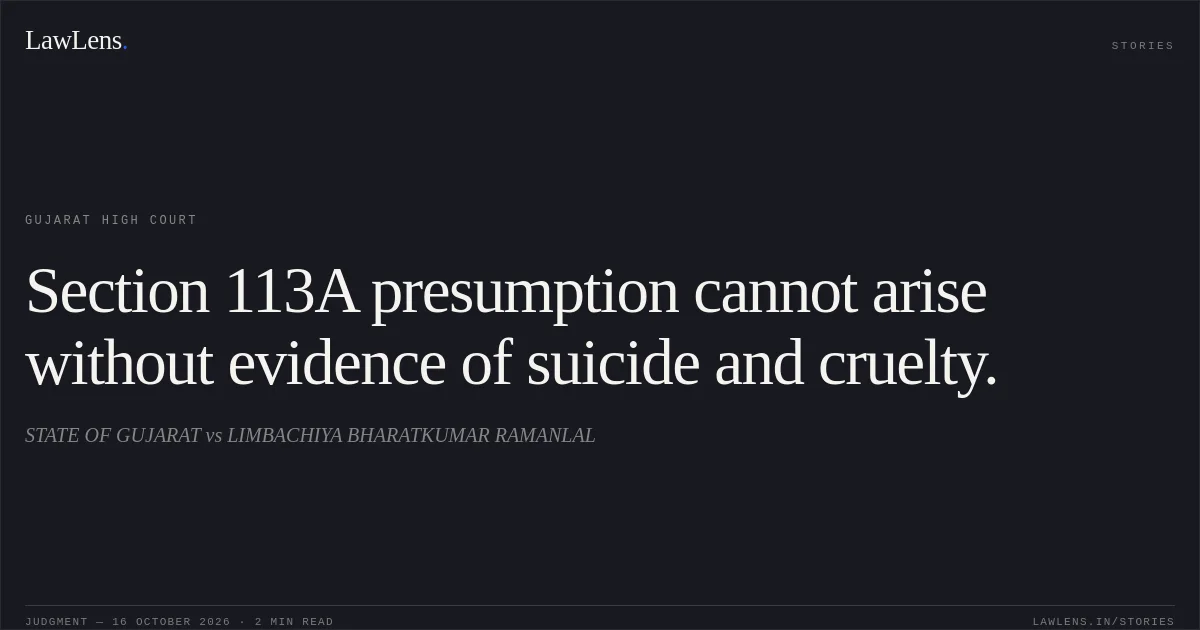
¶ 23Under Section 113A of the Evidence Act, a court may presume abetment where a married woman commits suicide within seven years of marriage and was subjected to cruelty, having regard to all the circumstances; the presumption requires evidence supporting its foundational conditions.
¶ 23–25On an appeal against acquittal, the appellate court may review and reappreciate the evidence, but must account for the reinforced presumption of innocence; where two reasonable views are possible, it should not disturb the acquittal.
¶ 28–31applying Chandrappa v. State of Karnataka, (2007) 4 SCC 415, and other cited authorities
¶ 28–31Provisions in the judgment · 5 · Linked ones open on LawLens
Code of Criminal Procedure, 1973 Section 209Section 378
Indian Penal Code, 1860 Section 107Section 114Section 306
04Reasoning
The High Court found that the prosecution witnesses’ later allegations of cruelty and dowry demand lacked specific particulars and materially differed from their initial statements, which contained no such allegations.
¶ 10–13, 18–20The medical evidence was consistent with the possibility of an accidental fall, and the scene panchnama did not independently establish that the accused had inflicted the injuries.
¶ 14–16, 18The prosecution therefore failed to prove cruelty under Section 498A, establish that the death was suicidal, or show abetment under Sections 306 and 107 IPC.
¶ 20, 24–25The conditions for invoking Section 113A were not established by cogent evidence.
¶ 20, 24–25The Trial Court’s assessment was a reasonable view of the evidence and disclosed no perversity or other basis for appellate interference.
¶ 22, 28–3305Holding
The High Court answered the issues against the appellants, holding that the Trial Court committed no material error in appreciating the evidence and that its acquittal was neither illegal nor perverse.
¶ 22, 32–33Both appeals were dismissed, the acquittal was confirmed, the bail bonds were cancelled, and the record and proceedings were directed to be returned to the Trial Court.
¶ 34Original Court PDF
STATE OF GUJARATvsLIMBACHIYA BHARATKUMAR RAMANLAL
Click to open original judgment
Original judgment, available to read, download and summarize on LawLens.in