Facts
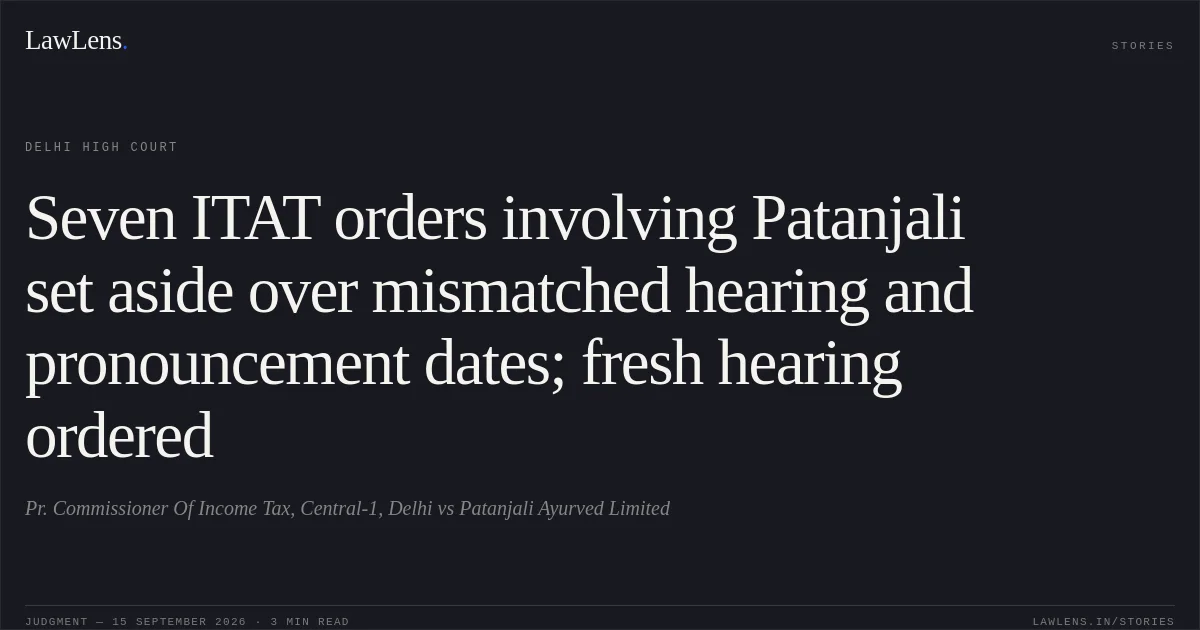
The Income Tax Appellate Tribunal (“ITAT”) disposed of seven cross-appeals concerning Patanjali Ayurved Limited for Assessment Years 2013–14, 2014–15, 2015–16 and 2017–18, arising from proceedings under Section 153C read with Section 143(3) of the Income-tax Act, 1961. The assessee’s appeals were ITA Nos. 534 to 537/Del/2025 and the Revenue’s appeals were ITA Nos. 605 to 607/Del/2025.
Source reference: para. 8; pp. 3–5The ITAT’s common order contained only a few substantive paragraphs, did not adequately address the parties’ contentions, and quashed the assessments on the ground that no addition was based on specific incriminating material found during search. It also recorded that four appeals were heard and pronounced on 6 August 2025, while the remaining three appeals were heard and pronounced on 13 August 2025, although all seven were dealt with in the same common order.
Source reference: paras. 1–2, 6–8; pp. 1–5The Delhi High Court found the order procedurally defective, opaque and lacking in reasoning. It consequently considered it necessary to interfere with all seven orders, including the orders not challenged by the Revenue because of applicable monetary limits.
Source reference: paras. 6–9; pp. 2–5Issues
1. Whether the ITAT’s common order, which failed to adequately discuss the issues and contentions and contained inconsistent dates of hearing and pronouncement, could be sustained in law?
Source reference: paras. 1–2, 6–8; pp. 1–52. Whether the High Court could set aside all seven ITAT orders, including orders not specifically challenged by the Revenue due to monetary-limit restrictions?
Source reference: para. 9; p. 53. Whether the High Court should determine the merits of the Section 153C assessments or remand the matters for fresh adjudication?
Source reference: paras. 9–11; p. 5Law Applied
The Court applied the fundamental requirement that an appellate adjudicatory order must disclose application of mind, address the relevant contentions and issues, and provide intelligible reasons, particularly where the Tribunal is the highest fact-finding authority.
Source reference: paras. 1, 6–7; pp. 1–3Proceedings concerning the assessments arose under Sections 153C and 143(3) of the Income-tax Act, 1961.
Source reference: para. 8; pp. 3–5The impugned ITAT order referred to the Supreme Court’s decision in PCIT v. Abhisar Buildwell Pvt. Ltd., (2023) 454 ITR 212 (SC), concerning the requirement of incriminating material in respect of completed or “unabated” assessments in search-related proceedings; however, the High Court expressly refrained from deciding the merits of that issue.
Source reference: para. 8; pp. 4–5; para. 11; p. 5An order passed without proper reasoning or in a manner demonstrating procedural irregularity cannot be sustained and may be set aside for fresh adjudication.
Source reference: paras. 6–10; pp. 2–6Reasoning
The Court held that the ITAT order was not merely brief but fundamentally deficient: it did not meaningfully deal with the parties’ submissions, did not explain its reasoning, and contained an unexplained inconsistency in recording different dates of hearing and pronouncement for appeals disposed of through one common order.
Source reference: paras. 1–2, 6–8; pp. 1–5Since the ITAT occupies the highest fact-finding position in the tax appellate hierarchy, such haste and lack of application of mind undermined the validity of the adjudication.
Source reference: paras. 1, 7; pp. 1–3The Court therefore declined to examine whether the assessments were properly quashed under Section 153C or whether the principle in Abhisar Buildwell applied. To ensure a legally reasoned and independent adjudication, it set aside all seven orders and restored the appeals to the ITAT for fresh decision by a different Bench.
Source reference: paras. 9–11; p. 5Holding
The High Court answered the procedural issues in favour of interference. It quashed and set aside all seven ITAT orders, including those not challenged by the Revenue because of monetary limits, and restored ITA Nos. 534 to 537/Del/2025 and ITA Nos. 605 to 607/Del/2025 to their original numbers for fresh adjudication.
The President of the ITAT was directed to place the matters before a Bench other than the Bench that had passed the impugned order.
Source reference: para. 10; p. 5The Court clarified that it had made no finding on the merits and that the ITAT was free to decide the matters independently in accordance with law.
Source reference: para. 11; p. 5Pending applications were also disposed of.
Source reference: para. 12; p. 6Acts & Sections Cited
2 provisions across 1 statute referred to in this judgment. Linked provisions open on LawLens.
Income Tax Act, 19612
Original Court PDF
Pr. Commissioner Of Income Tax, Central-1, DelhivsPatanjali Ayurved Limited
Click to open original judgment
Original judgment, available to read, download and summarize on LawLens.in