01Facts
The deceased, Sambhu Chowdhury, was an unmarried businessman in spices, milk food, and iron trading, and his elder brother, PW-11, was his partner in the business.
¶ 3 · ¶ 21On 5 February 2004, at about 11:00 p.m., after the deceased left his office at 159, Rabindra Sarani, he boarded the rear passenger seat of his Santro car, driven by PW-3, Ujjal Halder.
¶ 4–5The three appellants, Md. Nausad, Samser Ali, and Sk. Abdul Hamid, forcibly boarded the car. Abdul Hamid sat beside the driver, and Nausad and Samser sat on either side of the deceased, with a knife placed at PW-3's throat.
¶ 5–6The appellants assaulted the deceased, demanded money, and directed PW-3 to drive through central Kolkata.
¶ 6On R.G. Kar Road, they removed office files and money from the car's dickey.
¶ 6Near a cold storage on Canal West Road, Nausad shot the deceased in the head, and Samser slit his throat. The appellants then fled in a taxi, taking the car key and warning PW-3 to run.
¶ 7PW-3 reached the cold storage, informed PW-11, and went to Maniktala Police Station. The deceased was taken to N.R.S. Hospital, where he was declared dead.
¶ 8–9Post-mortem findings recorded a gunshot wound on the left temporal region, multiple incised throat wounds, and defensive incised wounds on the hands. The doctor opined the injuries were anti-mortem and homicidal.
¶ 27–28Ballistic evidence matched the cartridges and bullet hole to the seized pistol.
¶ 31 · ¶ 55Recoveries of the key, pistol, knife, jewellery, and cash were made on the appellants' leading statements.
¶ 10 · ¶ 22–24 · ¶ 37Identification at T.I. Parades was conducted by Judicial Magistrates PW-21 and PW-37.
¶ 29The Trial Court (Additional Sessions Judge, Fast Track, 1st Court, Alipore, S.T. No. 6(2) of 2005) convicted the three appellants under Section 302 IPC (life imprisonment), Section 397 IPC (R.I. 7 years), and Section 25(1-A) of the Arms Act (fine), with concurrent sentences.
¶ 1–2 · ¶ 38Four co-accused were acquitted, and a later-arrested co-accused was also acquitted.
¶ 1–2 · ¶ 3802Issues
i.1. Whether the appellants were reliably identified as the perpetrators by the eyewitness PW-3 and PW-4, given the lighting conditions and the T.I. Parade.
¶ 39–42 · ¶ 46 · ¶ 50ii.2. Whether the T.I. Parade was conducted in accordance with law, such that its identification evidence may be relied upon.
¶ 43–44iii.3. Whether the prosecution established each appellant's individual role in the assault, so as to sustain conviction under Section 302 read with Section 34 IPC.
¶ 45–49 · ¶ 53iv.4. Whether recovery of the pistol and other articles at the instance of the appellants was valid and proved their involvement, notwithstanding the Section 27 Evidence Act objections.
¶ 55–58v.5. Whether the examination under Section 313 Cr.P.C. was adequate and caused prejudice to the appellants.
¶ 59–6003Law Applied
The Court applied Section 302 IPC (murder) and Section 34 IPC (common intention), under which each participant is liable for the act causing death as if done alone, and participation requires no proof of an individual overt act, quoting Rajesh Kumar v. State of H.P., citing Ch. Pulla Reddy v. State of A.P.
¶ 40The Court relied on Nathuni Yadav v. State of Bihar, (1998) 9 SCC 238, holding that visibility is assessed by proximity, available light, and familiarity with the assailants.
¶ 41The Court applied Ravinder Kumar v. State of Punjab, (2001) 7 SCC 690, holding that extraordinary or traumatic events are retained in memory.
¶ 50The Court applied the T.I. Parade standards of Budhsen v. State of U.P., (1970) 2 SCC 128, and Kanan v. State of Kerala, (1979) 3 SCC 319, which require fairness in conduct.
¶ 43–44On recovery, the Court relied on Section 27 of the Evidence Act and Kulukuri Kottayya v. King Emperor (as diluted), holding that strict compliance with the procedure is not always required and that the evidentiary value depends on the facts, per Perumal Raja v. State, 2024 INSC 13.
¶ 58The Court applied Section 313 Cr.P.C., which requires that all incriminating material be put to the accused.
¶ 59–60Section 25(1-A) of the Arms Act and Section 397 IPC are applied as recorded in the sentencing paragraph.
¶ 1Provisions in the judgment · 7 · Linked ones open on LawLens
Indian Penal Code, 1860 Section 302Section 397Section 34
Arms Act, 1959 Section 25Section 27Section 7
Code of Criminal Procedure, 1973 Section 313
04Reasoning
The Court found PW-3's identification reliable. PW-3 spent 15–20 minutes in the car with the appellants, which passed through well-lit streets, and the halogen light at Chitpur Petrol Pump was adequate.
¶ 40–41PW-3 turned and saw Nausad with a gun and Samser with a knife at the moment of the shot, and this traumatic event was held to be durable in memory.
¶ 50PW-3 and PW-4 had also seen the appellants loitering near the office before the incident, which supported their identification.
¶ 42The Court held that the T.I. Parade was properly supervised by two Judicial Magistrates, and minor omissions did not vitiate it.
¶ 44On individual roles, the Court reasoned from the medical and spatial evidence. The fatal gunshot entered the right side of the deceased's head, and Nausad sat on his right, so Nausad fired the shot.
¶ 46–48Samser sat on the left and could not have inflicted a right-sided head injury, so he was likely armed only with the knife. PW-3 saw Samser cutting the victim's throat in the rear-view mirror.
¶ 47–49Under Section 34, each appellant's participation in the shared assault was therefore sufficient.
¶ 53The Court also found that PW-11's calls establish PW-3's presence in the car.
¶ 54On recoveries, the Court found the keys, pistol, knife, jewellery, and cash could not have been found without the appellants' disclosures. Ballistic evidence confirmed that the pistol fired the recovered cartridges.
¶ 55–56Minor discrepancies in the recovery did not discredit the seizures.
¶ 57–58The Court rejected the Section 313 challenge, finding that all material evidence had been put to the appellants and no prejudice was shown.
¶ 59–6005Holding
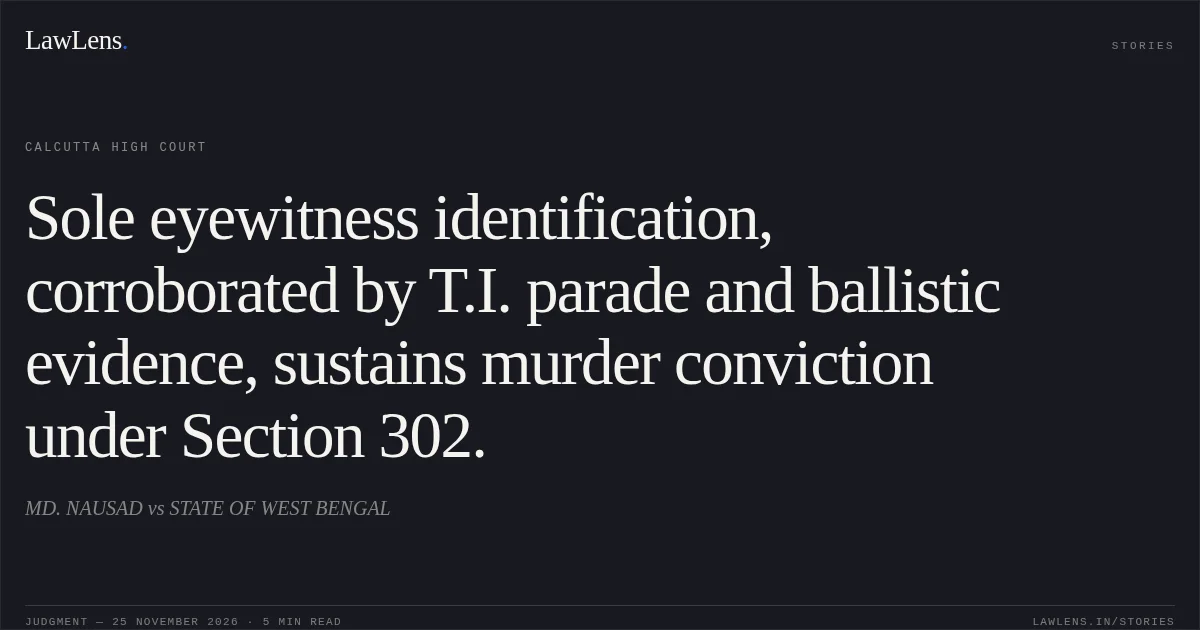
The Court answered each issue against the appellants. It held that the identification by PW-3 and PW-4 was reliable, that the T.I. Parade was lawfully conducted, that individual roles were proved, that the recoveries and ballistic evidence were admissible and probative, and that Section 313 Cr.P.C. was complied with.
¶ 40–60The impugned judgment of conviction and order of sentence dated 27 February 2012 were upheld. C.R.A. 233 of 2012, C.R.A. 245 of 2012, and C.R.A. 238 of 2013 were dismissed, and connected applications were disposed of. The Trial Court record is to be remitted for compliance.
¶ 61–62Original Court PDF
MD. NAUSADvsSTATE OF WEST BENGAL
Click to open original judgment
Original judgment, available to read, download and summarize on LawLens.in