01Facts
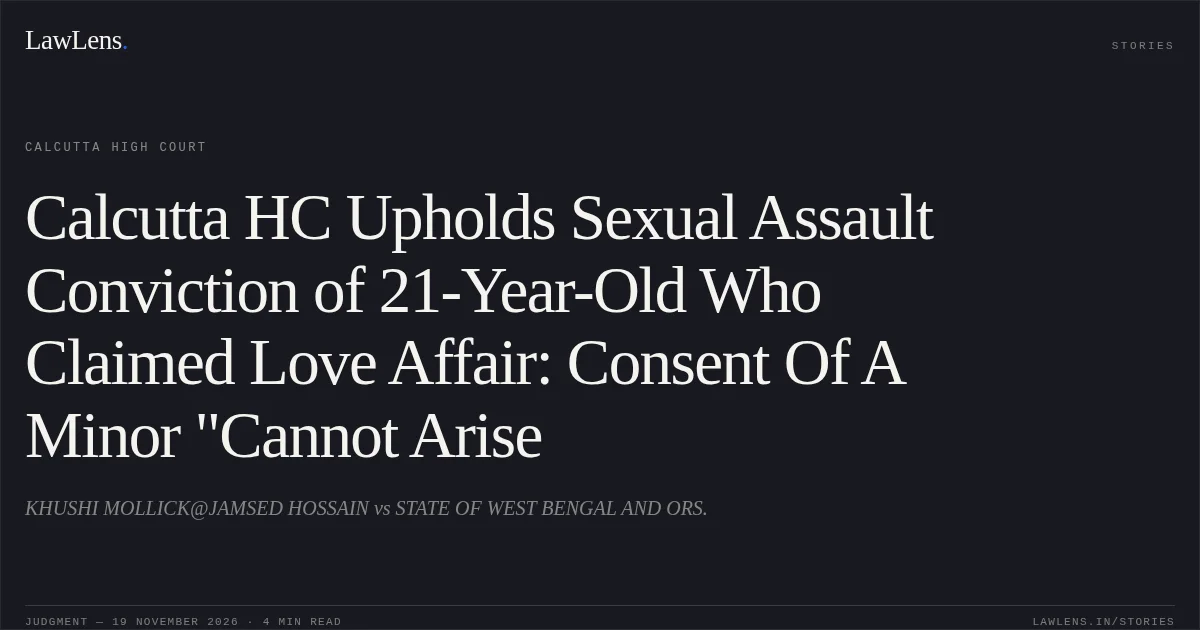
The appellant, aged about 21, was in a love relationship with the victim, then aged about 17 (birth certificate: D.O.B. 16.03.1999).
¶ 2 · ¶ 6 · ¶ 4The victim went missing on 26.11.2016.
¶ 3 · ¶ 8The father (PW-1) lodged an FIR on 04.12.2016 against unknown accused under Sections 363 and 365 IPC, registered as Burwan P.S. Case No. 440/2016.
¶ 3 · ¶ 8The victim was recovered on 08.12.2016 from Burwan bus stand, according to the first I.O. (PW-6).
¶ 3 · ¶ 8The prosecution case is that she was taken from the bus stand to a relative's house of the accused at Rajgram, kept there for a day, then taken to the appellant's house, where a sham marriage was conducted and sexual intercourse occurred over about 18–19 days.
¶ 9 · ¶ 4Her Section 164 Cr.P.C. statement was recorded on 09.12.2016.
¶ 4Medical examination on 26.01.2017 found an old healed tear of the hymen (PW-5).
¶ 3 · ¶ 4The Special Court under the POCSO Act, Kandi, Murshidabad (S.T. No. 02(04)2017) convicted the appellant under Sections 363 and 366 IPC, Section 4 POCSO (7 years' RI with fine), and Section 8 POCSO (3 years' RI with fine), with sentences running concurrently.
¶ 1The defence contended that the relationship was consensual, the victim had reached the age of discretion, she voluntarily co-habited with the appellant, and her Section 161 and 164 statements contradict each other.
¶ 202Issues
i.1. Whether the alleged consent of the victim, her cohabitation with the appellant, or her "age of discretion" can negate the offences where the victim was a minor.
¶ 2 · ¶ 6–7ii.2. Whether the discrepancy regarding the place of recovery (bus stand versus appellant's house) is fatal to the prosecution case.
¶ 3 · ¶ 11iii.3. Whether the appellant has rebutted the presumptions under Sections 29 and 30 of the POCSO Act.
¶ 2 · ¶ 14iv.4. Whether the prosecution proved its case beyond reasonable doubt, and whether the sentence is proper.
¶ 15–1603Law Applied
The age of the victim being a minor at the time of occurrence makes consent legally irrelevant, as the question of a minor's consent "cannot arise, especially vis-à-vis offences under the POCSO Act".
¶ 6–7Section 29 of the POCSO Act (presumption as to offences under Sections 3, 5, 7 and 9) and Section 30 of the POCSO Act (presumption of culpable mental state), which the accused must rebut.
¶ 2 · ¶ 14A minor victim's consistent testimony, uncontroverted in cross-examination and supported by medical and neighbour evidence, may be accepted without corroboration where no reason to disbelieve exists.
¶ 9–10 · ¶ 13A discrepancy regarding recovery is a minor discrepancy and not fatal where the prosecution case is otherwise consistent.
¶ 11Sections 363 and 366 IPC were referred to by the Court without separate analysis.
The parties cited State of Himachal Pradesh v. Manga Singh, (2019) 16 SCC 759; State of Rajasthan v. N.K., (2000) 5 SCC 13; and Nawabuddin v. State of Uttarakhand, (2022) 5 SCC 419, but the judgment does not discuss or expressly rely on them.
¶ 3Provisions in the judgment · 9 · Linked ones open on LawLens
Indian Penal Code, 1860 Section 363Section 365Section 366
Protection of Children from Sexual Offences Act, 2012 Section 4Section 8Section 29Section 30
Code of Criminal Procedure, 1973 Section 161Section 164
04Reasoning
The Court first fixed the victim's minority from the birth certificate, which rendered the consent and "age of discretion" arguments legally untenable.
¶ 6 · ¶ 7The Court assessed the victim's credibility: her account of kidnapping and rape was consistent before the Magistrate and the trial court, was not impeached in cross-examination, and included a favourable remark about her parents, which the Court treated as indicating she was not fabricating the story.
¶ 9Her disclosure to her father and to neighbour PW-4 shortly after recovery was treated as further support.
¶ 10The medical evidence was held to corroborate her account.
¶ 12On the recovery discrepancy, the Court reasoned that if the victim stayed at the appellant's house, she must have travelled from there to the bus stand, so the variance between the I.O.'s and the victim's accounts was a minor discrepancy that did not affect her categorical testimony.
¶ 11Having found no reason to disbelieve the minor's version, the Court held that the defence had failed to rebut the Section 29 and 30 presumptions.
¶ 13 · ¶ 14The Court found the sentencing approach of the trial court measured and reasonable.
¶ 16The judgment does not specifically address the alleged contradictions between the Section 161 and 164 statements, the difference between "relative's house" and "Sunderpur bus stand" as the kidnapping point, or the separate ingredients of Sections 363 and 366 IPC.
05Holding
The victim's minority made her consent legally immaterial, the recovery-place discrepancy was minor, the appellant failed to rebut the POCSO presumptions, and the prosecution proved its case beyond reasonable doubt.
¶ 6–7, 11, 14–15The Court found no legal or factual infirmity in the trial court's judgment and sentence.
¶ 17The appeal is dismissed, and the conviction under Sections 363 and 366 IPC and Sections 4 and 8 POCSO, with concurrent sentences, is upheld.
¶ 18The trial court records are to be returned forthwith, and certified copies are to be supplied to the parties on compliance with formalities.
¶ 19–20Original Court PDF
KHUSHI MOLLICK@JAMSED HOSSAINvsSTATE OF WEST BENGAL AND ORS.
Click to open original judgment
Original judgment, available to read, download and summarize on LawLens.in